Yearly Archives: 2015

Waiting TFW Long Distance II. The official release

by FFVL AFCK

De très belles images de Nicolas Raffi pour résumer la 1ère étape du GDF SUEZ Energies France kite tour,championnat de France de speed crossing qui s’est déroulée du 30 Avril au 3 Mai à l’Almanarre (83).
101 compétiteurs inscrits sur différents supports, twin tip surf race ou foil. Le niveau technique des riders a réellement augmenté depuis la saison passée et cela promet de belles bataille pour la seconde étape à Villeneuve-lès-Maguelone du 23 au 25 Mai.

Next show at TFW Long distance

Foiling Docking II – the kitefoil version

by Kitefoil Australia

Racing was called off ofr the day at the ISAF Sailing World Cup in Weymouth. The perfect opportunity for light wind expert Florian Gruber from Germany to demonstrate some kitefoiling action on his KFA MK3 foil, Temavento board and Ozone R1 17m kite in 4knots in the marina. Super smooth foiling gybes in almost no wind and mirror glassy water.

Parrot MiniDrones – Hydrofoil

By Parrot

Parrot has already invaded the skies with its drones. Now, it’s now ready to sail the ocean blue.

Parrot has unveiled a slew of new drones designed to work at night, carry small items and cruise on water.

The Hydrofoil is the company’s first drone that combines a MiniDrone with, well, a hydrofoil — a structure that lifts a boat above the water. Once the MiniDrone is securely attached, it can be rotated 90 degrees upward to become a four-bladed propeller for water operation.

Like all of Parrot’s drones, the Hydrofoil is controlled via Bluetooth with a smartphone app. It can cruise at a maximum speed of 6.2 miles per hour on water for up to seven minutes; the MiniDrone itself can fly at up to 11.18 mph for up to nine minutes when detached from the boat half.

An onboard camera can take snapshots at 640 x 480 (VGA) resolution and save it to the 1GB of internal storage.

The Hydrofoil will come in two different finishes and cost about €169 (about $190) when it launches in July.

Quant23: The Foiling Keelboat

by sailingscuttlebutt.com

quest23

Designer Hugh Welbourn has spent more than 10 years developing the patented Dynamic Stability System (DSS), which comprises a retractable hydrofoil that is deployed to leeward on a yacht.

The foil provides vertical lift to leeward, improving the yacht’s righting moment, an effect similar to having extra crew on the weather rail or a bigger keel bulb, and in turn dramatically increases performance.

DSS foils feature on a wide range of racing yachts such as multiple Rolex Sydney Hobart winner, Wild Oats XI, to the high performance Infiniti range of racers and cruiser races to sportsboats, Minis plus all manner of craft between.

However the very latest DSS foils not only provide righting moment, but extra vertical lift beneath the boat too.

In its first preliminary sea trials in Cowes last week, the Quant23 has proved itself to be one of its first – if not THE first – fully foiling keel boat. The DSS foils, in combination with a T-foil rudder, has enabled the Quant23 to sail fully airborne.

The Quant23 is the first yacht to have the new foils fitted and is the latest in the range of DSS-equipped sports boats designed by Hugh Welbourn for QuantBoats, following on from the Swiss company’s Quant28 and Quant30.

“Having spent many hours sailing a DSS boat, there are lots of other positive side aspects DSS delivers, some of which made me dream of other possibilities for it, such as flying,” QuantBoats’ Michael Aeppli explains. “Those who have sailed the Quant28 could feel that the boat came close, although this wasn’t what it was designed to do.”

Last week in Cowes, Aeppli and Welbourn’s expectations were fulfilled when daylight appeared beneath the hull of the newly launched Quant23 during preliminary sea trials.

While the Quant23 is a foiler (albeit with a fixed keel), Welbourn is at pains to point out that she is otherwise fundamentally different to a Moth or the latest America’s Cup catamarans. While those boats demand athleticism, great skill and technique to sail, the Quant23 is more mainstream. “The idea is simply a boat that anyone can leap into and ten minutes later they’re flying.”

“With the Quant23 the aim was not to create the world’s fastest foiler, but one of the easiest crafts to fly steadily, providing fun, fast rides, in a wide range of conditions,” Aeppli confirms. “For us this means that the boat shall do 90% of the work and not the crew – mostly this seems to be the other way round with many of the other foiling boats of today, with complicated systems to manage, understand and maintain all the time.”

Part of the secret lies in the inherent stability of the new DSS foils, compared to that of the inverted T-configuration foils of, for example, a Moth. The new foils, Welbourn maintains, help promote ‘easy foiling’ with the section, aspect ratio and length of the foil promoting early lift-off (i.e. full foiling in the least amount of wind) rather than ultimate top speed, which would require smaller foils with a less powerful section.

“It’s about finding the best balance between things that allows to you to fly three crew plus a boat with a 60kg bulb – a flying keelboat – without any great drama,” says Welbourn. He adds that the new generation DSS foil should be scalable, although at the end of the day physics comes into play.

While foiling ability may be the Quant23 sportsboat’s USP, it also has a futuristic-looking, ultra-low freeboard scow hull – blunt bowed, carrying its hull volume all the way forward and complete with chines and chamfered hull-deck join. The powerful, stable hull shape, Welbourn maintains, prevents the need for racks and such like, making the boat simple both to build and sail. And you don’t even need to shift crew weight fore and aft to alter the pitch of the foil: “We’ve previously seen that you really don’t have to move around at all actually.”

In terms of her ultimate performance, Welbourn believes that the Quant23 will be comfortably reaching in the mid-20s. Most impressive is her foiling ability which will see her foiling upwind in as little as 10 knots. “From day one we aimed at having an uphill mode, in not a lot of wind, but that’s another reason why the foils are so big.”

The first Quant23 is a prototype to be used for R&D prior to the boat going into full production. It is currently undergoing trials in Switzerland.

Light Winds For The First Flying Phantom Series Geneva

By Phantom International

Flying Phantom Geneva 2015

This weekend, and for the first time in Switzerland, the Flying Phantom Series Geneva took place. The event included the Phantom Trophy organized by the Yacht Club de Genève and the Geneva Rolle Geneva long distance race, and provided a unique opportunity for the Flying Phantoms to race on Lake Geneva.

Trophée Phantom by Yacht Club de Genève
On Friday the racecourse was setup in front of the Yacht Club de Genève. Four races were launched in light conditions i.e. 5 to 10 knots of wind, but that was sufficient for the Flying Phantoms to fly on their foils on the reaching start up to the clearing mark and during downwind legs. On the final scoreboard, 3 of the 4 races were taken into account. For the first place, the battle was intense between Billy Besson – Matthieu Vandame and Gurvan Bontemps – Benjamin Amiot, but in the end Billy and Matthieu scored two bullets on the first two races leading them to victory. Team Momentys with Thomas Normand at the helm and crewed by Antoine Joubert took a very nice third place on the podium, particularly as this was Thomas’s first event (Team Momentys’s Flying Phantom was helmed by Franck Cammas during the previous event in Carnac). Team Phantomas and Team Tilt also took part in their first Flying Phantom regatta taking respectively 4th and 5th positions.
No races were launched on Sunday due to the very unreliable wind that never wanted to get above 2-3 knots.

Geneva Rolle Geneva
On Saturday at 1pm, the Flying Phantom fleet lined up at the start of the 51st edition of the Geneva Rolle Geneva with 250 boats. The wind conditions were very light, 3 to 4 knots from the start leading to a long upwind leg to Rolle. Team Momentys with Thomas Normand and Antoine Joubert took the lead in the fleet as soon as they reached the end of the “Petit Lac” and were first at the buoy off Rolle. Thomas and Antoine claimed victory on the finish line after 8 hours 34 minutes and 04 seconds and came first in the sports catamaran fleet. The rest of the fleet were forced to abandon the race as the sun went down, as they were stuck with very wind in the middle of the lake; it was fortunate as 35 knots gusts arrived later that evening forcing part of the fleet to end their racing.

The program for this week includes the Société Nautique de Genève Tuesday regatta on the 9th and training sessions arranged with Flying Phantom customers, as well as introductory sessions to enable people to discover these boats.

Trophée Phantom by Yacht Club de Genève results
Ranking Team Helmsman Crew Race 1 Race 2 Race 3
1 FRA 1 Phantom Billy Besson Matthieu Vandame 1 1 2
2 FRA 4 Phantom Gurvan Bontemps Benjamin Amiot 2 2 1
3 FRA 8 Momentys Thomas Normand Antoine Joubert 3 4 3
4 GER 1 Phantomas Raphael Neuhann Elias Neuhann 4 5 5
5 SUI 5 Tilt Alex Schneiter Kristoffer Jonsson OCS 3 4
— NED 747 Plastic Soup DNS DNS DNS
— SUI 61 Tixwave DNS DNS DNS

Hannah White sets new singlehanded record across the English Channel

By Land Rover Sailing

Hannah White crosses the English Channel solo in a record time of 3 hours 44 minutes Photo © Anthony Cullen

Hannah White crosses the English Channel solo in a record time of 3 hours 44 minutes
Photo © Anthony Cullen

Hannah White, Land Rover Global Ambassador, has become the fastest person to cross the Channel in a single-handed dinghy. She completed the gruelling task in an International Moth. Starting from Cap de Gris in France, she landed in Dover, England, after crossing the 24 mile English channel in a record time of 3 hours, 44 minutes and 39 seconds.

Hannah, a relative beginner in hydrofoil sailing, only started to learn how to master this unique boat in February. Training for this Channel crossing challenge is a precursor to her ultimate quest: to break the Women’s Speed Sailing World Record over one nautical mile next year in a unique, purpose-built sailing hydrofoil.

A keen adventurer, Hannah has previously sailed the Atlantic solo three times, participated in the gruelling Haute Route Cycle Race across the French Alps and kayaked 205 miles across the rivers of England. She has been a Land Rover Global Ambassador since 2013.

Hannah White said: “I’m much more used to an arduous 3000-mile slog across oceans as opposed to a 24-mile sprint across the Channel, so the transition has been a real eye-opener. Speed sailing requires a very different physiology to long distance races, so this was really an opportunity for me to build my skills over a shorter distance in a hydrofoiling boat”.

Mark Cameron, Jaguar Land Rover Global Experiential Marketing Director said: “This Channel crossing highlights Hannah’s incredible ability to push herself beyond the limits of normal capability. As a global ambassador for Land Rover, Hannah embodies all the characteristics that are so central to our brand; strength, determination and an ability to go above and beyond.”

Hannah will be attempting to break the Women’s Speed Sailing Record over one nautical mile in the first quarter of 2016 in Speedbird, her state-of-the-art, unique hydrofoil sailboat. Land Rover is collaborating in the development of the Speedbird boat, drawing from its unparalleled innovation, engineering expertise and industry-leading facilities to ensure the boat is capable of breaking the current world record.

Hannah will be exhibiting the Speedbird boat at the Cardiff Act of the Extreme Sailing Series™ on the 18-21 June 2015.

Foiling Feeds the Mid-Life Crisis

From sailingscuttlebutt.com

When the America’s Cup moved to multihulls, the sight of 72-foot boats foiling on bits of carbon opened the imagination of designers to create more marketable options with foiling technology. Morrelli & Melvin, who helped Team New Zealand get airborne, designed the Nacra 20C FCS as one of the new options.

When John Sangmeister isn’t tending to Gladstone’s Long Beach, a favorite Southern California restaurant of Scuttlebutt editor Craig Leweck, or preparing his chartered Santa Cruz 70 for the 2015 Transpac Race, he is seen flying about in his Nacra 20C FCS. Here he chatted with Craig about his recent acquisition…

Read the entire post on sailingscuttlebutt.com

Don Montague has invented kiteboarding, he is part of the Google team about clean energy and …

… he is the father of the Kiteboat Project.

from Forbes by Bill Springer.

I met Don Montague on a seductively fast catamaran in St. Martin earlier this Spring. But it wasn’t until the next day when he returned to the boat with a team of very smart, and very talented guys, and a bonafide boatload of sensors, electronic equipment, computers, cameras, and a crazy-fast chase boat, that it became obvious that he wasn’t just another sailor. In fact, I was soon to learn he’s the world-champion windsurfer who went on to literally help invent kiteboarding with Robby Naish and others. And oh yea, he also helped found a “little” alternative energy company—Makani Power—that was acquired in 2013 by Google and is now part of the Google [x] team that’s working to make widespread clean energy a commercial reality.

Gunboat-G4-primo-volo-02

Ocean Images/GUNBOAT

But after a fantastic day spent sailing on the turquoise blue waters of Marigot Bay, we didn’t talk about any of that. In fact, what Don and his team have accomplished is pretty widely known in windsurfing and kite surfing circles, so we didn’t need to. Instead, he talked with the clear-eyed passion of a true pioneer about the speed and power that’s possible when you attach an extremely efficient kite and intricate control system (that of course Montague and his team have invented from scratch) to an extremely light and strong hydrofoiling hull (ditto) that’s capable of mind-boggling speeds and precise control.

“Have you heard about the Kiteboat Project?” he asked.

kiteboat k2

Credit Kiteboat Project

“We use a kite instead of sails for power and the boat we’re testing these days on San Francisco Bay sails pretty comfortably at well over 30 knots. We’re constantly testing and refining and improving. You should come check us out.”

Now, that’s an invite you just don’t get everyday. I was on a plane to San Francisco almost as soon as we returned from St Martin.

k2-720x480

Credit Kiteboat Project

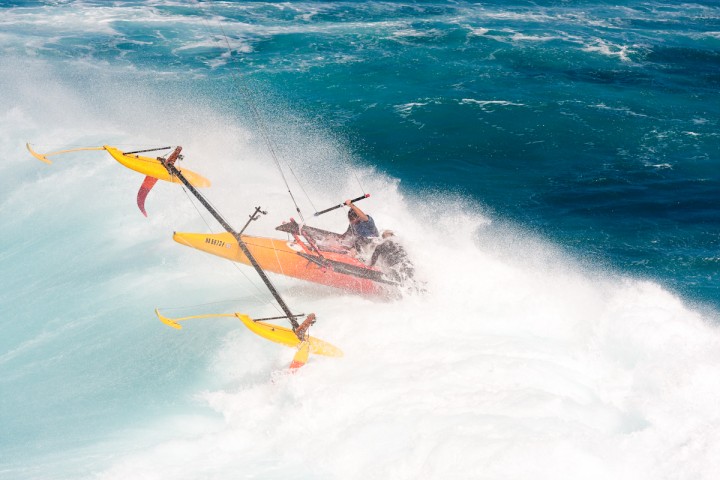
Montague and a team of equally inspired inventors have been attaching kites to boats since the mid-1990’s and they have been improving their designs continually since then. They first developed kites to use on surfing canoes and small catamarans. And there are tons of photos and videos of Don and his long-time sailing partner and boat designer Joe Brock punching through huge surf and completing crossings between islands in Montague’s native Hawaii.

Don was simply “holding on” to the kite controls in the early days. Credit Kiteboat Project

Don was simply “holding on” to the kite controls in the early days. Credit Kiteboat Project

They’ve developed countless hull, foil, kite, and control systems that they test in the rugged conditions in San Francisco Bay and the big swells of Hawaii. The boat I sailed on in San Francisco with Don and Joe is the prototype of a much bigger boat that they hope to will be able to sail from California to Hawaii (well over 2,200 miles) in less than 3 days. And for those of you who don’t know about sailing records, that’s simply insane! The current record is well over 5 days. So, what is it like to sail?

Unlike anything I’ve ever experienced on the water.

That’s yours truly smiling with the white sunglasses on. You’d smile too if you were sitting in that seat. Credit Kiteboat Project

That’s yours truly smiling with the white sunglasses on. You’d smile too if you were sitting in that seat. Credit Kiteboat Project

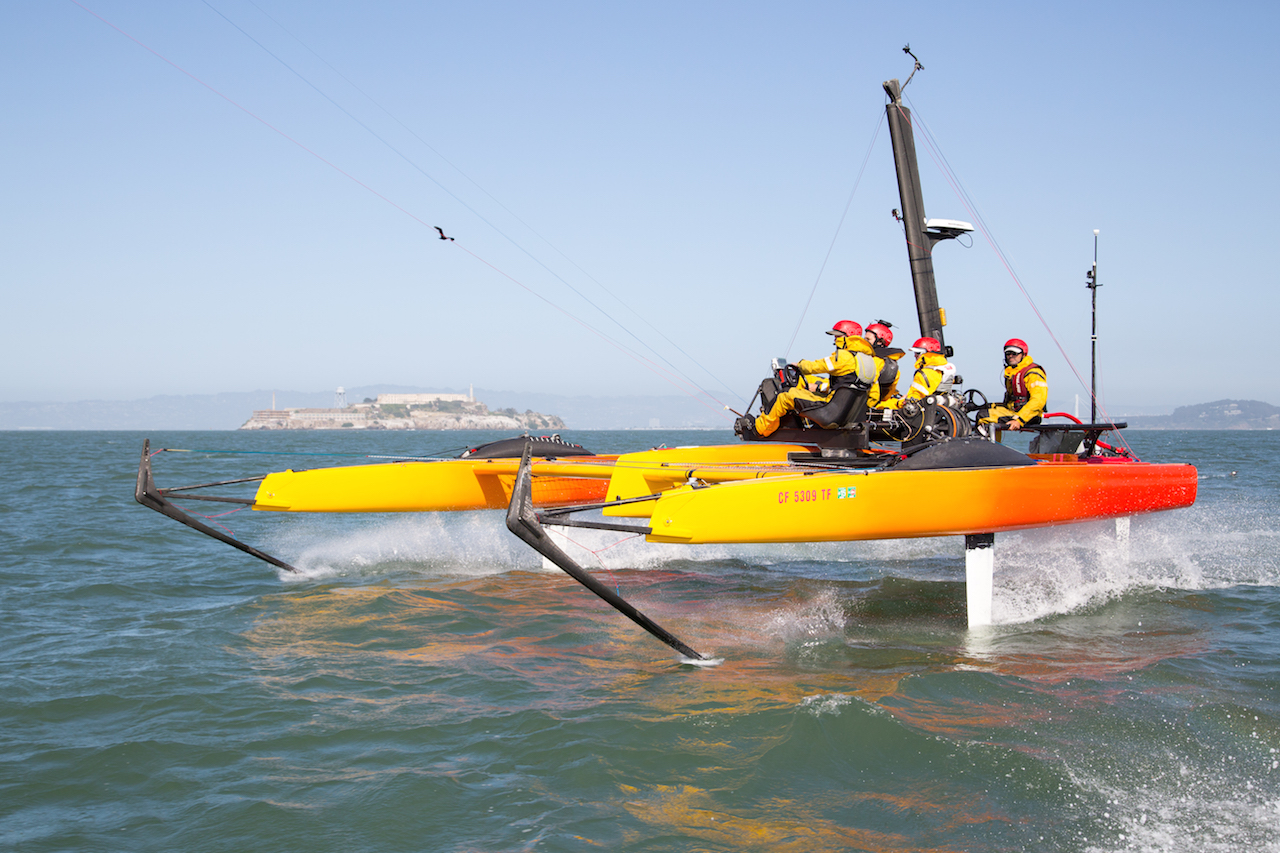
First off, we suited up with high tech gear to keep us dry and helmets equipped with full radio communications so we could talk to each other over the sound of the wind. (To get an idea of the sensation and sound of sailing at over 30 knots, put your head out a car window going 35-40 miles per hour.) Then, after a quick tow from KiteBoat’s dock space in Alameda, Don and Joe launched the kite (letting out the line from the boat’s short mast) and Don controled the kite from his custom-made carbon fiber chair while Joe steered in the seat next to him. Don then simply said “Ready?” dipped the kite down into its “power zone” and we took off faster than any other sailboat I’ve ever been on. The kite literally pulled the boat up on to its foils and the speeds jumped from 10 knots to well over 20 knots almost immediately. The black wands on the bows constantly adjust the foils to keep them at the proper angle to insure level flight through the water, and as you can see in the photos and videos, the entire “control center” (the three side-by-seats) of the boat rotates so that the “kite flyer” i.e. Don in the middle seat is always facing the kite (as opposed to facing where the boat is headed). And the speed? It’s intoxicating. After only spending a few days drag-racing past Alcatraz and under the Golden Gate Bridge with Don and his team, I have a whole new concept of speed. They’re exploring the limits of kite propulsion as we speak, and wait till you see what technological advancements they’re working on now. Already there are reports of computers being able to fly a large kite better than a human can, and soon sailing at 30 knots will be as common as…electricity. Remember Google [x] and the quest for clean energy? Those guys are currently building huge carbon fiber kites/wings (not too far from where Kiteboat is located) that are obviously inspired by Don’s kites, and are reportedly capable of creating a huge amounts of energy at a fraction of the cost and impact of other wind energy systems. And as I can report first hand, kites seem capable of creating more power from the wind than anything else.

When he’s not sailing or pushing a baby stroller all over New England, Bill Springer covers superyachts, offshore adventure, luxury travel, and technology. Follow him on Twitter or LinkedIn.