Yearly Archives: 2015

VESTAS Sailrocket 2 Vs Hidroptere. “The magic mile” world record*

by sailingcruisingscotlandtv.com

[youtube=https://www.youtube.com/watch?v=sZVIj5TUSKE]

Two days after finally smashing the Outright world speed sailing record, the Vestas Sailrocket 2 team decide to tackle the ‘Nautical Mile’ world record which was held by the mighty ‘Hydroptere’. It was always going to be an interesting challenge for the VSR2 team as the speed course that they sail on in Walvis Bay, Namibia is defined by a beach which is exactly 1.04 miles long. This requires them to launch the boat out in more exposed waters and try and get up to as high a speed as they dare in rough water before they hit the start of the mile. At the end of the course they also fire out into rough water and have to bring the boat to a stop. It’s hard on the boat. The beach is not straight but has a slight curve in it . The mile is measured by TRIMBLE GPS equipment in a straight line so pilot Paul Larsen needs to balance between sailing in close to the beach for the flat water… and sailing the straightest and hence shortest distance between A and B. In this run, with winds that averaged just under 25 knots, The team smashed not only the nautical mile record* by over 5 knots averaging over 55.3 knots… but also raised their own ‘Outright speed’ record* to 59.38 knots over 500 meters hitting a peak speed of 64.78 knots (74.55 mph, 120 kph). For Larsen it was the perfect payback for 10 years chasing ‘the perfect reach’. Speed sailing had paid him back in full and a dream was realised.
VSR2 performed exactly as predicted by the Sailrocket design team of Malcolm Barnsley and Chris Hornzee Jones at AEROTROPE. The spec for the boat was to be able to hit 65 knots in 26 knots of wind in order to average around 60 knots.
* All records subject to WSSRC ratification
Directed, filmed and edited by Ben Holder.
Oracle Team USA at Amlin International Moth Regatta

by OracleRacingTeam

[youtube=https://www.youtube.com/watch?v=unIa-deOnS8]

Several ORACLE TEAM USA sailors will take part in the International Moth regatta next week. The high-performance, one-man, foiling dinghy, gives an opportunity for all of the sailors to develop their flight skills. And next week, the competition will be many of the best Moth sailors in the world. Here’s a preview.
(Video by Javier Salinas / ORACLE TEAM USA)

Kite vs. Moth vs. Nacra F20 FCS vs. Marstrom 32

by Waterlust

[youtube=https://www.youtube.com/watch?v=nfBumbfPpnM]

The long-awaited sequel to the ultimate sailing showdown. Watch the battle between a hydrofoil kitesurfer, Moth, Nacra F20 FCS and Marstrom 32 as they battle for short course supremacy.

Athletes:
Kite – Zack Marks
Moth – Jonny Goldsberry
Nacra – John Casey & Colin Page
M32 – Team Bronco

PIPE DREAM

by DC Shoes

[youtube=www.youtube.com/watch?v=lDi9uFcD7XI]

DC presents Robbie “Maddo” Maddison’s “Pipe Dream,” giving the world a chance to witness history being made as Maddo rides his dirt bike on the powerful and iconic waves of Tahiti. From his helmet to motocross boots, Maddo was dressed for FMX when he took his dirt bike into the unchartered saltwater terrain of the Pacific Ocean in French Polynesia.


Franck Cammas recovering after accident

by americascup.com

m1153_crop169014_1024x576_proportional_14489783821950

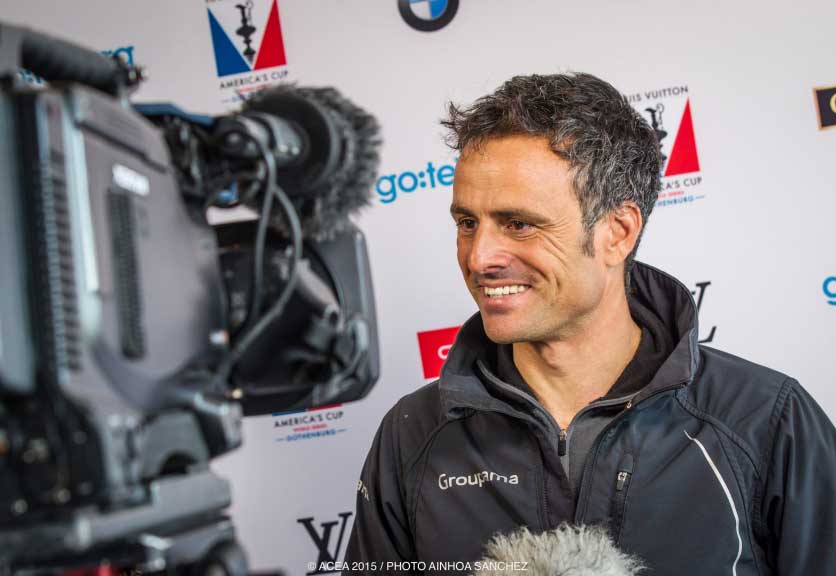
Franck Cammas, the skipper of Groupama Team France, is recovering following surgery on his leg after a training accident.

Cammas was two-boat training with his team in foiling GC32 catamarans when he lost his balance and fell overboard. His leg was struck by the rudder. The speed of the boat, combined with the fine edge of the foil, resulted in a double break of the fibia-tibia in his right leg.

He was transported to shore by RIB and then to hospital by helicopter. Specialists performed surgery on Monday night and on Tuesday the news came that the surgery was a success. Franck has a long road ahead of physical rehabilitation, but he has been assured by doctors he will not lose the use of his foot.

On Tuesday morning, Cammas was already asking about his team, anxious that they should resume training. He also expressed gratitude for all of the well-wishes sent his way.

While the injury isn’t expected to significantly impact the Groupama Team France campaign for the America’s Cup, it does put an end to Franck’s bid for a spot at the 2016 Olympic Games.

Franck Cammas Seriously Injured

by Scuttlebutt Sailing News

cammas

Quiberon Bay, Brittany, France (November 30, 2015) – The French skipper Franck Cammas was wounded in the right leg off Quiberon in western France during training in preparing for the America’s Cup 2017.

The accident took place this afternoon around 14:00 in the bay of Quiberon. “In a wind of around twenty knots, and while he was at the helm, Cammas went overboard and struck the rudder of his right leg while the hydrofoil catamaran was launched at full speed” said his team in a statement.

With a serious foot injury, an open fracture at the bottom of the right tibia, he was immediately rescued by the safety boat, which accompanied the two GC32’s during team training, and airlifted by helicopter to Nantes. At 18h, the French skipper was in the operating room “or is about to be there”, said a relative.

Cammas, 42 years old, one of France’s most talented sailors, is the skipper of Groupama Team France challenging for the 35th America’s Cup event to be held in 2017 in Bermuda. The GC32 are hydrofoil catamarans and used by the French challenge to train. The Cup itself will be sailed on the AC50 catamaran hydrofoil, about fifteen meters long.

Cats and the Cup: the first encounter over a century ago

by Foiling Week.

Nathanael Greene Herreshoff 1st was an American naval architect and mechanical engineer. “Captain Nat,” as he was known, revolutionized yacht design, and produced a succession of undefeated America’s Cup defenders between 1893-1920.

amaryllis

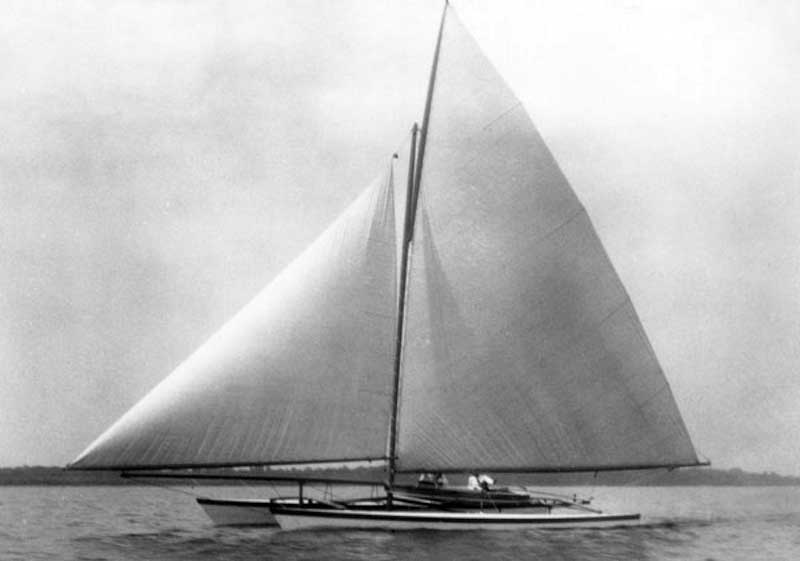
©Herreshoff Marine Museum – Amaryllis II, 1933 (Amaryllis – 1876 – replica)

Amaryllis was a catamaran sailboat designed by Nathanael Greene Herreshoff and launched in 1876. It was notable for its significant victory in the 1876 New York Centennial Regatta, which resulted in multihull sailing vessels being banned from organized sailing competitions. Ironically, Herreshoff was later to become a celebrated monohull designer. His America’s Cup winners were Vigilant, 1893 (of which Herreshoff was the helmsman); Defender, 1895; Columbia, 1899 & 1901; Reliance, 1903 and Resolute, 1920.

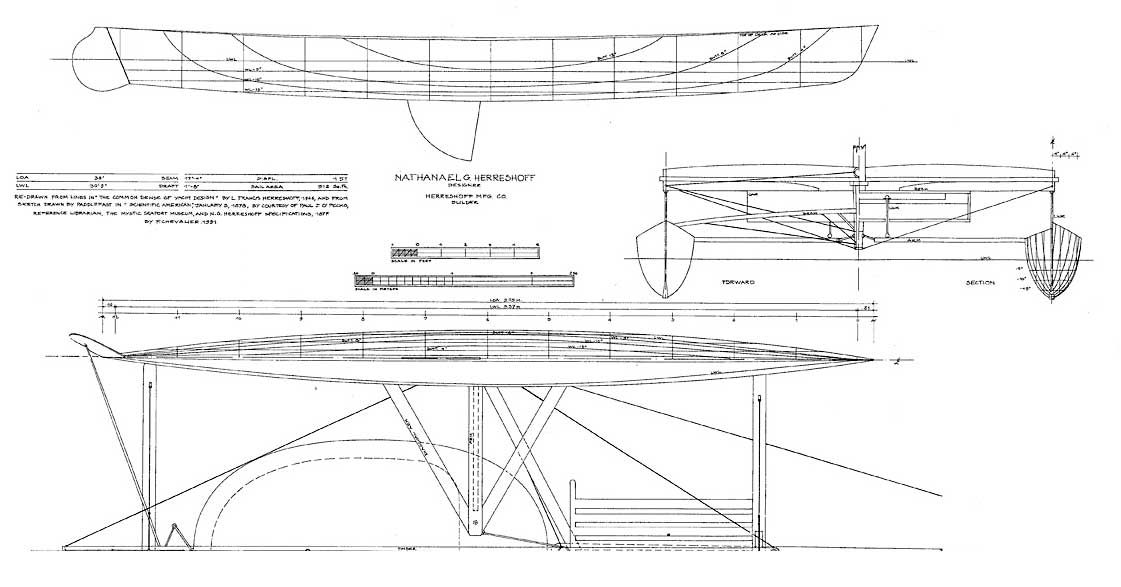
Extracted from 1870-1887 American and British Yacht Designs (François Chevalier & Jacques Taglang, 1991)

Extracted from 1870-1887 American and British Yacht Designs (François Chevalier & Jacques Taglang, 1991)

On June 24th, 1876, the day after the Centennial Regatta, The World printed:
The catamaran Amaryllis, constructed by Mr. Herreshoff, of Providence […] fairly flew along the Long Island shore, passing yacht after yacht as if they were anchored. As Amaryllis dashed over the line a winner she was saluted by guns from the yachts that were lying at anchor, and the excursion steamers screeched their loudest in honor of her victory.

The World also printed an editorial on page 4, excerpt:
A Revolutionary Yacht
Nobody protested against entering her for the race yesterday, for the reason probably that everybody expected to beat her, but everybody seems to have objected to being beaten by her. It behooves the owners of the large schooners, however, to take counsel together lest somebody should build an Amaryllis a hundred feet long and convert their crafts into useless lumber. It is a matter quite as important as keeping the America’s Cup.

Amaryllis blew the hatch covers off the crack sandbaggers, leading her nearest rival home by more than 20 minutes. The upstart boat, which her inventor called a “catamaran,” was instantly banned from organized racing. The excuse was Amaryllis had no cruising accommodations. Capt. Nat pointed out his cockpit could be completely enclosed with a boom tent, giving standing headroom, and was quite comfortable to sleep in on an air mattress. But this fell on deaf ears.

The Centennial regatta and the little catamaran aberration would have seemed very distantly related to the traditional America’s Cup schooners of very large size, but the reporter spelled out a glaring premonition: the future of regattas, and indeed, the America’s Cup itself, were put into question on the day that the very first American catamaran set sail. Eventually, the America’s Cup was defended with a catamaran, Dennis Conner”s Star & Stripes in 1988 and since 2010 seems to be the new way.

Bibliography:
– wikipedia.org/wiki/Nathanael_Greene_Herreshoff
– sailingtrivia.ravenyachts.fr/2013/08/the-evolution-of-sailing-multihulls.html
– “Multihulls Discovered: Part 1: Their origins, myths, magic, mana… and caveats that go along with these craft that have evolved from ancient heritage.” by Randy Thomas on Yachting, June 1985
– sfbaysss.org/forum/archive/index.php/t-655-p-4.html


Heaven Can Wait

by The Royal Gazette

bermudaheaven

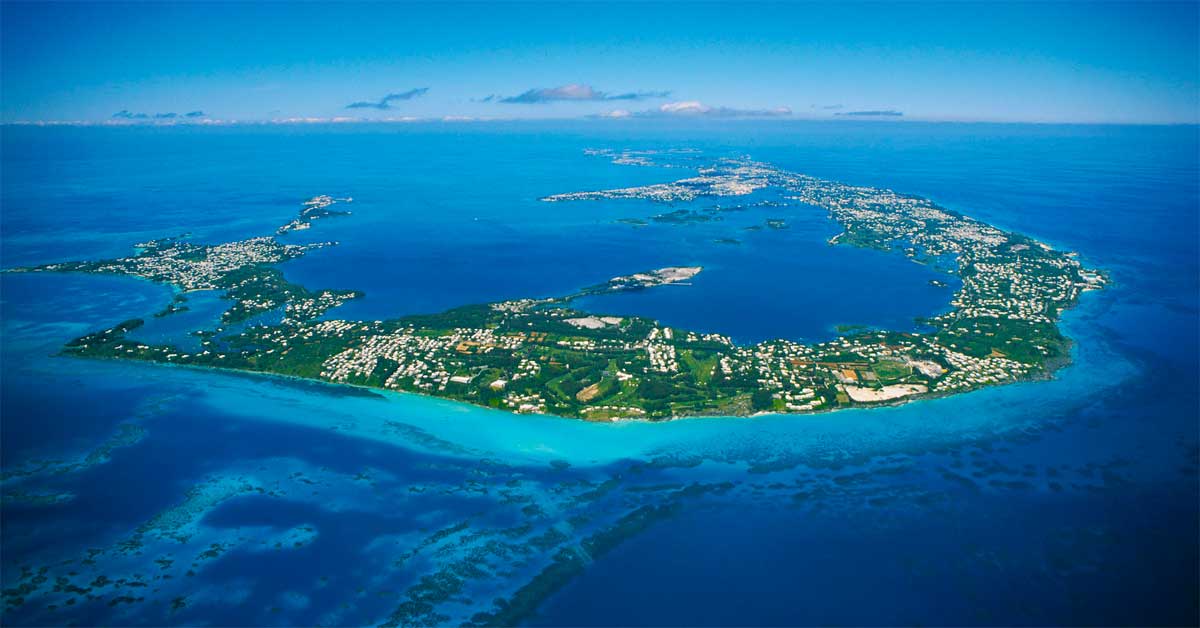
The Flying Phantom Series finale has been cancelled.

The regatta featuring 18-foot foiling catamarans, which was scheduled to take place on the Great Sound next week, was supposed to start on Sunday.

However, the start was postponed after a container housing ten Phantom catamarans from Europe arrived on the Island on November 16 on the Oleander cargo ship, but was mistakenly then shipped to New York the following day.

Despite efforts to salvage the event, including having the boats returned to the Island by Monday, the decision has been made to cancel the regatta.

Local organisers have yet to comment.

However, a spokesman for the Phanton International said: “Everybody is very disappointed, the sailors, the RBYC and all people that participated to the organization of the event. This mistake on the container management induced the cancellation of the event.

“We will evaluate with the class and RBYC to reschedule an event next year and would like to thank you and partners that supported the RBYC and the regatta.”

Yesterday, Warren Jones, the chief executive officer of Polaris Holding Company, the parent company of Stevedoring Services, apologised for his company’s mistake in sending the boats to New York.

“Certainly a mistake was made and they did go out, and we have made every effort to get them back as soon as we possibly can,” Jones said.

“I accept that responsibility and expressed my apologies to the organisers. We consider this as a very serious matter and take great pride in what we do. We are taking every effort to ensure that, as far as we can help it, that it doesn’t happen again.”

Jones said the container was mistakenly viewed to be an export.

“We’ve looked at what occurred, how it occurred and put steps in place to minimise it happening because in this business it can happen and does happen.

“Our business is serious and every mistake we make can cost thousands, so we are doing everything we can to ensure it doesn’t happen.

“There were other things that could have happened to mitigate this as well that have nothing to do with us. But the main thing is that if it didn’t go on the boat those things wouldn’t happened either.”

Phantom International and Royal Bermuda Yacht Club, the regatta hosts, considered bringing the container back by cargo plane. However, that solution was abandoned because of Thanksgiving.