Yearly Archives: 2015

First Foiling Training Center in France

by Pascale Gillard

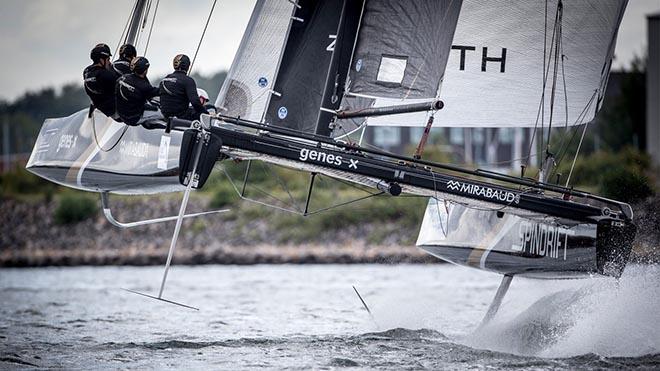
July 25th, 2015, Portsmouth(GBR), America's Cup World Series, © Yvan Zedda

July 25th, 2015, Portsmouth(GBR), America’s Cup World Series, © Yvan Zedda

After months of studies, followed by the search for a solid pool of partners, the National school of sailing and water sports is ready to officially launch the very first Foiling Training Centre in France. The first foil boards are expected end of October 2015 on the bay of Quiberon.

This is a remarkably ambitious project, initiated by the school of excellence Envsn, for the world of sailing in general. The school is ready to welcome young sportsmen and women with strong potential and provide training that will give them access to top-level sport, and maybe even professional sailing.

A pioneer centre for foiling training

An innovative idea

The aim of the Envsn training, practice and research facility is to contribute towards the training requirements of young sportsmen and women and professionals; taking them to top-level competitive sailing in foiling multihulls (catamarans and trimarans). It plans to cater to the needs of professional teams who are looking for young sportsmen and women from the FFVoile elite sporting scheme (PES) and its training facilities (Pôles France and Pôles Espoirs), by developing a tailor-made training programme devoted to these new innovative sailing techniques.

Partners

While the Morbihan regional council covers a significant part of the costs for training and regatta entries, others provide technical or material support, such as BIC Sport, who is providing three Flying Phantom foiling catamarans in the colours of the world leader in sailing sports and partners. In the same spirit, Groupama Team France who has chosen the Envsn as one of its training sites is contributing to the project by providing two GC32. The FFVoile is also playing an active role, offering its recruiting skills and expertise and supervising this top-level training scheme.

Aiming for excellence

A unique site for exceptional training

The bay of Quiberon was the natural choice for this project as it particularly suitable for the different types of navigation required for foil training. It possesses all the types of navigation zones within the same site: flat sea, swell, current or waves. As for the Envsn, it has been involved in training talented young multihull racers including Billy Besson and Moana Vaireaux, both currently in the French Olympic team.

Tomorrow’s foilers

So who will have the honour of joining this very first elite class?

A small number of 18 to 22 year olds, selected via the FFVoile contest, will have the privilege of following a one-year alternate training course, taking advantage of the best material (Phantom multihulls, Diam 24 and GC 32), the latest technology and exceptional multisport training conditions (performance optimisation on classic regatta circuits or on raids, personalised medical monitoring). Learning to fly on water is no easy challenge… This class will not only have the privilege of belonging to the world of “new generation” sailors, but will also take part in the transformation of the sport thanks to hydrofoil vessels.

The Flying Phantom mission initiated by the Envsn, BIC Sport and the Morbihan Regional Council will be coupled with the mission led by Groupama Team France and Association Team France in partnership with FFVoile, consisting of assembling a DIAM 24 youth crew under the Team France colours, who will be present at the Tour de France à la voile 2016 and at early season events.

july 23th 2015, Portsmouth(GBR), America's Cup World Series, Groupama Team France, Skipper, Franck Cammas. © Yvan Zedda/ Groupama Team France

july 23th 2015, Portsmouth(GBR), America’s Cup World Series, Groupama Team France, Skipper, Franck Cammas. © Yvan Zedda/ Groupama Team France

With the expert support, high level assistance and implication of the FFVoile, these two missions will be preparing all or some of the crew members who will take part in the Youth America’s Cup 2017, under the Team France colours.

Training sessions will take place at the Envsn, supervised by three experts: the FFVOILE, Groupama Team France and the Envsn.

Following in the footsteps of mentor

Franck Cammas…

In keeping with this quest for excellence, who better than Franck Cammas to sponsor this project? As the symbol of excellence in French sailing, he will be sponsoring these future champions and accompanying them throughout their training programme. At the helm of his foil-equipped AC45, he will be regularly present at Saint-Pierre de Quiberon for his own training sessions and will also to take part in the recruitment phase with Groupama Team France, in preparation for the America’s Cup in June 2017. The challenge for these young sportsmen and women is almost a dream beyond belief: lining up beside their mentor with Groupama for the Youth America’s Cup, set to take place in Bermuda in June 2017.

Specific training courses for pros

During the first half of 2016, training courses for professional racers who have never had the opportunity to try foiling will take place. Group training sessions will also be available for those who perform this sport.

Training for the coaches

If there is no coach there is no training centre. It appeared essential to provide the professional coaches with training in this extreme sport. Effectively, safety is crucial for hydrofoil navigation and racing. The speed of these vessels implicates issues that differ from traditional methods of training for sailing, both in terms of safety and tactics that must be mastered and communicated to those who partake in this high-level sport.
Franck Cammas rounds Cape Horn in a foiling catamaran

by Sail-World.com

Cap Horn - Julbo Sail Session 2015 © Jeremy Bernard

Cap Horn – Julbo Sail Session 2015 © Jeremy Bernard

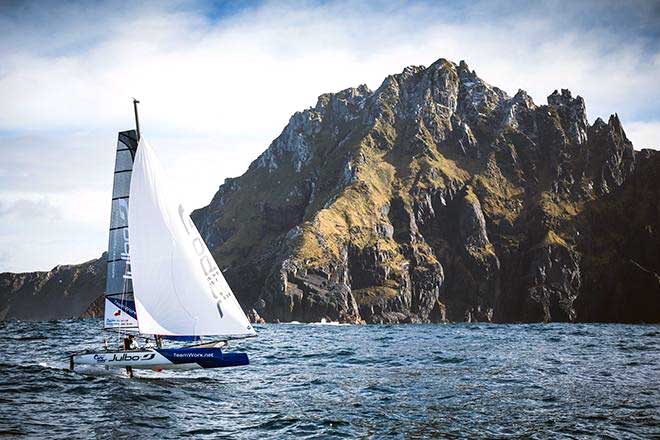
Franck Cammas, one of the most successful French sailors in the world, has done what no one has achieved before – rounded Cape Horn in a foiling catamaran

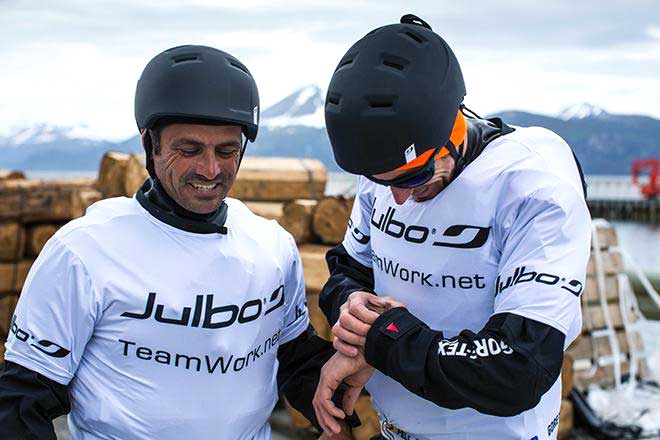
As part of the Julbo Sail Session, Franck Cammas rounded Cape Horn in a Nacra F20 Carbon FCS accompanied by a novice sailor -Johannes Wiebel (GER).

Weather conditions were good, with 15 knots of wind and 2.5-metre waves.

Cap Horn - Julbo Sail Session 2015 © Jeremy Bernard

Cap Horn – Julbo Sail Session 2015 © Jeremy Bernard

‘It’s been a really great and successful adventure,’ Franck Cammas said after getting back on land. ‘It’s unusual to have a weather window in 10 days for a boat like this to round Cape Horn. It’s my third passage and it’s really uncommon to do it with such a small boat.’

GC32 comes sailing down under

by LiveSailDie.com

© Team Vodafone Sailing

© Team Vodafone Sailing

It looks like Team Vodafone Sailing will have some competition on their hands!!!

Keri Keri, New Zealand – MARWIN RACING TEAM are bringing their GC32 foiling catamaran to sail in Bay of Islands and Auckland, New Zealand from December 2015 until March 2016. This new dynamic MARWIN RACING TEAM is an exciting collaboration between the four times Swiss Star Class Olympian and local New Zealand multiclass sailor and two time Olympian Sharon Ferris-Choat.

The GC32 ranks as the most exciting one desig n, America’s Cup style, foiling catamaran on the market – attracting worldwide media attention. Shipped directly from the inaugural GC32 European Racing Tour, the boat is ready for an action packed summer in New Zealand with race training, youth crew development and regattas.

Co-helm and Team Manager Sharon Ferris-Choat announced that team and crew trials will start in January for crew positions in the 2016 GC32 Racing Tour, the MARWIN Youth America’s Cup Academy and the Women’s Speed Challenge. “This is an amazing opportunity for local sailors to break into a European tour, on a world-class boat and as part of a professional team that successfully competed in the 2015 GC32 tour” said Sharon.

Racing in the GC32 tour round in Marseille, France, the boat reached a top speed of 37.1 knots (68 km/ph) and the team hope to bring this spectacle of speed to New Zealand waters racing in the Bay of Islands Race week and other regattas. The foiling catamaran is currently on a ship to New Zealand and is due by Christmas, giving the team time for selection trials, training and local racing through to March before the boat heads back to Europe.

Contact information: Sharon Ferris-Choat, MARWIN RACING TEAM, Team Manager
Facebook: www.facebook.com/nzgc32
Website: www.marwin.com

GC32 designer Martin Fischer talks foiling

by  Extreme Sailing Series

© Sander van der Borch / Bullitt GC32 Racing Tour

© Sander van der Borch / Bullitt GC32 Racing Tour

With the Extreme Sailing Series™ moving to the hydro-foiling GC32 catamaran in 2016, German naval architect and GC32 designer Martin Fischer talks through the technicalities of how these unbelievably fast rocketships rise up out of the water and fly across the surface.

Dr Fischer, who is at the forefront of the revolution in sailing brought about by the invention of foils, has got used to simplifying the complex design features and theories that underline a step-change in sailing that has already turned the leading edge of the sport into a hybrid between yachting as we thought we knew it and flying.

The key innovation is the foils, the slender carbon-fibre winglets or arms that are deployed under both hulls of the GC32 and provide the magical ingredient – lift. This is what enables the GC32s to rise up above the surface and fly in the air above the waves, travelling at speeds that would be unimaginable on conventional “displacement” boats.

“The foils work like wings on an aeroplane,” explained Dr Fischer, a physicist and specialist in fluid dynamics who has worked on America’s Cup yachts, Volvo Ocean Race yachts and maxi-multihulls for solo sailors. “The foils do two things at once on the GC32. They provide lateral resistance to counteract the sideforce created by the sails but, in addition, they also create a vertical force that pushes the boat up.”

And here’s the critical bit: “The faster you go, the more powerful this upwards force is and, at a certain speed, the vertical lift is big enough to carry the whole weight of the boat out of the water, just as a wing on a plane lifts the fuselage off the ground.”

One big difference between a racing catamaran and a plane is that a plane needs to keep rising to reach an altitude at which it can fly safely. By contrast a boat can only rise a relatively small amount before its foils lose contact with the water. If that happens the foils stall and the boat suddenly crashes into the weaves and stops. Not good.

To stop the GC32 rising too high, Dr Fisher worked out a profile for the foils so that the height of the boat stabilises automatically. “We opted for a V-shaped foil,” he said. “The specificity of this shape is such that it stabilises the foiling height automatically without any interaction from the crew. That makes it pretty easy for an inexperienced crew to sail this boat.”

In comparison to the foils that we saw being used at the 2013 America’s Cup in San Francisco, the foils on the GC32s are quite big. This is because you need bigger foils to generate lift in light airs and, unlike the big cats on San Francisco Bay where there was plenty of wind, the GC32s need to work in a broad range of conditions and often very light winds. The critical element is the take-off speed. At what point will the boat come up and start to fly? After running a series of simulations Dr Fischer arrived at a take-off speed of around 16 knots of boatspeed. This is achieved in about 14 or 15 knots of wind when the boats are going to windward and about eight knots of wind when the boats are going downwind under spinnaker.

Fischer knows perhaps better than anyone what it will take to race them at optimum performance. He says that with so many control points to adjust – rudders, sails, foils – trimming the boat and understanding where to deploy crew in terms of weight and balance will be critical. He predicts that subtle variations across the Extreme Sailing Series fleet will make all the difference in any given set of conditions.

Overall, however, the key will be managing the transition between displacement mode and foiling, especially at the turning points on the course. “Tacking and gybing are not so easy because on a foiling boat the speed is really high and during a gybe, for example, you lose a lot if you get back to displacement mode,” said Dr Fischer. “In order to reduce that loss, the crew have to be able to perform foiling gybes and that requires quite a bit of training, especially on a boat like the GC32 that does not have hydraulic systems to control the foils like on the America’s Cup boats.”

For everyone this is going to be an exciting season in the Extreme Sailing Series. For Dr Fischer, the adoption of the GC32 class is a special moment. “It is very exciting to have the GC32 in the Extreme Sailing Series. I am very proud of it.” he said.


A photographer’s bio

By foiling Week™

We asked our official photographer to describe herself

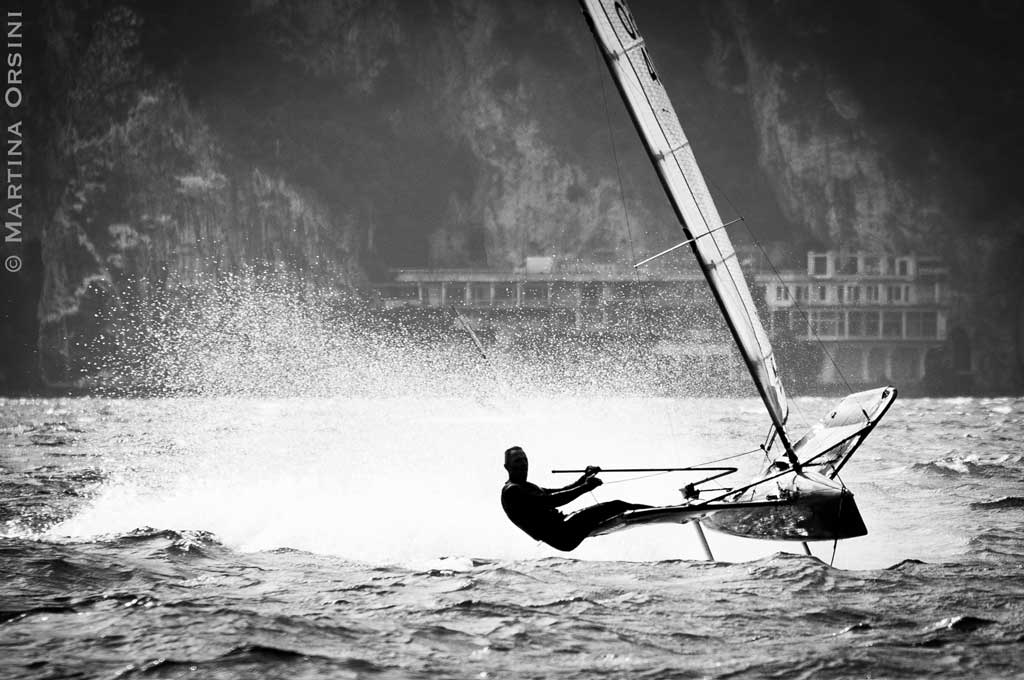
Martina Orsini

Martina Orsini

Since I was a child, I grew up loving travel and sailing, THANKS to my parents’ work and passion. They brought me in their travels and I remember I was always amazed by the diversity of landscape and culture IN every single country I visited. I needed to “record” everything I saw and, at some point, I realized that pen and notebook were not enough to do it. that’s how I had my first analogic camera, the ideal way to equipe my travel reports, with images.
In the same way the desire to go sailing did grow in me: I spent all the summers on board . I didn’t want to be a simple passenger,I wanted to be useful and, above all, I wanted to be able to say “One day I’ll go to see the world around the seas”. I started attending courses on dinghy and I understood immediatly that sailing was for me the most beautiful and poethic sport in the world.


Photography and sailing boats have been my two passions for over twentynine years. I developed them at the same time during high school and university. My first works as a photographer were travel articles written and snapped by me. After the graduation in philosophy, I choose a master in Photography and Visual design to study in depth the art of photography in all its aspects; it was no longer just a passion but it was becoming more and more a need, a way to express myself.


The opportunity to combine these two great loves was given to me in august 2012: I was called to do black and white portraits about sailors during the Moth World Championship in Campione del Garda. I remember I focused a lot on the surprise effect: I have never liked the portrait posing and so I was looking the most authentic expressions of the athletes while they were fitting out their boats, joking between them or waiting the wind’s coming. The human aspect has always been a pivot on which I wanted – and still want – to build my work, both in yacht race photography and in all the other types of photography.

After this event a kind of “chain reaction” has been generated and now I’m the official photographer of the Italian Moth Class Association, of the Foiling Week, of the “Vento di Sardegna” Team and of many other events linked to the nautical world. Follow the construction of a boat in the yard and see it born, taking pictures in beautiful places, try those same boats subjects of my photographs and say right now “I’m doing what I always loved”, it can only be an achievement for me, a satisfaction. And I hope to keep it doing until I really go around the seas to see the world with my boat, armed with a Nikon!

Vote for Martina at 2015 MIRABAUD YACHT RACING IMAGE

Vote for Martina at 2015 MIRABAUD YACHT RACING IMAGE

(Facebook access needed)

More on Martina at www.martinaorsini.blogspot.it

The Kiwis not so secret weapon

by America’s Cup

https://youtu.be/R2ZwrUuZ8gM

Peter Burling, winner of the inaugural Red Bull Youth America’s Cup, has helmed Emirates Team New Zealand to the lead after the first three Louis Vuitton America’s Cup World Series events. And he, along with his 49er and LVACWS crew Blair Tuke, has just been named the ISAF Male World Sailor(s) of the Year.

Foiling Moth is first around Hong Kong

By mysailing.com.au

mothhrg

… Finding adequate breeze, Stompf-Jepsen noted the scorching progress of RHKYC Coach, Rob Partridge on his International Moth, who had already passed through the second of two check-in gates at Cyberport and quickly made the decision to allow the fleet to ‘go all the way’.

Partridge finished after just over 2 hours and 47 minutes of racing – not a course record but enough to claim Line Honours by a country mile. Next boat to finish was at the other end of the size spectrum, with Frank Pong’s 72 foot Jelik completing the course ahead of a mix of big boats, dinghies, one-design keelboats and beach catamarans …

Read more at mysailing.com.au

New Yacht Technology Off to a Rough Start

On New York Times by Chris Museler

Armel Le Cléac’h’s Banque Populaire VIII is one of the new VPLP-Verdier boats, considered the most complex monohull sailboats ever built. Credit Transat Jacques Vabre

Armel Le Cléac’h’s Banque Populaire VIII is one of the new VPLP-Verdier boats, considered the most complex monohull sailboats ever built. Credit Transat Jacques Vabre

The last place the British sailor Alex Thomson expected to be last week was lying on the ceiling of his new racing yacht in the North Atlantic.

With the Vendée Globe, the premier solo round-the-world race, starting in a year, Thomson was testing a new generation of innovative hydrofoils in the 5,400-mile Transat Jacques Vabre from Le Havre, France, to Itajaí, Brazil.

The double-handed race, which started Oct. 25, featured several first-of-their-kind 60-foot yachts, known as Imoca 60s, designed by Guillaume Verdier and VPLP Design.

Four days after the start of the race, Thomson and his Hugo Boss crewmate, Guillermo Altadill, had to be rescued off the tip of Galicia, Spain, with their boat dis…

Continue reading on New York Times

The US Garage Band vs. The World

by Chris Museler

“OK, someone has to take a picture and send it to our hosts as a thank you gift,” shouted Anthony Kotoun, the Dali Lama of the US Moth fleet at dinner a few nights ago. “Then we have to shanghai Zack Maxim’s boat from the shipping company. There’s a $200 prize for anyone willing to wake up at 6 a.m. tomorrow for the 1.18-hour drive…” And the list rolled on that way until our beers and grilled oysters were delivered.

cm01

November US Moth Training Camp, Neuse River, NC

It was a pretty spendy call to take a week from work and family and head to the Neuse River in North Carolina for a training session in the outrageously quick and touchy Moth. The US fleet was offered rooms and a launch at Steve and Heidi Benjamin’s compound on this enormous estuary of brackish water and oyster fishermen.

The major selling point? A $10,000 prize, of course! Amlin International Moth Regatta in December has hand-selected the best sailors in the world to bring their personal, single-handed boats to Bermuda and race for not only a prize purse but bragging rights. You see, all the top America’s Cup teams (with the highest paid sailors on the planet) have fleets of Moths for their sailors to train with. And the Royal Yachting Association has sponsored elite Mothies from the UK for a few years now to top this influential class. They all want to beat the crap out of each other on their own terms, with their own boats. Trimmers wanting to take races off their Cup helmsmen, etc.

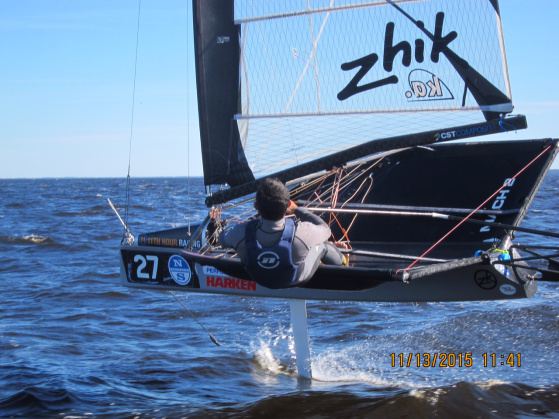
Victor Diaz de Leon, nearing 30 knots downwind, Neuse River, NC

Victor Diaz de Leon, nearing 30 knots downwind, Neuse River, NC

cm03

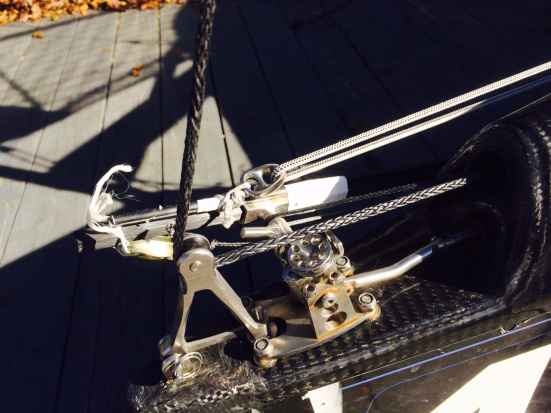
3-D Printed adjustable forestay fitting by Nat Shaver

Then there are the Americans, last week layered in wetsuits during the day getting ripped off their trampolines and hucked into the brown water of the Intercoastal Waterway when the chop would pitch the boats while they were hitting 30 knots. Strangely absent from many of the Cup teams and only supported by the environmentally forward thinking 11th Hour Racing, this group of pro and amateur sailors have been covered in carbon dust and resin every week for the past season adjusting, designing, 3-D printing and training their way toward their goal of out sailing the privileged group in Bermuda.

Last week was my chance to witness how the DIY approach to boat work and training can get someone ready to beat the most well paid, and funded, teams in the world. Very American!

Mach2 Moth box always doubling as work bench

Mach2 Moth box always doubling as work bench

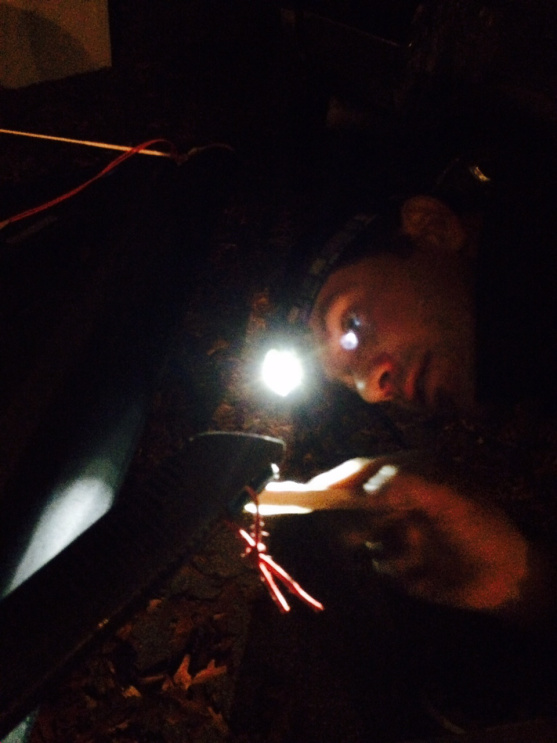
The routine has been the same for this group since the frigid mornings of last April in Newport, the fleet’s summer home. Boat work at night and hours of training during the day to test new systems. North Carolina was a hyper-focused version of this system. Late the other night, Nat Shaver, who designed foils for Team New Zealand in the last Cup and is now working with the French Cup Team was jamming on one of his many carbon fixes since the training camp began.”It’ll be so shitty and ugly,” he said, after using a dremel to grind off the broken bits at the end of his homemade boom, “but it’ll do the job, I think.”

11 p.m. boom repair, 49 degrees

11 p.m. boom repair, 49 degrees

Moth sailors in America easily spend 70 percent of their time on boat work in this development class and barely the remaining 30 on the water. The base structure of the boats is the Mach 2 Moth built by McConaghy in China.

Why do the boats need so much work? Foiling sailboats are still new, at the boundaries of the sport and when you are traveling upwind at 16-17 knots and downwind at 20-30, the most minute adjustment can make many knots-worth of difference. So the short answer is: systems.

Making carbon levers to articulate and assist canting the rig from side to side, gluing little tabs to anchor sail adjustment pulleys (some so tiny they are sourced from remote control boat manufacturers) and repairing the constantly breaking modifications to the carbon wing bars and booms are added to work lists daily, attended to at night, and tested the next day.

The Americans are their own pit crews and coaches. And they want to kick ass next month. Jamestown Distributors president Mike Mills, a foil boarder himself, saw an awesome parallel between what this group is doing and what he was part of in the late 1990s in the International 505 class, easily the most elite double handed class in the world. Mike won the worlds in 1998 with Nick Trotmen after years of this very organic approach. JD sent me down with boxes of their house brand Total Boat epoxies and supplies to support the group.

Asking around, I realized that literally all the top performance sailors in the US, all plugging away in their garages to modify and repair their boats, use JD and the growing line of Total Boat products, especially the epoxies and fibers.

And when you do everything yourself, and pay out of your own pocket to make your boat faster, knowing there is a company that understands and gets you what you need STAT, makes a huge difference.

I’ll report back on how it all went with the work lists, which fixes worked, which didn’t and if this rag-tag group of rouge sailors will be ready to dethrone a few of those fully-sponsored pros in Bermuda next month.