Author Archives: Foiling Week

Story of a gamble

by Gitana Team

In late 2013, the members of Gitana Team embark on an adventure that is as thrilling as it is complex: overhauling the Multi70 Edmond de Rothschild, a 70-footer initially built to race in crewed configuration on a one-design circuit, in a bid to become the first flying offshore trimaran. It is an ambitious project. Like Rome, which wasn’t built in a day, the transformations to Gitana XV call for over two years’ research and innovation to satisfy the objectives of the five-arrow team. However, everyone agrees that the interplay is very worthwhile. Just a few days ago, equipped with her new appendages, the Multi70 Edmond de Rothschild definitively took flight, racking up some 43 knots on the speedo in 20 knots of breeze and thus validating the efforts of a whole team, supported by the passion and commitment of the boat’s owners, Ariane and Benjamin de Rothschild.

There is nothing new about the idea of flying… but the 34th edition of the America’s Cup, which was held in 2013 in San Francisco, revived this quest to such an extent that it has changed the face of contemporary offshore racing, modifying the vision and the ambition of the sailors who shape the milieu. The spectacular images of the AC72s, the winged catamarans created during the last Cup, quickly find an echo within Gitana Team. However, true to the aspirations which guided its creation in 2000, the stable founded by Baron Benjamin de Rothschild is keen to gear its sights towards the open ocean. We review the team’s perfectly choreographed ramping up of activities.

2014, the Rhum launch pad

In this way, from late 2013, a series of studies is launched with a view to a participation in the Route du Rhum in the main Ultime multihull category. In a bid to do well and stand a chance of keeping pace with the class’ XXL competitors, which measure between 30 and 40 metres compared with Gitana XV’s 21 metres, all the appendages (rudders and foils) need revising, as does as the sail plan. However, there isn’t much time left and the full jobs list is abandoned in favour of enhancing the boat’s reliability in a manner that is more coherent with the sports programme: T-foil rudders replacing the classic rudders. A new genre of appendage for an oceanic trimaran, they are the result of a close collaboration between the Gitana design office, naval architect Guillaume Verdier, who is as talented as he is modest, and the members of Team New Zealand, Jamie France, Bobby Kleinschmit as well as the Pure Design company. The intended speed gains are considerable. However, as ever, the theory still has to be transferred to the water. Sébastien Josse’s very fine third place in the famous transatlantic race between Saint Malo and Pointe-à-Pitre has a rather positive ring to it for the five-arrow team.

“ The system of lifting surfaces developed by Gitana Team, in collaboration with Guillaume Verdier’s team, has clearly proven itself and the rudders have made it to Guadeloupe intact. This transatlantic has enabled us to validate the system’s reliability in rough weather over the first days of racing, as well as throughout the remainder of our journey. The T-foil rudders create an indisputable turbo effect on the boat on certain points of sail. They are also appealing in terms of safety as we’ve made solid gains in stability, which notably enabled me to go on the attack during the first few days in the big breeze, without feeling that I was putting myself in danger. Gitana Team’s gamble was a daring one given the short amount of time we had for development and making her reliable but the experiment is a success. There is still considerable room for improvement and the next www of the adventure promises to be thrilling,” Sébastien Josse comments on his arrival in Pointe-à-Pitre on 11 November 2014.

2015, foils on guard

The feedback from the Route du Rhum backed up the theories put forward by the naval architects and reinforced Gitana Team’s choices. For all that, Sébastien Josse and his men are only at the start of their journey. Now free from any sports programme, the Mulit70 Edmond de Rothschild is to become a fantastic test laboratory. With the appendages trialled during the Route du Rhum proving to be super efficient, it’s time to switch to the second phase of the initial project, namely equipping the trimaran with new foils. Favouring a research approach, it is decided that these appendages must be asymmetric: L to port and C to starboard. This highly informative and promising test phase results in the boat’s debut flights offshore.

2016, the realisation

The third and final phase must enable Gitana Team to take the project to another level and live up to the expectations of the original project. To achieve this, the members of the technical team have to make structural modifications to the platform, particularly around the foil casing. These will be the main focus of the winter refit. Meantime, new foils with profiles more geared towards flight are built. On 22 March, Gitana XV puts in her first tacks as the 2016 iteration: the sensations are excellent as are the speeds! With many miles in flight making between 35 and 40 knots, the boat racking up a record 43 knots in 20 knots of breeze and the shared sentiment that they have a lot more to discover… The first part of the gamble has paid off: the Multi70 Edmond de Rothschild has just taken flight!

“Theory is one thing, putting it into practice is another. Despite the calibre of the project’s contributors and the ground we’ve covered in terms of digital calculation, nothing replaces miles on the water. Being in a position to benefit from a platform like Gitana XV throughout this period of reflection, followed by the construction of the future Maxi, is an incredible opportunity, which we’ve been able to make full use of.

Dedicated to flight, this second test campaign has proven to be more than positive! The sea trials we’re carrying out right now are just incredible, so much so that I never thought I’d see the day… With our new appendages, we’ve exceeded speeds we hadn’t expected to reach in this configuration, or at least not as quickly! Speed is a very important thing, but on top of that these latest sea trials have also taught us a great deal about how the boat handles, which is clearly very different to our understanding thus far. The boat no longer floats, she flies along on two blades… We’ve passed a very important milestone. We’ve also learned very interesting lessons about what steps to avoid in the future in terms of both our architectural choices and the on-board systems. As such, the design office has a significant amount of data with which to continue its research. The work never stops and the sea state is still something we need to make progress with!” explains Sébastien Josse

However, the incredible sensation of flight on such a machine, as pleasant as it is to be powered up at over 40 knots, is not Gitana Team’s only objective of course. Following the announcement made in May 2015, the five-arrow team also began construction of a maxi-multihull at the Multiplast yard in Vannes, south-west Brittany back in November. This craft, the twelfth in the history of Gitana Team, will reap the full benefit of the trials carried out on the Multi70 Edmond de Rothschild from 2014 to 2016. Indeed, Sébastien Josse and his men have been able to build the future on the water rather than solely at a desk.

“Today is massively satisfying and I feel immense pride for the entire team that I manage. The project seemed a bit crazy when we began in late 2013 but once again, within Gitana Team, we benefited from the unfailing support and enthusiasm of the owners of the boat, Ariane and Benjamin de Rothschild. When we presented the project to them, they immediately understood the challenges and the appeal of staking out the future and they didn’t hesitate an instant in encouraging us along this pioneering route. We were in a transition phase because we were at the dawn of major technological change. Indeed, the switch from sailing in Archimedean mode to flight mode might be compared to the switch from steam engines to combustion engines. Although the America’s Cup had gone a long way to showing us the direction things were heading in terms of flight in inshore racing, transferring that knowledge to offshore sailing was a whole new ball game as the very philosophy of flight is different. It’s a far cry from simply getting big multihulls to fly around the world as the AC72s did in San Francisco bay… It’s something else entirely, but the expected gains are huge and this is where the future’s at. We’ve passed a milestone and a new adventure is opening up in front of us!” admits Cyril Dardashti, Director of Gitana Team.
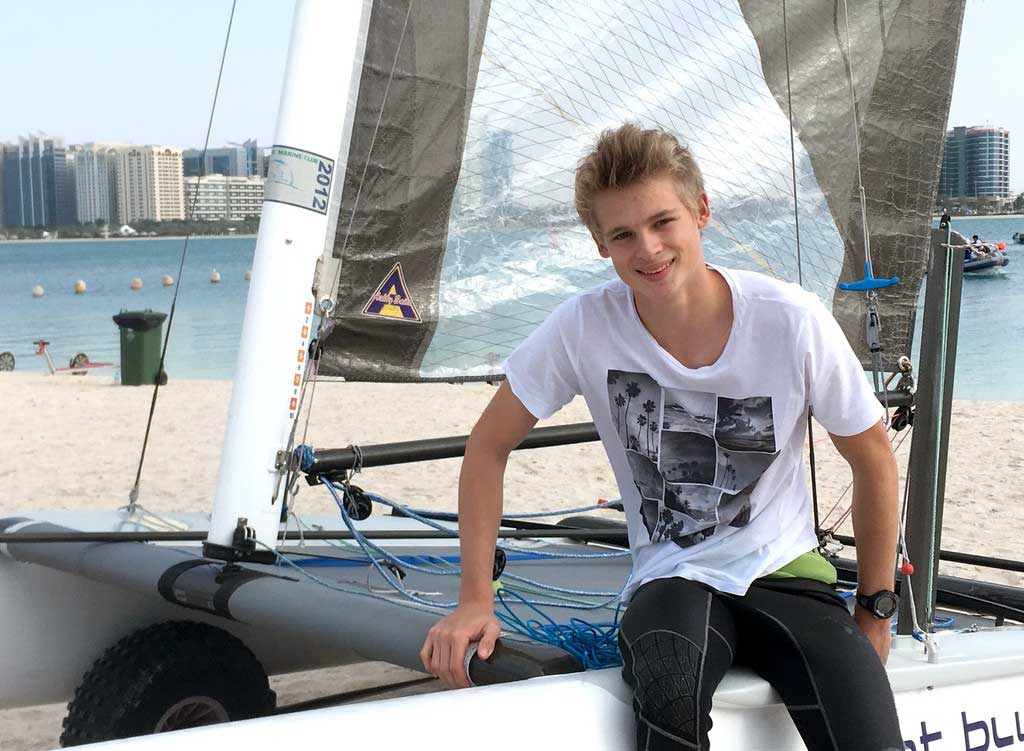
Oscar Lindley-Smith is not like most teenagers

by totaluae.com

uaeboy

He doesn’t spend his weekends hanging out with friends, watching films or walking around a mall.

As the world’s youngest competitive foiling helm – a sailor who steers a catamaran which flies up on top of the water suspended on a pair of hydrofoils – 16-year-old Oscar, who lives in Abu Dhabi, spends most of his spare time at sea.

And now he has another mission to occupy him: to secure US$240,000 of sponsorship to help him forge a career in the sport and compete in Foiling Week – the world’s only dedicated event for foiling boats – on Lake Garda in Italy this summer
.

He hopes to find a company or companies that will sponsor him to help him continue his sailing experience and be recognised at the top of the field.

Foiling is the new generation,” says Oscar, who used to sail an 8-feet long mono hull but has since moved on to a Flying Phantom, an 18ft carbon fibre catamaran, which his family has shared with another family for just over a year.

There are less than 100 of these boats around. We bought boat No 11 from the first batch of boats. So I am one of the most experienced young helms anyway for this boat, which is a unique selling point I’m trying to use.

But because the boats are so new, they are expensive.

If his sponsorship bid is successful, the money will pay for the purchase of another boat, which is worth upwards of €40,000 (Dh167,355) to use in Europe, plus all the running costs, spares and repairs. He will also find a professional crew to take the place of his father, who currently sails with him.

As a sailor I will be the youngest foiling person in the world competing at the high end. There will be no one else of my age up there competing,” says Oscar.

Any company that partners with me from the beginning will also benefit from this success. At the moment sailing is in a massive growth www. The viewings have gone up tenfold since even last year. It is a very spectacular sport with these new boats. There are lots of different stunts that can be done that create spectacular imagery.

Oscar was introduced to sailing at the age of three, but was not immediately taken by the sport as it was initially limited to group exercises with paddles to keep it safe. But his potential was quickly noticed and he was soon sailing twice a week.

That was when I really started enjoying it because we were racing and sailing independently instead of doing these exercises,” says Oscar, who is from the UK but has lived in the UAE for the past 11 years.

One of the main things I enjoy is being out and the feeling this gives you. There is a lot of responsibility on you. It is all about the hard work you put in and I really enjoy reaping these rewards when racing.

To help secure the sponsorship, Oscar, who attends Brighton College, has produced his own proposal document to present his business case. The document outlines his motivations – the freedom, challenge and enjoyment it offers – as well as his achievements, plus short and long-term targets. It shows where a company could display its logo, such as on his rash top, trousers, trailer, the boat itself and even his car.

But most importantly, the document outlines why a company should sponsor him. According to Oscar, the company or companies will receive global TV coverage reaching at least 5.5 million unique viewers and a further 200,000 views via social media. In the UAE, Oscar points out that he trains on the Abu Dhabi Corniche breakwater surrounded by five-star hotels and apartments, which received 1.2m visitors in the first quarter in 2014. He estimates sponsors will receive a further 1,000 views from him sailing in front of Jebel Ali Hotel in Dubai. And more than 2m visitors to Lake Garda will see him train there over the summer.

Foiling is the high performance top end of sailing that has exploded since the last America’s Cup was raced using giant foiling catamarans,” says the sponsorship proposal, which Oscar put together himself.

The speed that comes with foiling has drawn many times more spectators than has ever previously been seen in sailing – it has become the Formula One of the sport. Drones continually film and broadcast to spectators on the shore. TV and YouTube coverage is released after every race.

But persuading companies to get on board here is hard. Oscar has spoken to a few so far, but his conversations have been limited to email so far. Juggling sailing and school is also a challenge.

I am getting interesting pressure from both sides. I was recently in Oman for the America’s Cup and catching up just two days from that was difficult. I have my AS levels in a month’s time so it is very difficult,” he says.

I am trying to do both, because if something happens in my sailing, if I get an injury or something, I need a fallback plan. At the moment it is sort of a double focus.

business@thenational.ae

Le petit hydroptère d’E.T.

by Frédéric Monsonnec – Auteur depuis 2008 du blog Foilers
Texte originele ici

Non non, George Lucas n’avait pas prévu de faire voler E.T. l’extraterrestre à bord d’un hydroptère (enfin je ne le pense pas).

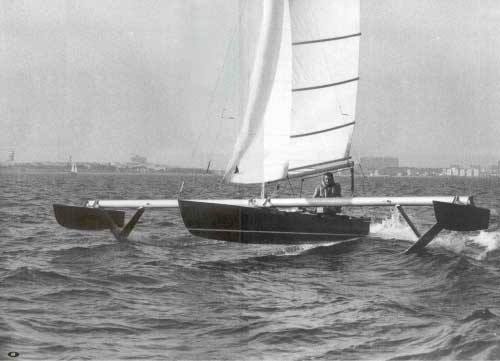
E. T. c’est aussi le grand Eric Tabarly qui, d’une certaine manière, était un extraterrestre ! Les photos du bel hybride que pilota Eric Tabarly en 1976, ont du faire naitre des vocations de pilotes d’engins à foils (au moins une!).

Photo Bernard Deguy 1976

Photo Bernard Deguy 1976

La genèse
L’idée d’utiliser des hydrofoils, Eric Tabarly, l’avait déjà fin 1971. Il souhaitait développer un foiler pour améliorer la stabilité d’un trimaran de course tout en diminuant la trainée (il avait croisé Williwaw le premier foiler océanique en 1969 aux USA). En 1975, il rencontre Alain de Bergh et Claude Picard ingénieurs chez Dassault. Le duo, qui va s’intéresser au projet d’Eric Tabarly, va se transformer en trio avec l’arrivée de l’aérodynamicien Pierre Perrier. Puis en quatuor avec le professeur Tsen du CEAT ENSMA de Poitiers. C’est Alain de Bergh qui, après plusieurs semaines de recherches, propose d’étudier la possibilité de faire voler l’engin. En 1975 des essais en soufflerie sont réalisés, des foils sont testés à l’école nationale supérieur de mécanique aéronautique de Poitiers (ENSMA) et une maquette sur un plan d’eau (tractée par une canne à pêche !)…

En 1976, au retour du Triangle Atlantique qu’il vient de gagner avec Pen Duick VI, Eric Tabarly rencontre Jean Garnault professeur à l’IUT Génie civil de La Rochelle. Jean Garnault lui propose de construire la maquette navigante de son projet. Cette maquette devait permettre de valider les idées d’Eric et des ingénieurs de Dassault. Idées qui, à l’époque, faisaient sourire certains. La maquette devait surtout permettre d’observer le comportement d’un hydroptère à voile en navigation. En Angleterre et en France, d’autres engins de ce type existaient déjà comme ceux de Claude Tisserand (Véliplanes) ou de Roland Tiercelin (Trimama, Triplane …), mais l’engin réalisé par Jean Garnault allait permettre de valider les premières esquisses du projet.

Réalisation
La bête fut construite à partir de la coque centrale d’un Tornado, de son gréement, d’un profil de mat pour le bras de liaison, de flotteurs en contre plaqué stratifié et de foils à priori eux aussi en CP stratifié. Le safran était équipé d’un empennage en V dont l’incidence était réglable en tournant la barre sur elle-même (rotation d’un pas de vis, puis d’une crémaillère fixée en tête de safran).

Pour augmenter la surface du pont, une plaque de contre plaqué avait été rajoutée sur la coque centrale. Sur chaque côté de cette plaque, étaient fixés 2 répétiteurs (girouette, anémomètre …). Cette plate forme rendait le canot légèrement plus «confortable» mais les pieds du barreur se trouvaient tout de même au même niveau que ses fesses. La barre se trouvait dans le dos du pilote, ce qui ne devait pas permettre un pilotage en finesse.

Sur la coque de Tornado, à l’emplacement de la poutre arrière, un petit profilé dépassant de chaque coté avait été boulonné. Il permettait de fixer une pantoire pour l’écoute de GV. De même à l’avant, une mini poutre servait de point de fixation à la poulie d’écoute de foc.

Voiles & voiliers N°448 juin 08

Voiles & voiliers N°448 juin 08

Caractéristiques :
Longueur : 6.09 m
Largeur : 7m
Poids : 160 kg environ, 230 avec le pilote
Surface de voilure : GV 16,87 m² ; Foc 5,20 m²
Longueur des foils : 2 m

Navigations
Assemblé au port des Minimes (arrivé démonté sur une remorque tractée par une DS), l’engin a volé dés sa première sortie, au près serré, par 10/15 nœuds de vent. Il semble que le premier vol n’est pas été réalisé par Eric Tabarly mais par quelqu’un de l’équipe de La rochelle…

Eric Tabarly, qui avait ancré Pen Duick VI à la Rochelle pour l’occasion, fut enchanté par le comportement tout en douceur de l’engin. Décollage et atterrissage en souplesse, passage dans le clapot et le sillage de bateaux à moteur sans soucis. De temps en temps, une jambe de force crochait l’eau mais rien de dramatique. L’envol avait lieu dès 10 nœuds, la vitesse max. atteinte lors de ces essais fut de 15 noeuds.

Hors Série Voile magazine « Tabarly » 1996

Hors Série Voile magazine « Tabarly » 1996

La suite
En 1976, malgré ces navigations encourageantes (durant tout l’été), en l’absence de sponsor, le projet piétine. Autre point négatif, pour réaliser un trimaran de 18 m, l’extrapolation à l’échelle 1 des résultats obtenus à partir de la maquette impliquait un poids maxi de 6,2 tonnes et des foils de 6m de long. Les matériaux de l’époque ne permettaient pas de construire un engin de ce poids et des foils de cette dimension (nous étions aux balbutiements de l’utilisation du carbone). Il a donc fallu se « contenter » de réaliser un foiler en aluminium : Paul Ricard. Mais l’idée de faire voler un hydroptère n’a jamais quitté Eric Tabarly…

Bien des années plus tard, en 1985 Alain Thébault rencontra Alain de Bergh pour lui présenter ses croquis puis Eric Tabarly. Lorsque Alain Thébault, avec l’aide d’Eric Tabarly, a souhaité relancer le projet d’hydroptère, il a voulu réutiliser cette maquette pour refaire des essais. Malheureusement, il semble qu’Eric Tabarly avait oublié de remercier Jean Garnault et l’équipe de l’IUT de La Rochelle pour leur travail (dixit A Thébault, Pilote d’un rêve Flammarion 2005). Alain Thébault essuya donc un refus, et réalisa une nouvelle maquette sur laquelle il navigua de 1987 à 1992. La suite, nous la connaissons…

Sauf erreur, la maquette de 76 après être restée plus de 20 ans remisée, serait maintenant la propriété d’une personne du team d’un tri ORMA. Je rêve d’admirer ce canot de près. Si il existe toujours, il mérite sa place dans un musée ou encore mieux sur l’eau !

Complément d’informations ou rectifications bienvenues !!

Bateaux N°594 nov 07

Bateaux N°594 nov 07

Rudo Enserink: a success story

by think3.eu

Next level yacht design with ThinkDesign.

rudo0

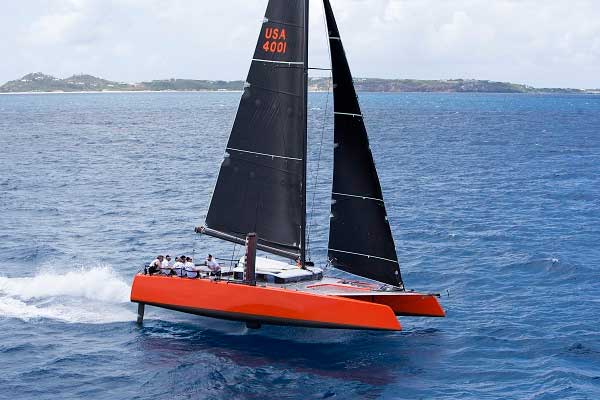
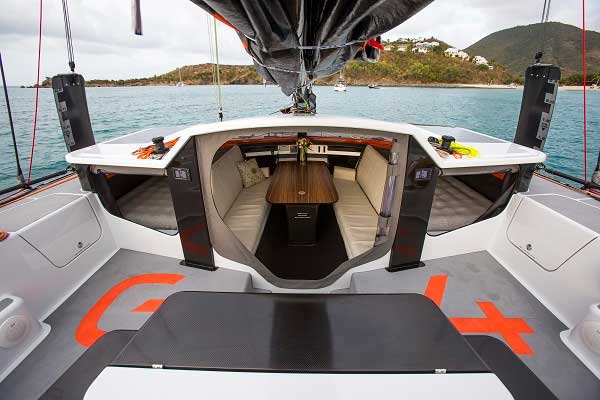
In 2013, DNA/Holland Composites invited independent Netherlands based industrial designer Rudo Enserink to lead a team of sailors and engineers to develop a new 40-foot catamaran from idea to market. What started off as a super sporty coastal cruiser ended a year and a half later as a state of the art, fully hydro-foiling super-fast catamaran with sleeping space for up to 8, a full blown galley and ample storage. ThinkDesign proved to be the perfect design tool to design the Holland Composites build G4.

As foiling technology for racing sailboats is really new, as demonstrated in the 2013 America’s Cup, developing a foiling cruiser with developments happening all over the place requires quite some flexibility from the design toolbox. ThinkDesign CAD provided a solid and flexible environment that could host both the highly advanced surfaces needed for hulls and foils, as well as lots of technical components varying from imported geometry of electric drives and sailing hardware to newly developed hydraulic main sheet control pedals and foil rake adjustment systems.

Enserink sees himself more as a design Swiss army knife than a specialist yacht designer.
Together with composites engineer Pieter Jan Dwarshuis from Holland Composites, they laid out a molding and assembly system that clearly served two goals: to bring the light ship displacement of the vessel down below 3 metric tons without compromising strength and stiffness of the platform, and to have a mold system capable of reproducing various versions of the G4 at industrial speed and quality.
This resulted in a highly complex carbon fiber tooling set that enables fast and effortless assembly. Due to the high surface accuracy and precise manufacturing of the tools and parts, just a bit of filler is needed before the paint job is done.

rudo1

The prepreg carbon and Nomex hull was an immediate success in the Caribbean racing circuit. In both the races of St. Barth and Antigua, the G4 scored very high points against much larger vessels.
Rudo Enserink is delighted with the success of this project. “It was design team member Mischa Heemskerk who kept pushing the hydrofoiling stuff. He’s an amazing sailor with lots of experience converting smaller catamarans on hydrofoils. We took quite a risk when we decided to put her on foils. That happened around half way in to the design process, at a point where the molds for the hulls were already made. I had a feeling this changeover was going to happen so I prepared the mold divisions and deck line in such a way the foiling stuff could be easily placed”.
He explains: “Giving the unique character of this ship it was quite a gamble to tell where the foiling dagger boards were going to be, so we decided to design a very large dagger board case that could hold these boards at three positions, about 30cm apart, enabling us to balance the boat perfectly for foiling without having to open up the hulls. Obviously, keeping control of the design at hand with so many changes and new ideas requires CAD software that can keep up with this.

rudo2

ThinkDesign proved to be pivotal across the development and build of the G4. “On one day I’d be calling the CNC plant who mills the tooling plugs, the naval architect who wants input for his FDM and some systems supplier to get 3D files for importing, while the sales people were asking for renderings to show the prospective buyers” Enserink says. “Time and time again, the ThinkDesign exported 3D files turned out to import into other systems flawlessly, with great continuity control and manifold parts”.

rudo3

The main shape of the vessel is modeled using associative curves and surfaces that are then combined in to solids. This allowed Enserink to set up a model that could easily be changed following the many evaluations yacht design brings about. “As we learned more about the ship we were designing, we needed to make slight changes to the center of buoyancy and bulkhead locations. If I had made the model with fixed surfaces, I would have gone crazy and would probably have caused weeks of delays redoing my work. Because the hull shape is controlled by just a few curves with only 4 to 6 control points each, I could tweak and tweak and the model would update instantly.”

rudo4

Enserink had tasked himself with keeping a modern, racey yet functional look. “I had to fight some battles with the boat people on this. I know how to sail but I was surrounded by people that probably spend more time on the water than on land, and they have their culture of their own. I tried not to blend in too much by doing what everybody does; I kept defining the shape of the yacht with the sailor in mind. Everything and every dimension has a function, and having people move about on the boat comfortably and safely had my top priority. There is very little ornamentation on this boat but I think I succeeded in sculpting something that will have heads turn for years to come.
There is no way in the world I could have pulled this off without ThinkDesign as my trusted CAD!

About Rudo Enserink:
After his graduation from Delft University of Technology as Industrial Design Engineer in the early nineties, Rudo has been designing everything from musical instruments to liquid dispensers and from LED luminaires to A-class catamarans. He has been using ThinkDesign since the CadLab days.
www.enserinkdesign.com

About Holland Composites:
Founded in 1993 by industrial design engineer Pieterjan Dwarshuis, Holland Composites has been steadily growing from a garage shop to one of the largest composites facilities in the Netherlands. Current capabilities include a 6*2,5m autoclave, a 30*6m calibrated glass table and an XXL waterjet cutting machine, alongside an all-star core team of 25 composites professionals. A strong product mix of making industrial specials, building components and sailing crafts, with a strong emphasis on development makes Holland Composites a truly unique tech company.
www.hollandcomposites.nl

Des foils pour Bastide Otio

by Made in Midi

kitoaprilfools

Rassurez-vous je ne suis pas devenu complètement foil ! C’était pour voir si vous suiviez ! BastideOtio conserve ses appendices d’origine!
Kito de Pavant

Voici la blague bien pensé:

bastideotio

Le secret aura été bien gardé pendant tout l’hiver.

Mais l’équipe Made in Midi, dirigée par Kito de Pavant, avait aménagé son programme 2016 avec cette possibilité de décider, même tardivement, de mettre ou de ne pas mettre de nouveaux appendices sur l’IMOCA 60’ Bastide Otio.

Les études ont été menées par un petit groupe d’experts de l’industrie aéronautique, en toute discrétion. L’idée était de faire différemment des autres 60’ équipés de foils en 2015 et d’avoir une réflexion autonome, sans pression aucune. Les ordinateurs et les cerveaux ont chauffé pendant de longues semaines pour aboutir à une solution originale, simple et on l’espère, efficace.

L’équipe de chercheurs, dirigée par Laurent Prunet, a travaillé pour améliorer sensiblement les performances de Bastide Otio aux allures portantes sans dégrader celles-ci face au vent, ce qui peut représenter 30% des conditions rencontrées sur le Vendée Globe.

Il s’agit tout simplement de rajouter des plans porteurs aux dérives existantes, ce qui permet notamment d’utiliser les 2 appendices aux allures portantes pour soulever le bateau et le faire déjauger. Au contraire, lorsque la dérive est remontée, le plan porteur s’encastre dans la coque pour ne pas ralentir le bateau dans le petit temps par exemple où l’on a vu les nouveaux bateaux fortement handicapés.

Laurent Prunet : « Le challenge était particulièrement intéressant. Nous avions carte blanche pour inventer un système original. Notre équipe a beaucoup travaillé pour imaginer plusieurs propositions mais chacune se heurtait à la complexité de la jauge IMOCA et aux contraintes d’un parcours aussi exigeant que le Vendée Globe. La relation avec l’équipe Sixteam a toujours été constructive. Cela restera un excellent souvenir pour nous chercheurs. »

Kito de Pavant : « Il n’y a que les imbéciles qui ne changent pas d’avis !!! C’est vrai que la Transat Jacques Vabre nous avait incités à rester sages pour le prochain Vendée Globe mais l’opportunité de lancer une étude en étroite collaboration avec des experts de l’industrie aéronautique s’est présentée cet hiver. Et les résultats de cette étude nous ont convaincus. Evidemment, cela retarde quelque peu la mise à l’eau du bateau mais nous n’avions de toute façon pas prévu de participer aux transat du printemps…»

Maître CoQ déploie ses ailes

by Maître CoQ

maitrecoq_ailes

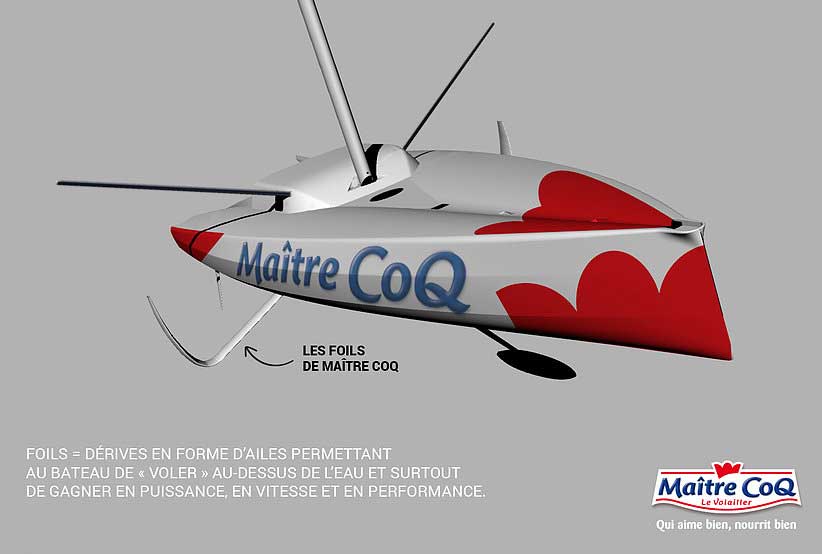
Jérémie Beyou et Maître CoQ se projettent vers le Vendée Globe 2016. Affichant clairement leurs hautes ambitions, ils ont pris la décision commune d’équiper le 60 pieds IMOCA de foils en vue du tour du monde en solitaire. Le bateau entrera au chantier CDK de Port-la-Forêt le 25 novembre.

Jérémie Beyou, Stéphane Sallé, Directeur Général de Maître CoQ, et Philippe Legros, responsable de la performance, nous expliquent les raisons qui ont dicté ce choix et évoquent la collaboration avec le designer néo-zélandais Nick Holroyd, spécialiste des foils sur l’America’s Cup.

Pourquoi avez-vous pris la décision de doter Maître CoQ de foils en vue de la saison prochaine ?
Jérémie Beyou : « Cela fait plusieurs mois que nous travaillons dessus : nous avons commencé par faire un VPP (programme de prédiction de vitesse) précis du bateau dans sa configuration actuelle, puis simulé un autre VPP avec le bateau équipé de foils de différentes géométries. Nous avons ensuite fait tourner ces VPP sur des routages autour du monde, qui n’ont fait que confirmer les chiffres obtenus, à savoir que Maître CoQ avec des foils était toujours plus rapide sur la durée, certains routages donnant jusqu’à cinq jours de différence. Ensuite, nous nous sommes comparés aux nouveaux bateaux mis à l’eau cette année : si, lors des premiers wwws d’août, nous avons été un peu circonspects, ceux de septembre nous ont permis de constater que certains nouveaux bateaux avaient beaucoup progressé, notamment Banque Populaire, tandis que Gitana (Edmond de Rothschild) a été d’entrée de jeu bluffant à certaines allures. »

maitrecoq_bateau

La victoire sur la Transat Jacques Vabre d’un bateau non équipé de foils, a-t-il remis en cause votre choix ?
Philippe Legros : « Non, au contraire, il nous a confortés dans notre décision : vu le contexte, la performance de Banque Populaire (deuxième place) est remarquable : on a bien vu qu’ils (Armel Le Cléac’h et Erwan Tabarly, les skippers) ont volontairement navigué beaucoup plus prudemment que les autres en début de course, ce qui leur a permis d’être le seul des bateaux neufs à passer. Une fois que le vent s’est calmé et que la mer s’est rangée, ils ont pu utiliser leurs foils, et à partir de là, de 40 milles de retard, ils sont passés à 35 d’avance au Pot-au-noir. Le bateau, dans cette configuration, a des capacités d’accélération impressionnantes sur la durée. Ces performances ont donc confirmé nos études et nos observations et je pense que si la course avait eu lieu un an plus tard, Banque Populaire, bien plus fiabilisé, serait arrivé nettement devant PRB. En vue du Vendée Globe, nous avions le choix entre optimiser encore Maître CoQ en faisant notamment de nouvelles dérives ou passer aux foils, Jérémie a été clair sur le sujet : son objectif, c’est de gagner. Ce qui n’est à notre avis pas possible avec des dérives seules. Les différences de vitesse entre les « foilers » et anciens bateaux peuvent aller jusqu’à 3 nœuds au reaching. Sachant que le Vendée Globe est avant tout une course de reaching, les écarts à l’arrivée pourraient se compter en jours. »

Votre abandon sur la Transat Jacques Vabre a-t-il influé sur votre décision ?
Jérémie Beyou : « Nous avions quoi qu’il arrive anticipé, en réservant pour cet hiver Heol Composites et le chantier CDK de Port-la-Forêt pour fabriquer et implanter ces foils ou au minimum des nouvelles dérives. Le fait de ne pas courir la Transat BtoB nous permet de démarrer le chantier plus tôt, donc de naviguer le plus possible avec le bateau en version Vendée Globe. C’est primordial, compte tenu de l’importance des modifications qui nécessiteront beaucoup de temps de fiabilisation, de mise au point et d’optimisation. »

maitrecoq_foil

Avec qui collaborez-vous pour ces foils ?
Jérémie Beyou : « Avec Pierre-François Dargnies, le directeur technique de Beyou Racing qui travaille sur le dossier depuis plusieurs mois, nous avons fait tout l’avant-projet avec Sam Manuard, qui nous a aidés pour les études préliminaires ; ensuite, nous avons souhaité collaborer avec des gens ayant déjà travaillé sur ce type de pièce, à savoir le chantier CDK et Heol Composites, qui a construit tous les foils des nouveaux bateaux, sauf ceux d’Hugo Boss. Au niveau du design, nous sommes allés regarder du côté de l’America’s Cup en faisant appel à Nick Holroyd, que je connaissais de réputation. Il a été « head-designer » de Team New Zealand pendant des années et a donc une très grande expérience dans le domaine du foil, c’est quelqu’un de brillant, un « ultra spécialiste ». Comme il quittait Team New Zealand (il a depuis rejoint SoftBank Team Japan), il a répondu favorablement à ma demande. Il est venu sur le bateau, il a tout de suite vu quels foils il fallait, quelles autres problématiques cela induisait…
Je suis très heureux de collaborer avec lui. Enfin, je vais personnellement m’impliquer dans ce chantier pour m’imprégner de toutes ces modifications. Je vais aussi mettre à profit cette période pour passer du temps avec Maître CoQ afin de préparer au mieux ce Vendée Globe à tous les niveaux. C’est un moment hyper important pour tout le monde, il faut faire en sorte que nous le vivions tous du mieux possible. »

Quelle est la position du partenaire Maître CoQ par rapport à cette décision de faire des foils ?
Stéphane Sallé, Directeur Général de Maître CoQ : « Notre accompagnement aux côtés de Jérémie s’appuie sur plusieurs valeurs fortes : performance, audace, innovation, partage, confiance… L’optimisation du potentiel de l’IMOCA Maître CoQ sur le prochain Vendée Globe passe par ce choix de poser des foils qui représente l’avenir de la course au large. Si Maître CoQ n’avait pas innové par le passé, nous ne serions pas leaders aujourd’hui. L’innovation et l’audace sont les clés de la réussite de Maître CoQ : créer de nouveaux produits qui répondent à de nouvelles envies et se différencier dans un milieu hyper concurrentiel. Il en est de même sur le prochain Vendée Globe qui est l’objectif N°1 de notre programme de sponsoring. »

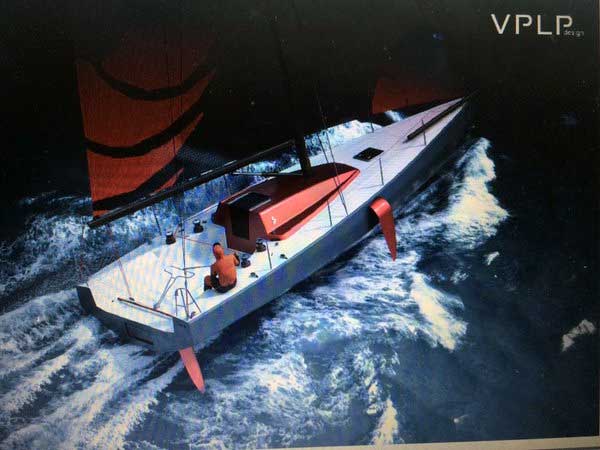
Figaro 3 à foils par VPLP

by Classe Figaro Bénéteau

Le nouveau Classe Figaro Bénéteau III par le cabinet VPLP

Le nouveau Classe Figaro Bénéteau III par le cabinet VPLP

Le Président de la classe Figaro Bénéteau, Yannig Livory, a déclaré:

Les trois cabinets d’architecte ont chacun présenté leur projet. Puis on a fait une réunion à huis clos pour se poser les bonnes questions et avoir des compléments d’informations et que la commission nouveau monotype de la classe Figaro Bénéteau puisse exposer son avis. Suite à ça, on a mis un système de vote en place afin que les adhérents votent. Au final, le choix s’est porté sur le projet VPLP. La prochaine étape, c’est d’entériner ce choix par le comité de pilotage qui se réunit jeudi prochain

Nous avons décidé à l’Assemblée Générale de décembre 2014, de nous pencher sur un nouveau monotype à partir d’un questionnaire établi en janvier de la même année. Nous avons cherché à nous projeter pour savoir quels étaient les fondamentaux à conserver non seulement au niveau du support mais aussi pour les courses et le calendrier. L’Assemblée Générale Extraordinaire de Bordeaux avant La Solitaire 2015 a entériné la collaboration avec le chantier Bénéteau et la date de mise en service de ce nouveau monotype : 2019. Parce que cela donne le temps de la réflexion et de la mise au point, de la construction de cinquante unités, mais aussi parce que ce seront les cinquante ans de La Solitaire… Et on peut espérer comme en 2003, que d’anciens Figaristes reviennent se tester !