Author Archives: Foiling Week

The Flying Phantom chosen for Red Bull Foiling Generation

Phantom International is proud to announce that the Flying Phantom has been chosen by Roman Hagara and Hans Peter Steinacher for the Red Bull Foiling Generation 2015. A global sailing series that kicks off in Japan in April 2015. Below the Double Olympic champions and Red Bull Foiling Generation Sports Directors explain how they search for the world’s best talents and the format of this new sailing series.

“We are looking for the world’s best talents”
If you mix the experience and skills of double Olympic champions Roman Hagara and Hans Peter Steinacher, four brand-new Flying Phantom, regattas in seven countries and the world’s best young sailors then you have Red Bull Foiling Generation, a sailing series that kicks off in Japan in April 2015.

The global sailing series is open to talented sailors aged 16-20 who will be racing the Flying Phantom class innovative catamarans, a spectacular two-person vessel, capable of reaching speeds of up to 35 knots.

“We are looking for the world’s best talents”, said Red Bull Foiling Generation sports director Hans Peter Steinacher, inviting the new generation of sailors to take a step forward.

“To fly above the water with such an 18-foot catamaran gives you a good impression of what it is like to compete in a full-sized America’s Cup catamaran,” said Roman Hagara, double Olympic champion and sports director of the Red Bull Foiling Generation.

The Red Bull Foiling Generation starts in 2015 with seven events in Japan, the UK, Italy, Sweden, Denmark, Russia and France.

The races will usher in a new sailing knockout format with four boats at the start of every race, each distinctly marked with a colour, either, red, yellow, blue or grey.
The top two teams automatically advance to the next round, while the losing pair get another shot at qualifying with a lucky loser round. The draw will be further reduced in the quarter-finals and the last four, with the winner in the final crowned national competition winner.

The winners of their respective national will be invited to the inaugural world final of the Red Bull Foiling Generation in 2016 to compete but not merely for glory and honor.

Right before every event, sailing heroes Hagara and Steinacher will introduce the young sailors to the art of foiling and coach them.

“We are offering outstanding young sailors a unique career path starting on foiling catamarans in the Red Bull Foiling Generation, the Red Bull Youth America’s Cup and the Red Bull Sailing Team competing in the Extreme Sailing Series”, said Hans Peter Steinacher of the fantastic opportunities offered by the new series.

Red Bull Foiling Generation race calendar 2015

17. – 19. April Wakayama / Japan
26. – 28. June Weymouth / United Kingdom
10. – 12. July Malcesine/ Italy
07. – 09. August Malmö / Sweden
04. – 06. September Aarhus / Denmark
25. – 27. September St. Petersburg / Russia
19. – 21. October TBA / France

RedBull Foiling Generation

BAR develop virtual flying machine

From Ben Ainslie Racing

Without cutting edge design and engineering, no one wins the America’s Cup. In pursuit of their goal, the British team has developed their own sophisticated 3D sailing simulator, modelled on those used by the world of motorsport. The virtual flying machine will support the vital link between sailors and designers, creating an important feedback mechanism between the two core parts of the performance team. It also provides an equally important feedback loop within the design team’s optimisation process. The man leading the team behind BAR’s (virtual) flying machine is Dr. James Roche, formerly of McLaren Applied Technologies, where he had worked on the design of the skeleton sled that Lizzy Yarnold used to slide to gold at the Sochi Winter Olympics.

Dr. James Roche – The man behind the Virtual Flying Machine
By Mark Chisnell 

The ground floor of Ben Ainslie Racing’s temporary headquarters has been through several lives in the short time that the team has been there. It started as a boatshed, but the boat-building quickly outgrew the available space and was moved to another facility. Once the dust had been cleared, a sealed, air-conditioned room was built to house the computer servers that power the design team’s thinking and research. Two areas were partitioned off for meeting rooms, as the growing team swallowed the desk space on the first floor. A gym was built, so the sailing team could fit training sessions into busy days, and in one corner…


BAR Foiling Simulator

The simulator links the Sailing Team – who use it for training – and the Design Team

Continue reading on Ben Ainslie Racing

The future of water toys : The Quadrofoil

From windward-islands.net

qf_3-1024x347

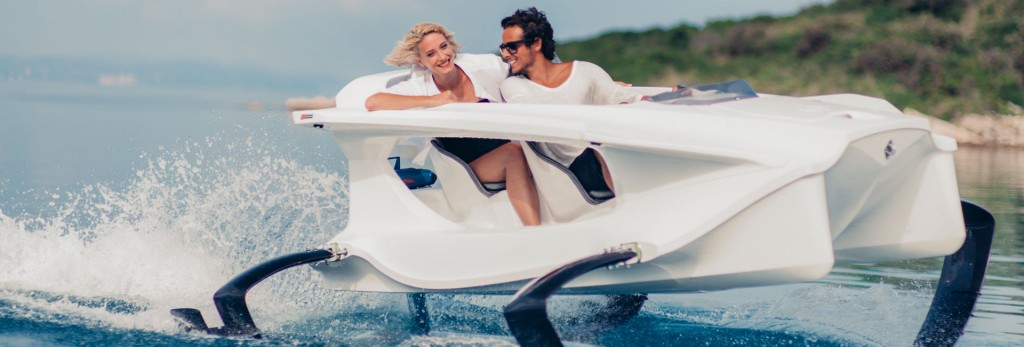
No kidding, forget about your old Donuts, Banana, Seabob, Kayak and Jetski ! The future of water toys is here : The Quadrofoil Watercraft. This electric hydrofoiling watercraft will take your yacht charter vacations to the next level, and will provide you with a brand new thrilling water experience. The luxury water toy Quadrofoil, comes with a futuristic aerodynamic design plus a hydrofoil steering system. And is capable of reaching a cruising speed of 21 knots.

The Quadrofoil Watercraft will be available in two versions :

1The Q2S Electric Limited Edition
(Available only for the first 100 requests, so act fast !)
From 22.500 €, shipping March 201

*Specs :

Height 1213 mm
Seats 2
Length 2990 mm
Speed up to 40 km/h (21 knots)
Width (without foils) 1500 mm
Range up to 100 km
Total width 2500 mm
Batteries 10 KWh
Weight 100 kg
Motor QE 5,5 KW

The Q2A Electric
From 15.000 €, shipping in the second quarter of 2015

Specs :

Height 1213 mm
Seats 2
Length 2990 mm
Speed up to 30 km/h (16 knots)
Width (without foils) 1500 mm
Range up to 50 km
Total width 2500 mm
Batteries 4,5 KWh
Weight 100 kg
Motor QE 3,7 KW

Safran, le premier IMOCA 60’ foil, mis à l’eau!

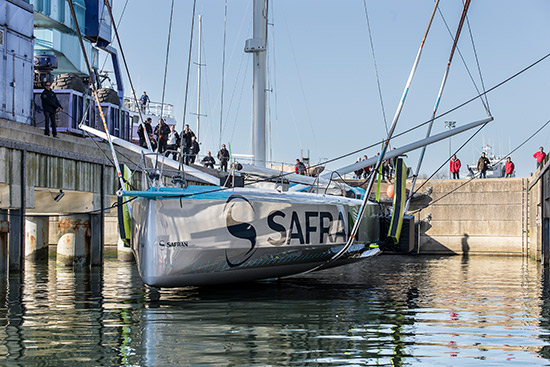
Ce jeudi 5 février à 17h30, au chantier CDK de Lorient, Safran, le nouvel IMOCA 60’ de Morgan Lagravière a été mis à l’eau pour la première fois. Après un an de construction à Port-La-Forêt puis Lorient, le plan VPLP-Guillaume Verdier, premier de la toute nouvelle génération de 60 pieds conçus pour le Vendée Globe 2016, a été dévoilé au public.

Safran IMOCA 60

© DPPI / Jean Marie Liot

La mise à l’eau d’un bateau est toujours chargée d’émotions, surtout quand il affiche des évolutions technologiques notables. « J’ai vécu l’année 2014 comme une année de transition où je me suis plongé dans la construction de mon bateau, tout en rêvant du moment où je pourrais entrer dans la phase d’optimisation et de compétition. Désormais je suis impatient de naviguer à bord de ce bateau, et ce moment arrive à grand pas ! », souligne Morgan Lagravière, skipper du nouveau Safran.
SAFRAN IMOCA 60 a foil

© DPPI / Jean Marie Liot

Un projet de longue haleine, désormais concret…
Depuis 2013, le Safran Sailing Team et les architectes Guillaume Verdier et Vincent Lauriot-Prévost, ont planché sur le projet d’un bateau novateur, répondant à la nouvelle jauge Imoca, avec des performances maximales. Safran affiche ainsi une carène puissante dotée de foils (plan porteur permettant de soulager la coque aux allures portantes et donc de gagner en vitesse), d’un mât aile pivotant très reculé, d’un cockpit au centre de gravité abaissé et d’un volume de coque avant prononcé. « La nouvelle jauge, qui impose à tous les bateaux d’avoir les même quilles et les mêmes mâts (aile ou classique mais standardisés, ndlr), n’a finalement pas été une contrainte, mais sans doute un moyen d’innover encore… Pour ma part, j’ai particulièrement travaillé sur le cockpit. Les deux transats à bord du premier Safran m’ont servi d’expérience », explique Morgan.

© DPPI / Jean Marie Liot

© DPPI / Jean Marie Liot

Marc Guillemot, skipper du premier Safran, a eu un rôle majeur dans le développement du nouvel IMOCA 60’, et a pu apporter son savoir-faire riche de plus de trente années de navigations en compétition sur toutes les mers du globe.« Ce fut deux ans de travail intense mais tellement riche. Je pense que la conception du nouveau Safran n’aurait pas été la même si je ne m’étais pas inspiré de mes expériences. Je me souviens y avoir beaucoup réfléchis lors de la dernière Transat Jacques Vabre. Je suis très heureux d’avoir participé à ce projet… », confie Marc lors de ce moment important.

La mise à l’eau de Safran, qui garde le numéro 25, magnifique luge de 18,28 m de long et de 5,85 m de large, fut un moment intense pour toute l’équipe de CDK et du Safran Sailing Team.

Les mots de Morgan Lagravière : « Je ne m’attendais pas à ressentir autant d’émotions lors de cette mise à l’eau. Je viens de prendre la barre de Safran pour la première fois et j’ai déjà eu l’impression de rentrer en communion avec mon bateau. Cela me procure beaucoup de plaisir pour moi mais aussi pour toute l’équipe qui a construit de magnifique bateau. Je viens de vivre un moment très important dans ma vie de marin ».

Le nouveau Safran en bref :
-La coque est plus large avec une étrave plus volumineuse pour dégager l’avant et garder un équilibre de carène même lorsque le bateau gîte.
-Le bouchain est plus haut pour augmenter la puissance.
-Le cockpit est reculé et abaissé pour une meilleure protection.
-Le mât aile est rotatif avec des outriggers pour une meilleure aérodynamique.
-Les plans porteurs : foils de type « moustache de Dali » pour augmenter la puissance.

Caractéristiques techniques :
DATE DE MISE À L’EAU : Le 5 mars 2015
PORT D’ATTACHE : La Trinité-sur-Mer (Morbihan / France)
ARCHITECTES : Cabinet VPLP et Guillaume Verdier
DÉCORATION : Isabelle Keller
CONSTRUCTEUR : Chantier Naval CDK
LONGUEUR : 18,28 m (60 pieds)
LARGEUR : 5,80 m
TIRANT D’EAU : 4,50 m
MÂT : aile pivotant
GRAND VOILE : 160 m2
GENNAKER : 280 m2
SOLENT : 150 m2
TRINQUETTE : 100 m2

The Gunboat G4 is a Fully Foiling Tesla

From swizzlesportsmedia.com

Gunboat G4

Lots of very smart people have been working to develop and produce a reliable, affordable, effective, and lightweight electric/hybrid electric system to be used on yachts for decades! And I’m not going to bore you with the details of all the electric yacht motors that were launched with great fanfare only to flounder on the rocks of electrical engineering reality. But after spending a large and fascinating chunk of time with Oceanvolt‘s Janne Kjellman (a very smart engineer from Finland), I’m going to make a not so dramatic prediction: These folks have figured it out.

Mastervolt drive

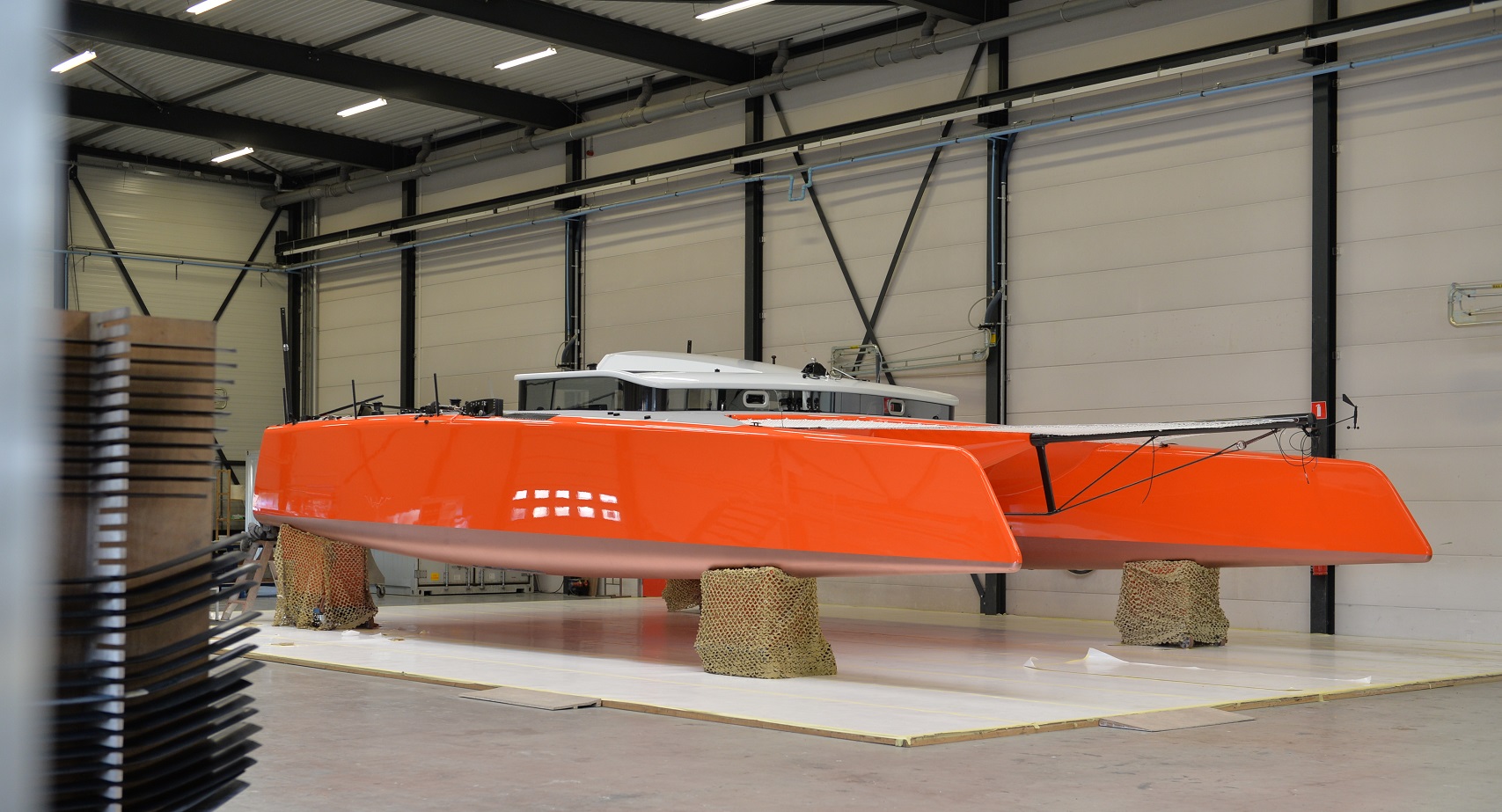
And the groundbreaking Gunboat G4 that’s just about to literally “fly” (it looks fast even on a concrete floor, doesn’t it) out of the Dutch boatyard where it was built is making the most of this game-changing technology. And be sure to watch for the full story of the G4 and other disruptive designs that will be running in an upcoming issue of Boat International.

Continue reading on swizzlesportsmedia.com