The level of satisfaction or achievement on flying an A-class on current foil conf has no par.
Good video to see how dynamic is to sail , and handle foiling while learning, have already better rides than today, but this one is good to see the work involved.
Best sequence at 1:50.
FP ? F20FCS? Those stable flyers out of the box are for ‘rookies’! Don´t waste time and try to learn foiling one of these in current state of development, Historic times and I feel lucky to be a part of it.
It was an informal test after 1 day of launching the FP, no swap of crews for instance. We just tested like 5-6 times during the day upwind and downwind matchups.Video above is unedited 2:18 of upwind which represents the day perfectly.
EDIT: As my good friends crewing the Nacra thought the report was assigning responsibility to them (all the contrary, they had the best handling and best speed of the day as reported) I will simply put that in an informal first test upwind, 12-.14 knots, gusty conditions and some chop, the FP with Gurvan Bontemps as crew won first round.
I’ve been informed that the Youth RB Series Foiling Generation will be only for youths living in the countries where the events are going to be held.
I really don´t get this decision and it is quite far away from …
Without cutting edge design and engineering, no one wins the America’s Cup. In pursuit of their goal, the British team has developed their own sophisticated 3D sailing simulator, modelled on those used by the world of motorsport. The virtual flying machine will support the vital link between sailors and designers, creating an important feedback mechanism between the two core parts of the performance team. It also provides an equally important feedback loop within the design team’s optimisation process. The man leading the team behind BAR’s (virtual) flying machine is Dr. James Roche, formerly of McLaren Applied Technologies, where he had worked on the design of the skeleton sled that Lizzy Yarnold used to slide to gold at the Sochi Winter Olympics.
Dr. James Roche – The man behind the Virtual Flying Machine By Mark Chisnell
The ground floor of Ben Ainslie Racing’s temporary headquarters has been through several lives in the short time that the team has been there. It started as a boatshed, but the boat-building quickly outgrew the available space and was moved to another facility. Once the dust had been cleared, a sealed, air-conditioned room was built to house the computer servers that power the design team’s thinking and research. Two areas were partitioned off for meeting rooms, as the growing team swallowed the desk space on the first floor. A gym was built, so the sailing team could fit training sessions into busy days, and in one corner…
The simulator links the Sailing Team – who use it for training – and the Design Team
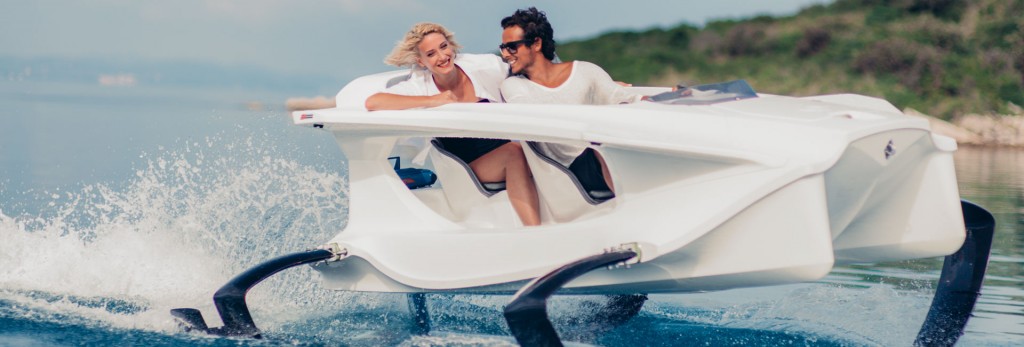
No kidding, forget about your old Donuts, Banana, Seabob, Kayak and Jetski ! The future of water toys is here : The Quadrofoil Watercraft. This electric hydrofoiling watercraft will take your yacht charter vacations to the next level, and will provide you with a brand new thrilling water experience. The luxury water toy Quadrofoil, comes with a futuristic aerodynamic design plus a hydrofoil steering system. And is capable of reaching a cruising speed of 21 knots.
The Quadrofoil Watercraft will be available in two versions :
1The Q2S Electric Limited Edition
(Available only for the first 100 requests, so act fast !)
From 22.500 €, shipping March 201
*Specs :
Height 1213 mm
Seats 2
Length 2990 mm
Speed up to 40 km/h (21 knots)
Width (without foils) 1500 mm
Range up to 100 km
Total width 2500 mm
Batteries 10 KWh
Weight 100 kg
Motor QE 5,5 KW
The Q2A Electric
From 15.000 €, shipping in the second quarter of 2015
Specs :
Height 1213 mm
Seats 2
Length 2990 mm
Speed up to 30 km/h (16 knots)
Width (without foils) 1500 mm
Range up to 50 km
Total width 2500 mm
Batteries 4,5 KWh
Weight 100 kg
Motor QE 3,7 KW
Lots of very smart people have been working to develop and produce a reliable, affordable, effective, and lightweight electric/hybrid electric system to be used on yachts for decades! And I’m not going to bore you with the details of all the electric yacht motors that were launched with great fanfare only to flounder on the rocks of electrical engineering reality. But after spending a large and fascinating chunk of time with Oceanvolt‘s Janne Kjellman (a very smart engineer from Finland), I’m going to make a not so dramatic prediction: These folks have figured it out.
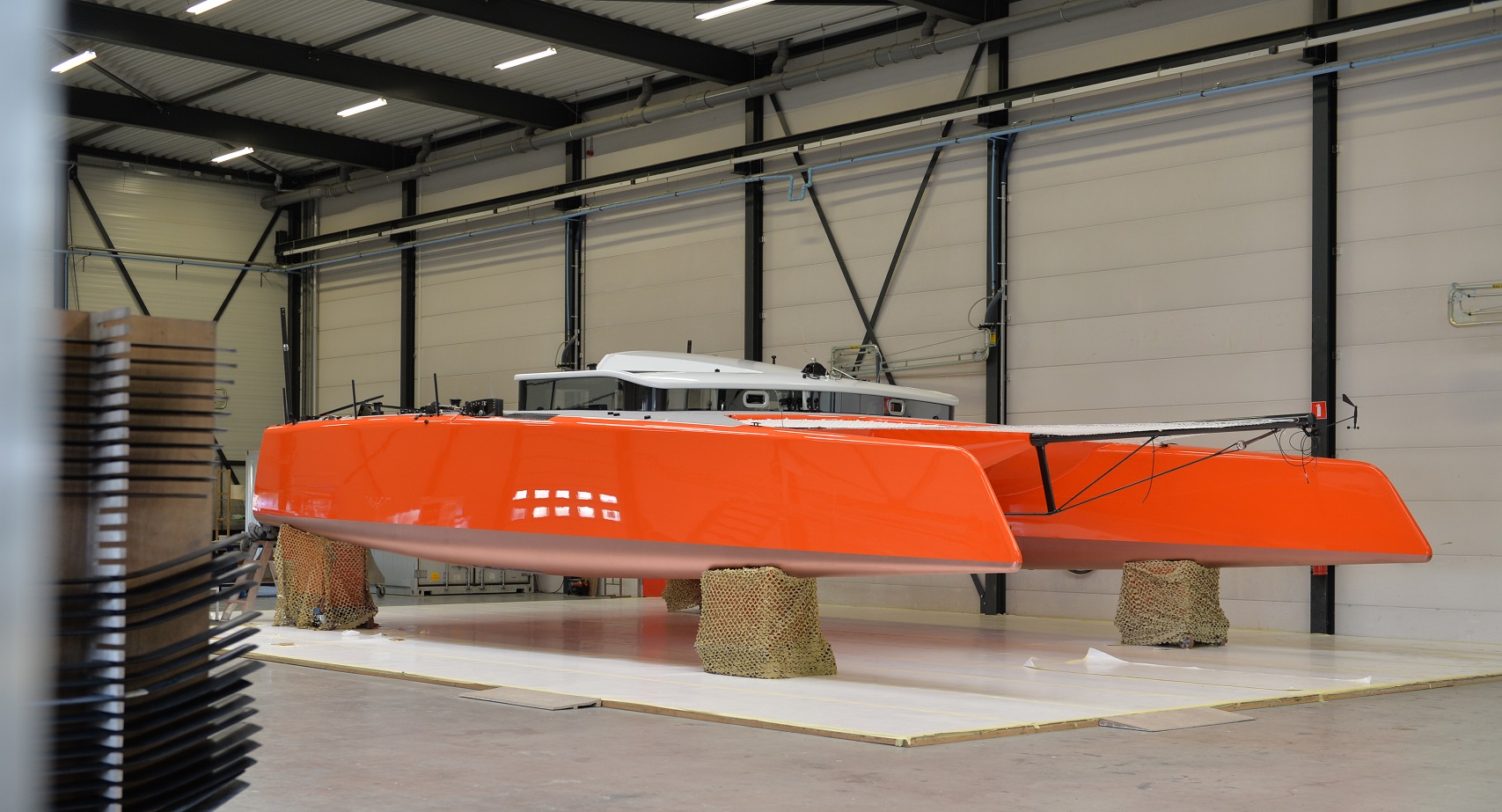
And the groundbreaking Gunboat G4 that’s just about to literally “fly” (it looks fast even on a concrete floor, doesn’t it) out of the Dutch boatyard where it was built is making the most of this game-changing technology. And be sure to watch for the full story of the G4 and other disruptive designs that will be running in an upcoming issue of Boat International.
With the next Little America’s Cup set to be held on Lake Geneva this September a new project has emerged from Montreal.
The Rafale C-class catamaran project was started in autumn 2013 by students at the École de Technologie Supérieure. It’s aim is to design and build a catamaran to compete in the next C-Class Catamaran World Championship.
Supported by Julien Chaussée, a former member of the British C-Class team Invictus and Simon Joncas, a professor at ETS and specialist in composite materials, 20 undergraduate BAcc and MAcc students are working hard to build this cutting edge catamaran.
With an estimated budget of $ 130,000, the C-Class catamaran project is significant to get to the start line in Geneva in September 2015 with a brand new boat ‘made-in Quebec’ . Thanks to partnerships with different companies, who make high quality materials and services available for the team, the boat is schedule to be on the water in the summer of 2015.
The Montreal team intends to be the first ever student team to …
From sailinganarchy.com
” … He stuck new pieces onto existing curved boards. Easy. Perhaps not perfect but a great proof of concept, a critical step in development, and an easy way to learn. … ”
” … Total new expense over his existing boat built in 2011? I don’t know but wouldn’t be surprised if it was less than $1K … ”
A 1st look at the just splashed AC 45 Turbo which splased in San Francisco Bay today,
with all intents and purposes to get her out on her maiden voyage and official begin the
testing phase as the team heads towards defending the Cup in 2017!
This website uses cookies to improve your experience. We'll assume you're ok with this, but you can opt-out if you wish. Cookie settingsACCEPT
Privacy & Cookies Policy
Privacy Overview
This website uses cookies to improve your experience while you navigate through the website. Out of these cookies, the cookies that are categorized as necessary are stored on your browser as they are as essential for the working of basic functionalities of the website. We also use third-party cookies that help us analyze and understand how you use this website. These cookies will be stored in your browser only with your consent. You also have the option to opt-out of these cookies. But opting out of some of these cookies may have an effect on your browsing experience.
Necessary cookies are absolutely essential for the website to function properly. This category only includes cookies that ensures basic functionalities and security features of the website. These cookies do not store any personal information.