Yearly Archives: 2015

March 1972, the first foiling Moth

From moth-sailing.org
Franks Foiler  

By 1970 I had been interested in hydrofoils for some time as a
member of the Amateur Yacht Research Society, and I had made several
successful sailing models. It occurred to me that any high performance
racing dinghy should make a good platform for adding hydrofoils.

frank_foiler1

I had a moth “Renegade IV” which had been Queensland Champion in 1969. The sail
area at less than 82 sq. ft. was smaller than any sailing hydrofoil that
I know of. (And may still stand as a record if you discount foiled
sailboards?)

In adding foils I did not want to modify or ruin the boat so I
utilised existing attachment points for stays and rudder. I did have to
screw the bow foil gantry to the noseblock however.

The configuration I developed was unique – two main lateral
foils, 6′ by about 14″, surface piercing, for lift, stability and
lateral resistance set at about 45deg. dihedral. For steering and pitch
control there were rudders fore and aft with foils. On the aft rudder
was a low-dihedral submerged foil 6″ chord by about 3′ span. The surface
piercing foil on the bow rudder was of somewhat greater span and set at
about 30deg. dihedral. The two rudders were linked so that the lateral
foils were not loaded or unloaded when turning. The linkage could be
adjusted so that (in theory) more or less pressure could be thrown on
the lee foil.

The foils were shaped by hand in the laundry of my Shepparton
unit out of the toughest Australian hardwood I could find. The section
was flat on the bottom with a slight curve up at the leading edge, and
arc of circle on the upper surface. The leading edge was sharp.
Thickness would have been less than 8%.

The first trials at Albert Park Lake and on Lake Glenmaggie were
hopeless (and incidentally everyone who saw the boat strongly affirmed
that foiling would be impossible). The “stick and string” structure was
a bit like a certain brand of collapsible furniture in that nothing held
up until everything was locked in place.
frank_foiler2

The boat could be launched and sailed off a beach in conventional
mode, then in deep water the foils lowered and the centreboard
retracted.

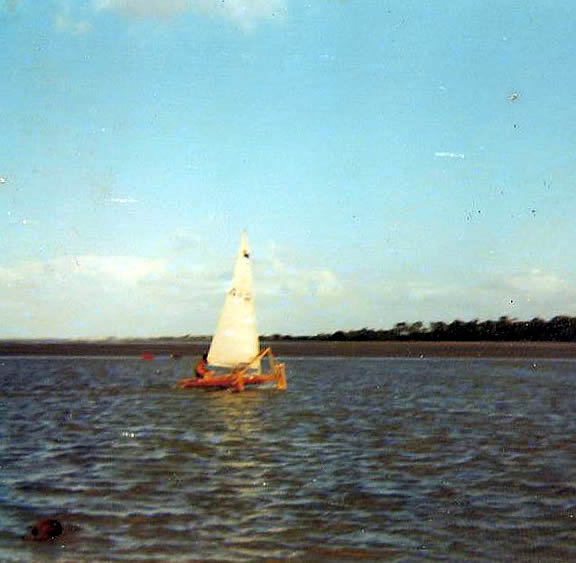
Finally in March 1972, at Cabbage Tree Creek near Brisbane,
Queensland, I achieved lift-off in about 15 knots of wind.

The best thing about it was how easy it all was – it was
absolutely controllable and stable with no vices. Any dummy could have
sailed it, though I think only my mate Tony Turbot ever did. It was he
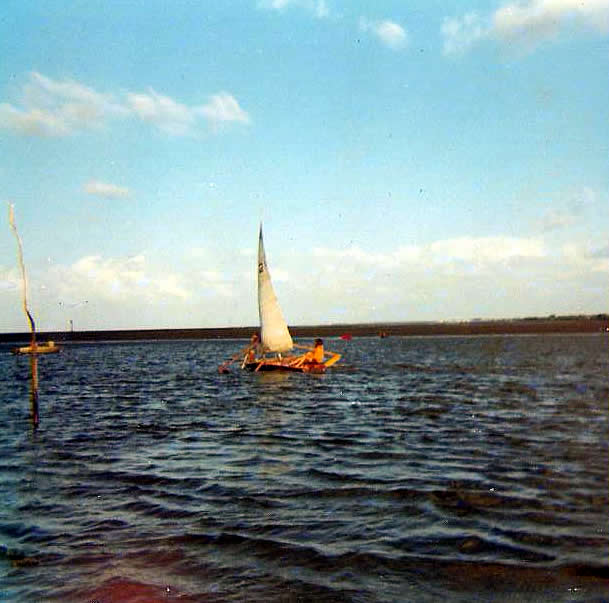
who took the photos with my Box Brownie and his colour camera.
frank_foiler3

On the foils it was about as fast as the Mark II Moth that was
sailing there at the time. Once, as I remember, I almost managed a gybe
on foils. It came down after the sail came across and just before I
could power up on the new tack. I usually gybed because tacking involved
a stern board.

Off the foils it sailed ok but was slower than a sabot.

Its worst feature was its intolerance of even small waves. They
sucked it down off the foils. I eventually bust the bow foil pushing it
in waves. The hardwood bent like a steel spring before it broke.
Thereafter it would not foil – I could only get it to do half-hearted
“bunny hops”.

frank_foiler4

ony bought the boat as I was on my way overseas. The boat
eventually cracked up. The foils I never saw again.

All this is true, so help me God.

P. Frank Raisin (11th. Jan. 2008)

Source post http://moth-sailing.org/franks-foiler/
Foiling in the USA

Foiling in the USA is April 9 at 7pm EST

This is the HOTTEST TOPIC in sailing today and since there has been overwhelming interest in this discussion, Thursday’s talk will be broadcast LIVE with the help of LiveStream producers

LIVE STREAMING HERE

A Q&A will be held with the live audience and a TWITTER Feed will be used to handle questions from viewers around the world

The New York Times correspondent CHRIS MUSELER makes sense of the latest developments
GunBoat founder PETER JOHNSTONE on live SkypeVideo chat about the foiling G4 cruiser/racer catamaran in trials THIS WEEK!

The Foiling Week founder Luca Rizzotti will chime in from Lake Garda to explain the vibe when the world’s top foil designers get together to create the future of the sport

AND contributions from other influential visionaries including radical kite foiler Bryan Lake, Waterlust Project filmmaker Patrick Rynne, US Sailing Executive Director Jack Gierhart and more!!!

It Happens at Doyle Sailmakers This Thursday Night, April 9th 7PM
If you want to come in person drive to Doyle Sails LI,1345 New York Ave.
Huntington Station, NY 11746
We’ll Have Pizza, Bring Your Own:

  • Bottle
  • Folding Chair
  • Slippers for the floor
  • $15 Donation for Chris’s Efforts

Please RSVP to: Info@DoyleSailsLI.com

Does the Cup of the future irrevocably turn its back on its history as a challenger- driven event, conducted in the manner of grand yachting?

A GREAT post By Kimball Livingston on blueplanettimes.com

DC-Time

Does Russell get his catamaran circuit or not?
That is the question.
I mean, the catamaran circuit he really wants, in the long run, even if he has to drag the America’s Cup with it.
It’s a question underlying all the chatter and all the undercurrents and all the dissension surrounding the outlook for America’s Cup 35 at this www of the AC potboiler du jour. And, of course, the vote to move to smaller boats closer to the familiar AC45 model, and to run all of the America’s Cup eliminations in Bermuda.
To lower entry costs and bump up the number of competitors, perhaps one or two from Asia, at the risk of peeling off a couple of, should we say, “minor” teams. Patrizio Bertelli’s Luna Rossa, for example, which threatened to withdraw in such case, and today announced — ta da — they have withdrawn.
No arithmetic, please, or we’ll soon be talking about the plight of Team New Zealand.
DC-TimeThe last time the America’s Cup made as big a … Continue reading on blueplanettimes.com

Loïck Peyron

From americascup.com

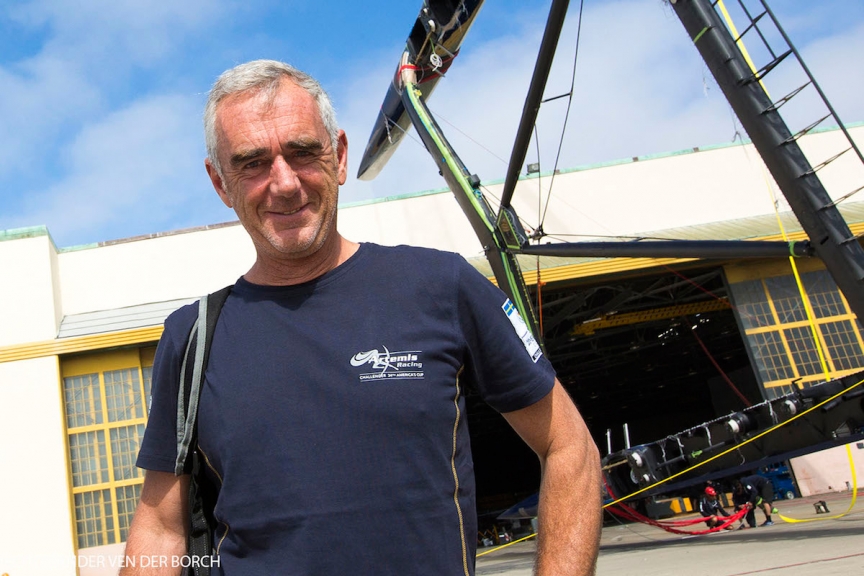
Loick Peyron

You won’t find an America’s Cup sailor with the depth and breadth of experience of Loïck Peyron. From his fully-crewed assaults on the round the world record, to his various monohull and multihull solo exploits, Peyron is a sailor who has done it all.

Now in his second campaign with Artemis Racing, he is nominally listed as a ‘designer’. But the French legend is much more than this, providing a vital link between the sailing and design worlds.

“I’m involved in many areas because that’s my way,” he explains. “I don’t want to be too specialized. That’s what happens when you’ve been a solo sailor as much as I have. You have to know a little bit – and sometimes quite a lot – about everything.”

Peyron counts many years of experience on multihulls, from round the world behemoths, to the old ORMA circuit, to the catamaran that Alinghi designed and constructed for the 2010 America’s Cup. Alinghi 5 was one of the most incredible boats ever built at the time, but it was eclipsed, if only just slightly, by the American trimaran powered by its towering wing sail, which went on to win the America’s Cup for Oracle Racing.

“When you look back, it’s hard to believe that was just five years ago. We have learned so much since then,” he says, thinking back to those boats, which are almost primitive in comparison to what is being tested by the teams today.

“Each time the America’s Cup becomes interested in something, it forces a huge jump as a lot of clever people focus on that area and start pushing the progress. A century ago we can imagine this was happening maybe with winches and aluminum masts. Today it’s foiling.

“The funny thing with foiling is that speed isn’t related to size. In a classic scenario, speed is related to the waterline length of the boat. But the foiling world is absolutely different. Speed is restricted by drag and by righting moment. That’s why a smaller foiling boat can be quite fast compared to a bigger one. That’s why the boats we have today are so much faster than those monster boats we built in 2010, for example. But it all started from there.

“The main reason behind the new class rule is to push the costs down, so there are some one-design elements in new America’s Cup Class. But one area that is free is the appendages and the controls and there is a lot of room to refine and improve here. The main area of importance on this boat is the drag – aero and hydro. So the appendages are so much more important. The small little details in shape and surface are problems we need to solve. Getting this right can make such a big difference.”

Peyron says Artemis Racing designers are already poring over the new class rule, putting their thinking caps on, sharpening their pencils, and figuring out the best approach. He loves it.

“In the America’s Cup you have so much talent across so may areas that the place is always buzzing. It’s a great ambiance. Everyone is thinking all the time on how to make things work better.

“But it’s a fight every day, by the way,” he says, laughing. “Because hopefully, no one agrees. So you have to defend your opinions and test the options and sometimes learn to accept another point of view. But with this process, the best ideas win out and the boat goes a little bit faster.”

And the incredible flying machines continue to evolve; faster and faster.

The real Flying Dutchman

Gunboat-G4-primo-volo-02

A milestone day on the waters of St Maarten. The G4 lifted up on her foils and flew. Top speed was 29.7 knots. A huge thank you to the whole Gunboat G4 development team including the DNA Design Team, including Mischa Heemskerk, Pieter Jan Dwarshuis, and Rudo Enserink, the G4 build team at Holland Composites, including Sven Janssen and Thijs van Riemsdijk, the Hall Spars G4 team including Jacques Swart, Dave Moffat and Ben Hall, and the North Sails G4 team including JB Braun, Kimo Worthington, Jonathan Bartlett and James Allsop. Mostly, we wish to thank owner Eduardo Perez for his belief in this dream, and his unwavering support.

Is downsizing now complete?

From Team Luna Rossa Challenge

bertelli-prada

Luna Rossa announces its withdrawal from the 35th America’S Cup

The result of the vote proposed by the Event Authority with the agreement of the Defender of the 35th America’s Cup has overturned, with a majority vote, the America’s Cup Class Rule for the boat with which this edition will be held; this happened notwithstanding the fact that such rule had been previously adopted unanimously by the teams and was in force since June 2014.

Following a careful evaluation of the serious implications of this unprecedented initiative, Team Luna Rossa confirms that it will withdraw from the 35th America’s Cup.

Team Luna Rossa indeed considers illegitimate the procedure adopted and founded on an evident abuse of process by surreptitious use of procedures to modify the Protocol in order to overturn the Class Rule, which instead requires the unanimity of the teams entered.

This is an attempt to introduce boats that are substantially monotypes and in total contrast with the ultra-centennial tradition of the America’s Cup, not to mention a two-month extension period to introduce further modifications to the rules, decided by the majority.

All of the above contributes to a lack of credibility and uncertain technical grounds for what should instead be the most sophisticated sailing competition in the world.

This radical change also implies a waste of important resources already invested based on the rules that were sanctioned in June last year. This means that the claim to reduce costs reveals itself as a pure pretext aimed to annihilate research and development achievements of some teams, and to favor instead preconceived technical and sporting positions by means of changing the most important element in the competition, the boat.

As a confirmation of this, it is important to underline the fact that Luna Rossa frequently advanced proposals aimed at containing costs that however would not have changed the nature of the boats, but these proposals have systematically been rejected by the Defender.

Team Luna Rossa has also taken into consideration the possibility to protest through the Arbitration Panel as foreseen by the Protocol; it has however noted that, ten months after signing the Protocol, the Defender is only now initiating the first formal procedures to compose this important body. This fact contributes to making the entire governance of the Event even less credible and reliable.

Team Luna Rossa regrets the repercussions that this difficult decision will have on the members of the Team – although it will honor all of its contractual obligations – and on the sailing event planned to take place in Cagliari next June and obviously understands the disappointment of the many fans who have supported Luna Rossa during the last four editions of the America’s Cup.

Patrizio Bertelli declared: “I want to thank the whole team for its hard work during this past year; regretfully this effort has been frustrated by this manoeuvre that is unprecedented in the history of the America’s Cup.

However, in sports, as in life, one cannot always go for compromise, after compromise, after compromise; sometimes it is necessary to make decisions that are painful but must be clear cut, as only these can make everybody aware of the drifts of the system and therefore set the basis for the future: respect of legality and sportsmanship”.

Sir Ben Ainslie on #downsizing

From americascup.com

Ben Ainslie

The Ben Ainslie Racing team has published a story explaining the team’s take on the new rule changes that usher in a new era of the America’s Cup:

The America’s Cup has ushered in a new era this week with the transition to a smaller class of boat. The process of this transition has attracted a lot of attention and we wanted to clarify what’s happened, and BAR’s position on it.

The rule change to introduce a new class of boat was passed by a majority vote of the Competitor Forum, comprising the six teams currently entered in the America’s Cup. Like the other big teams, we have had a design team of more than 20 people working on our AC62 design for many months.

Despite this investment of money and resource, we voted in favor of the change because we believe it is in the best interests of the America’s Cup and the sport of sailing. The class rules has already been published, and the team have already begun the process of examining the new rules and looking for the design, technology and innovation opportunities.

The new boats will be able to achieve speeds of close to 50 miles an hour, far faster than any other current racing series in global sailing, and a match for the 72 foot boats that raced the 34th America’s Cup. The spectator experience and television product will be undiminished, and perhaps even enhanced as the new boats will be much more manoeuvrable and able to engage more closely in the duel that is the America’s Cup.

Read the full story on the BAR website

Downsizing is complete

From americascup.com

The downsizers

The downsizers

The America’s Cup teams have agreed to make changes aimed at significantly reducing costs for the 2017 America’s Cup.

Central to these changes is the introduction of an exciting new America’s Cup Class – a wing-sailed, foiling catamaran between 45 and 50 feet.

“The move to the new America’s Cup Class is a major step forward for the America’s Cup,” said Commercial Commissioner Harvey Schiller, following the vote.

“Collectively, the teams have agreed current costs are neither justified, nor sustainable, and a majority have together taken a sensible course of action to cut costs. I believe this puts the America’s Cup on a firm foundation for today and for the future.”

Crucially, the new class will cost much less over the life of a campaign, with potential savings across design, build and operations, making it a revolutionary cost-saving measure for the sport in both the short and long term.

“The changes being made are to reduce the current costs and complexity which are barriers to new teams wishing to enter the America’s Cup,” said Iain Percy, the team manager for Artemis Racing.

A majority of the current teams favored the new class, with the expectation it will be used in the next edition of the America’s Cup as well, in order to lower the barrier to entry – both technological and financial – to new teams.

Looking towards the future, the new America’s Cup Class will put the event on a path towards economic sustainability. Numerous one-design components will focus the design effort on areas that have an impact on performance, cutting costs significantly, but not diminishing the design challenge.

“The America’s Cup – like Formula One – has to be a design race as well as a race on the water,” noted Ben Ainslie, the team principal at Ben Ainslie Racing. “That has always been part of the Cup’s appeal. That is what attracts some of the world’s best engineers – people like Adrian Newey, who has shown a real passion for the design challenge of the America’s Cup.”

“This wasn’t an easy process,” admitted ORACLE TEAM USA skipper Jimmy Spithill. “The established teams, ourselves included, were well down the path of designing an AC62. But there is a bigger picture to consider. We needed to bring the costs down, but we had to respect the design component of the event as that’s always been one of the biggest challenges in winning the America’s Cup.”

The savings the competitors will realize in this edition of the Cup may spark additional entries, with at least one potential team from Asia expected to challenge and other international teams considering their options.

“To be a global success, the America’s Cup needs to be accessible to the best teams, not just the biggest and wealthiest ones,” said Franck Cammas, the skipper of Team France. “So we must change in this way.”

“While it’s true there are a few critics of this move, we have to adjust to the time. This is a rule that provides the essential of the America’s Cup – the design challenge, the sport, the athletic spectacle – without such a prohibitive cost,” said Olympic medalist Roland Gaebler who has been working to establish a German Challenge. “My focus had been on the next America’s Cup but with these changes we may be able to accelerate that.”

The rule changes were passed by a majority vote of the Competitor Forum, comprising the six teams currently entered in the America’s Cup. An updated Protocol and a new Class Rule will be published this week.

A majority of the teams has also now indicated a preference that all of the racing in 2017 be conducted at a single venue, Bermuda. The America’s Cup Event Authority will consider this in nominating a venue for the America’s Cup Qualifiers.