Hannah White, Land Rover Global Ambassador, has become the fastest person to cross the Channel in a single-handed dinghy. She completed the gruelling task in an International Moth. Starting from Cap de Gris in France, she landed in Dover, England, after crossing the 24 mile English channel in a record time of 3 hours, 44 minutes and 39 seconds.
Hannah, a relative beginner in hydrofoil sailing, only started to learn how to master this unique boat in February. Training for this Channel crossing challenge is a precursor to her ultimate quest: to break the Women’s Speed Sailing World Record over one nautical mile next year in a unique, purpose-built sailing hydrofoil.
A keen adventurer, Hannah has previously sailed the Atlantic solo three times, participated in the gruelling Haute Route Cycle Race across the French Alps and kayaked 205 miles across the rivers of England. She has been a Land Rover Global Ambassador since 2013.
Hannah White said: “I’m much more used to an arduous 3000-mile slog across oceans as opposed to a 24-mile sprint across the Channel, so the transition has been a real eye-opener. Speed sailing requires a very different physiology to long distance races, so this was really an opportunity for me to build my skills over a shorter distance in a hydrofoiling boat”.
Mark Cameron, Jaguar Land Rover Global Experiential Marketing Director said: “This Channel crossing highlights Hannah’s incredible ability to push herself beyond the limits of normal capability. As a global ambassador for Land Rover, Hannah embodies all the characteristics that are so central to our brand; strength, determination and an ability to go above and beyond.”
Hannah will be attempting to break the Women’s Speed Sailing Record over one nautical mile in the first quarter of 2016 in Speedbird, her state-of-the-art, unique hydrofoil sailboat. Land Rover is collaborating in the development of the Speedbird boat, drawing from its unparalleled innovation, engineering expertise and industry-leading facilities to ensure the boat is capable of breaking the current world record.
Hannah will be exhibiting the Speedbird boat at the Cardiff Act of the Extreme Sailing Series™ on the 18-21 June 2015.
When the America’s Cup moved to multihulls, the sight of 72-foot boats foiling on bits of carbon opened the imagination of designers to create more marketable options with foiling technology. Morrelli & Melvin, who helped Team New Zealand get airborne, designed the Nacra 20C FCS as one of the new options.
When John Sangmeister isn’t tending to Gladstone’s Long Beach, a favorite Southern California restaurant of Scuttlebutt editor Craig Leweck, or preparing his chartered Santa Cruz 70 for the 2015 Transpac Race, he is seen flying about in his Nacra 20C FCS. Here he chatted with Craig about his recent acquisition…
I met Don Montague on a seductively fast catamaran in St. Martin earlier this Spring. But it wasn’t until the next day when he returned to the boat with a team of very smart, and very talented guys, and a bonafide boatload of sensors, electronic equipment, computers, cameras, and a crazy-fast chase boat, that it became obvious that he wasn’t just another sailor. In fact, I was soon to learn he’s the world-champion windsurfer who went on to literally help invent kiteboarding with Robby Naish and others. And oh yea, he also helped found a “little” alternative energy company—Makani Power—that was acquired in 2013 by Google and is now part of the Google [x] team that’s working to make widespread clean energy a commercial reality.
Ocean Images/GUNBOAT
But after a fantastic day spent sailing on the turquoise blue waters of Marigot Bay, we didn’t talk about any of that. In fact, what Don and his team have accomplished is pretty widely known in windsurfing and kite surfing circles, so we didn’t need to. Instead, he talked with the clear-eyed passion of a true pioneer about the speed and power that’s possible when you attach an extremely efficient kite and intricate control system (that of course Montague and his team have invented from scratch) to an extremely light and strong hydrofoiling hull (ditto) that’s capable of mind-boggling speeds and precise control.
“Have you heard about the Kiteboat Project?” he asked.
Credit Kiteboat Project
“We use a kite instead of sails for power and the boat we’re testing these days on San Francisco Bay sails pretty comfortably at well over 30 knots. We’re constantly testing and refining and improving. You should come check us out.”
Now, that’s an invite you just don’t get everyday. I was on a plane to San Francisco almost as soon as we returned from St Martin.
Credit Kiteboat Project
Montague and a team of equally inspired inventors have been attaching kites to boats since the mid-1990’s and they have been improving their designs continually since then. They first developed kites to use on surfing canoes and small catamarans. And there are tons of photos and videos of Don and his long-time sailing partner and boat designer Joe Brock punching through huge surf and completing crossings between islands in Montague’s native Hawaii.
Don was simply “holding on” to the kite controls in the early days. Credit Kiteboat Project
They’ve developed countless hull, foil, kite, and control systems that they test in the rugged conditions in San Francisco Bay and the big swells of Hawaii. The boat I sailed on in San Francisco with Don and Joe is the prototype of a much bigger boat that they hope to will be able to sail from California to Hawaii (well over 2,200 miles) in less than 3 days. And for those of you who don’t know about sailing records, that’s simply insane! The current record is well over 5 days. So, what is it like to sail?
Unlike anything I’ve ever experienced on the water.
That’s yours truly smiling with the white sunglasses on. You’d smile too if you were sitting in that seat. Credit Kiteboat Project
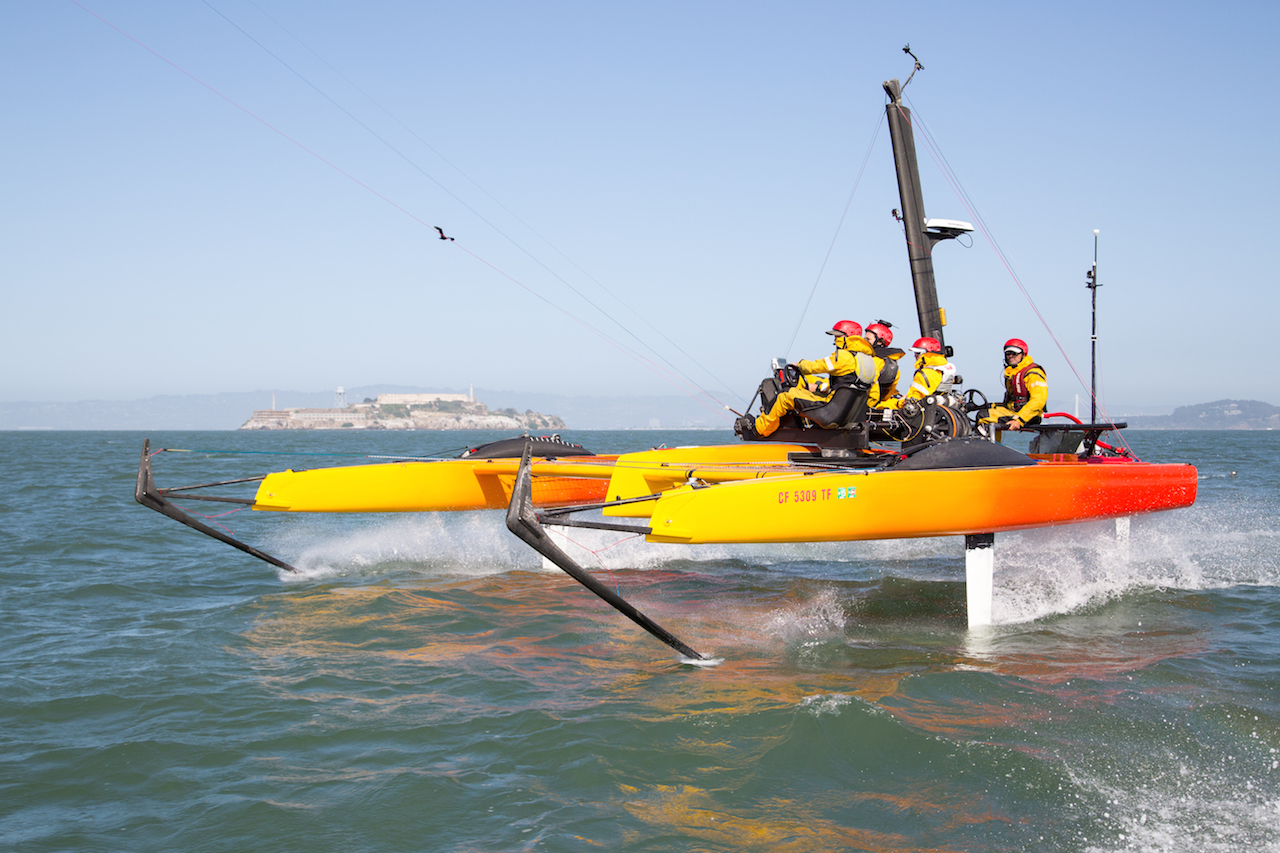
First off, we suited up with high tech gear to keep us dry and helmets equipped with full radio communications so we could talk to each other over the sound of the wind. (To get an idea of the sensation and sound of sailing at over 30 knots, put your head out a car window going 35-40 miles per hour.) Then, after a quick tow from KiteBoat’s dock space in Alameda, Don and Joe launched the kite (letting out the line from the boat’s short mast) and Don controled the kite from his custom-made carbon fiber chair while Joe steered in the seat next to him. Don then simply said “Ready?” dipped the kite down into its “power zone” and we took off faster than any other sailboat I’ve ever been on. The kite literally pulled the boat up on to its foils and the speeds jumped from 10 knots to well over 20 knots almost immediately. The black wands on the bows constantly adjust the foils to keep them at the proper angle to insure level flight through the water, and as you can see in the photos and videos, the entire “control center” (the three side-by-seats) of the boat rotates so that the “kite flyer” i.e. Don in the middle seat is always facing the kite (as opposed to facing where the boat is headed). And the speed? It’s intoxicating. After only spending a few days drag-racing past Alcatraz and under the Golden Gate Bridge with Don and his team, I have a whole new concept of speed. They’re exploring the limits of kite propulsion as we speak, and wait till you see what technological advancements they’re working on now. Already there are reports of computers being able to fly a large kite better than a human can, and soon sailing at 30 knots will be as common as…electricity. Remember Google [x] and the quest for clean energy? Those guys are currently building huge carbon fiber kites/wings (not too far from where Kiteboat is located) that are obviously inspired by Don’s kites, and are reportedly capable of creating a huge amounts of energy at a fraction of the cost and impact of other wind energy systems. And as I can report first hand, kites seem capable of creating more power from the wind than anything else.
When he’s not sailing or pushing a baby stroller all over New England, Bill Springer covers superyachts, offshore adventure, luxury travel, and technology. Follow him on Twitter or LinkedIn.
Back on Rules and to get a more clear position on US Class intentions, we’ve prepared a Q&A with USACA current President, Bailey White, which will address all doubts we might have on this local decision:
What is Rule 8 in the A-Class?
Rule 8 is much like the anti-flying rule that the most recent America’s Cup had. For many years, leading catamaran sailors and designers around the world believed that fully foiling catamarans would not be good racing and that limitations on foil dimensions or foil functionality would ensure catamarans would only partially lift. Partial lifting catamarans and trimarans (typically with curved boards) have proven to be very fast and easy to handle as long as there are lifting surfaces on the rudders too. I have even seen c-board A-cats foil upwind if only briefly.
What we saw with the AC72s and now with our own class is that foiling boats are wonderful to race and sail and that full flying foils can be built within class dimensions. In fact, the flying has added another dimension to the racing and people love it! We are getting more and more people into the class and don’t expect this to slow down no matter what happens with Rule 8.
Can you tell us what you mean that Rule 8 is suspended in the US and Canada?
This is really a misnomer and we should not have used this language. We have voted to let people experiment in our local events. This means that people will be able to race experimental A-Class boats that have boards in from the bottom or boards that are longer or closer together with A-Class boats. These experimental boats cannot win or place in events as an A-Class, but we can all see how they compare and how they develop. We can do something like an asterisk beside their entry in the scoring and do a scoring subdivision for them and prizes as well. We already run other scoring subdivisions by age, gender, and even skill level.
Our mission is to encourage as many boats on the water as possible, and we hope this will be one more way to do that.
So you are still part of the International A-Class?
Absolutely! Our sailors understand future North American Champions will need to have a boat compliant will all A-Class rules.
What is the purpose then of the change?
We had about half of our fleet with foiling capabilities in our recent North Americans and learned basically everyone wants to fly. It just looks so fun, and it is becoming clear that in medium conditions foiling A-cats are faster around the track. People believe that relaxing Rule 8 will let them foil more cheaply and easily as they convert their existing boats to foiling.
Why not just put a proposal together for the next Worlds to vote on?
We are doing this. We are putting together a proposal for other countries to review, and Ben Hall is helping get the right people involved. We felt that by allowing people to experiment now, we would learn more about what is involved in doing boat conversions and be able to speak with a better perspective when we next meet in Italy.
What should people who want to get involved in the A-Class do for now?
Buy a boat! If they can afford a new one, that is the best course of action as they get a boat fully compliant and built for foiling. Control systems, foiling rudders, strong transoms, etc all come with the latest boats and allow someone to get on the water and up and out of it immediately.
If they are shorter on funds or a builder, talk with an existing class member about how they can get involved. In spite of all the interest in flying, just learning the boat and how to sail it to its potential takes some time. Getting an older boat and getting good at trapezing downwind is a great step to take and one that will give tremendous satisfaction.
Either way, we haven’t seen more interest or excitement in the boat in the last 20 years. Please contact me if you would like to get involved at our facebook page: facebook.com/usaclass.
Bailey White
President
United States A-Class Association
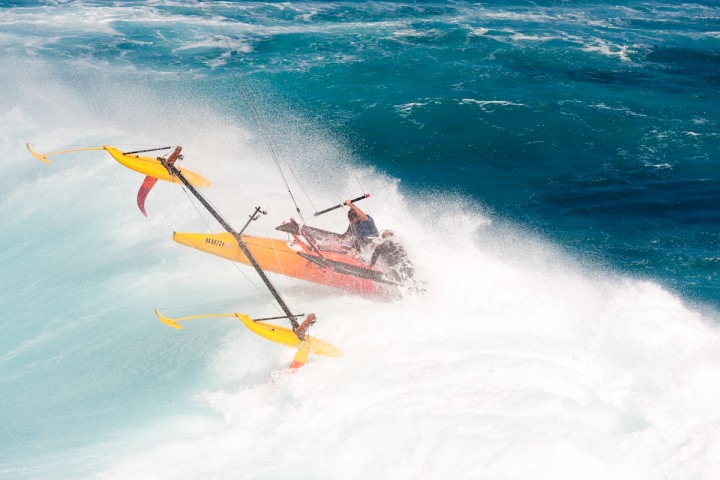
Don Montague and Joe Brock Jumping waves in Maui on the kiting Trifoiler. 16 sqm kite. Helicopter footage by Darrell Wong and Roland Chen. Boat and kite cameras by Don and Joe. Helicopter Pilot: Don Shear. Video by Andrea Dunlap. Music by Yung Sir.
Morgan Lagravière, skipper du tout nouveau monocoque Safran réalise ses premières navigations d’essai en vue de sa préparation pour le Vendée Globe 2016
Sailing Anarchy comment: “The world’s first outward-facing J/foil made its debut last week, and Morgan Lagraviere seems to have the Open 60Safran going pretty well.”
Alinghi have broken the GC32 speed record! Last week, in a training session on Lake Geneva, the team clocked 39.21 knots, well over a whole knot faster than the previous record that was set on Lake Garda in July 2014. Perhaps even more impressive, the top speed is a full five knots faster than the team’s previous personal best of 34.2 knots, set only earlier this year. With such a rapid trajectory, the elusive 40 knot barrier is in sight. Onwards and, indeed, upwards!
ideo highlights and interviews from the final day of racing at the 2015 Japan Moth National Championships. Congratulations to 4-time Moth Nationals Champion, Hiroki Goto!
There was no racing on Day 2 of the 2015 Japan Moth National Championships due to unstable wind conditions. There was however, a cheerleading squad cheering on two rival universities in a traditional teams racing match. Tomorrow (Sunday) is the final day of racing and the forecast is looking good.
This website uses cookies to improve your experience. We'll assume you're ok with this, but you can opt-out if you wish. Cookie settingsACCEPT
Privacy & Cookies Policy
Privacy Overview
This website uses cookies to improve your experience while you navigate through the website. Out of these cookies, the cookies that are categorized as necessary are stored on your browser as they are as essential for the working of basic functionalities of the website. We also use third-party cookies that help us analyze and understand how you use this website. These cookies will be stored in your browser only with your consent. You also have the option to opt-out of these cookies. But opting out of some of these cookies may have an effect on your browsing experience.
Necessary cookies are absolutely essential for the website to function properly. This category only includes cookies that ensures basic functionalities and security features of the website. These cookies do not store any personal information.