From International Moth Class Association
Video highlights from day 1 of the Japan Moth National Championships, hosted in Hayama. Hear from Hiroki Goto and Kohei Kajimoto about their rivalry and other things.


From International Moth Class Association
Video highlights from day 1 of the Japan Moth National Championships, hosted in Hayama. Hear from Hiroki Goto and Kohei Kajimoto about their rivalry and other things.
Vom Neue Zürcher Zeitung
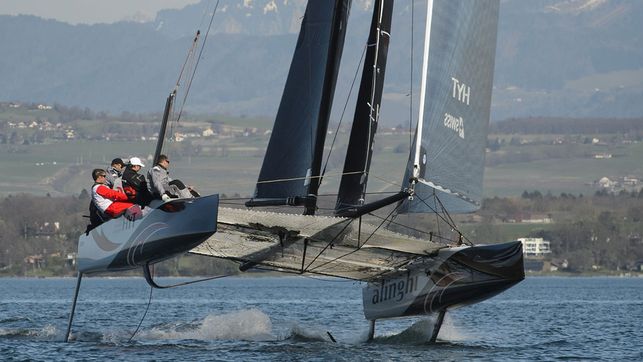
Für Ernesto Bertarelli war es Neuland. Mit den Foils hatte der zweifache America’s-Cup-Sieger und erfahrene Kat-Segler kaum Erfahrungen, als er vor zwei Monaten an einer Test-Regatta auf GC32-Booten in Marseille teilnahm. «Das hat unglaublich Spass gemacht», bilanzierte der Genfer nach der Regatta auf den zehn Meter langen Einheitskatamaranen, den Great-Cup32-Hightech-Booten auf zwei Kufen. Diese junge Bootsklasse ist mit J-Foils und T-Ruder ausgerüstet, bei entsprechendem Wind können sich die beiden Kufen bis zu anderthalb Meter abheben. Dadurch fliegt der Kat förmlich über das Wasser. Die «fliegenden Boote» sind aus dem letzten America’s Cup 2013 bekannt, der von Oracle gewonnen wurde. Die Crew hatte zum Schluss der Regatta den Umgang mit den Tragflügeln besser beherrscht als der Gegner aus Neuseeland.
Fliegende Boote
Im America’s Cup wurden Foils der ersten Generation bereits 2010 eingesetzt. Doch in Valencia stand damals das 70 Meter hohe starre Flügelsegel des Oracle-Trimarans vor allem wegen seiner Grösse im Mittelpunkt. In Bermuda, wo 2017 die nächste Ausgabe des prestigeträchtigsten Segelrennens stattfindet, wird der Flügelmast nur eine untergeordnete Rolle spielen, weil alle Konkurrenten den gleichen haben werden. Bei den Foils jedoch geniessen die Designer eine gewisse Freiheit, und gewinnen wird diejenige Crew, die das Segeln auf den Tragflügeln am besten beherrscht. Verständlich deshalb, dass die Segler der teilnehmenden Teams bereits jetzt auf diversen kleinen Foilern das «Fliegen über dem Wasser» üben.
Im Flugmodus auf kleinen Booten
wr. Ein Foil funktioniert wie der Flügel eines Flugzeugs. Bei genügender Geschwindigkeit erzeugt es Auftrieb, so dass die Bootsrümpfe aus dem Wasser gehoben werden. Dadurch verringert sich der Widerstand im Wasser, die Boots-Geschwindigkeit erhöht sich. Auf geraden Strecken ist das leichter zu bewerkstelligen, schwieriger wird das Foilen beim Wenden und Halsen. Jüngstes Produkt auf dem hart umkämpften Markt der foilenden Sport-Katamarane ist der «Flying Phantom», der für zwei Personen gedacht ist und rund 30 000 Euro kostet. Der Oracle-Coach Philippe Presti bestellte mehrere Exemplare für sein Team. Die Erfahrung beim Folien mit kleinen Booten sei sehr hilfreich. Die Crew würde viel über das Verhalten im Flugmodus lernen.
Mit dem gleichen Boot wird Red Bull für 16 bis 20 Jahre alte Segler, die sogenannte Foiling-Generation, eine Regatta-Serie in sieben Ländern durchführen. Rechtzeitig auf den Foiling-Boom gesetzt hat auch Flavio Marazzi. Seit 2013 segelt er in der GC32-Serie mit, wo er jetzt auf die Bertarelli-Konkurrenz trifft. Der vierfache Olympiateilnehmer aus Bern bevorzugt starke Winde. Verständlich, denn bei Winden unter zehn Knoten bleiben die Rümpfe vollständig im Wasser, und der angestrebte Flugmodus fällt dahin.
Um diese Entwicklung nicht zu verpassen, hat sich Alinghi für die Teilnahme am GC32-Circuit entschlossen, möglicherweise auch im Hinblick auf eine spätere Cup-Teilnahme. Ebenso nimmt Spindrift Racing an dieser Serie teil, der Rennstall, der von Bertarellis Schwester Dona und deren Lebenspartner Yann Guichard geführt wird. «Den fliegenden Booten gehört die Zukunft», sagt der Franzose Guichard zum Engagement von Spindrift. Im Segeln geht die Entwicklung der ersten Hydrofoils, die in der motorisierten Schifffahrt schon seit über einhundert Jahren eingesetzt werden, unter anderem auf die französische Segellegende Yves Tarbaly zurück. Tarbalys Mitsegler Alain Thébaut sorgte 2009 mit dem Hydroptère für Furore, als er den Weltrekord auf Kurzdistanzen brach.
Der entscheidende Durchbruch gelang jedoch in der Moth-Klasse (Motte), die Anfang dieses Jahrhunderts dank den Freiheiten in der Konstruktion die Einführung von Foils ermöglichte. Den Siegeszug traten die Foils danach an, weil sich Oracle in der Entscheidung um den 33. America’s Cup 2010 für ein Mehrrumpf-Boot entschied und sich in Valencia gegen Alinghi durchsetzte. Damit war die Basis für den Katamaran mit Foils als neues Cup-Boot gelegt. 2013 sorgte der AC72 in San Francisco für den spektakulärsten Cup der Geschichte. Die Racer aus Amerika und Neuseeland flogen förmlich über das Wasser und erreichten Geschwindigkeiten von über 80 km/h.
Dank der Weiterentwicklung der Foils könnte der Oracle-Besitzer Larry Ellison seine Vision, den Segelsport der Facebook-Generation näherzubringen, am 35. America’s Cup in Bermuda doch noch realisieren. Die Spitzensegler wollen auf den Rausch der Geschwindigkeit nicht mehr verzichten, und auch der segelnde Nachwuchs ist fasziniert von den Foilern, die in kleineren Versionen Geschwindigkeiten von über 60 km/h erreichen. So ist kaum verwunderlich, dass im Sog der jüngsten Cup-Entwicklung ein regelrechter Foiler-Boom ausgebrochen ist.
Neue Dimension
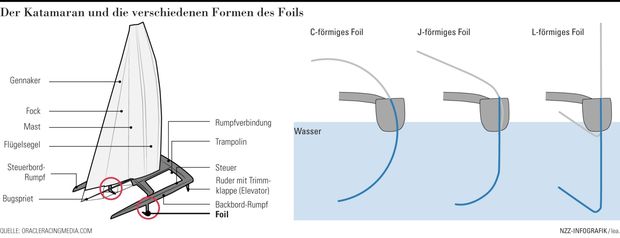
Nils Frei, seit vielen Jahren auf den Alinghi-Booten Segeltrimmer, spricht sogar von einer neuen Dimension im Segeln. «Es ist eine richtige Revolution im Gange, die ich in keiner anderen Sportart beobachte», sagt der Bieler. Möglich sei diese rasende Entwicklung, weil die Foils dank neuster Technologie trotz starker Belastung nicht mehr brechen. Die L-, T- oder J-förmigen Foils seien sehr flexibel geworden. Und man stehe erst am Anfang dieser Entwicklung, in fünf Jahren könnten die Foils noch dynamischer sein und auch punkto Form weit differenzierter.
Der technologische Fortschritt im Segelsport fasziniert Frei. Zusammen mit seinem Mitsegler Yves Detray hat er einen foilenden Kitekat entwickelt. Der Prototyp erregte letztes Jahr an der «Foiling Week» Aufsehen. Neben dem Erfahrungsaustausch gab es in jener Woche auf dem Gardasee auch spektakuläre Rennen zwischen diversen Sportgeräten mit Foils. Die neuste Entwicklung ist bei den Kitesurfern zu beobachten: Sie haben ebenfalls ein Foil unter dem Board montiert. Frei hat sich selber ein solches Brett zugelegt, er prophezeit einen Boom, «weil foilende Kiteboards das schnellste sind, was es gegenwärtig auf den Seen gibt».
Die Entwicklung der Foils-Technologie macht übrigens auch vor den Einrumpf-Booten nicht halt. In der nächsten Vendée Globe, der Weltumsegelung für Einhandsegler, werden 2016 mindestens ein halbes Dutzend Open 60 mit Foils am Start sein. Bei der Minitransat, der Einsteiger-Regatta für Solo-Segler, sind Foils ebenso ein Thema. In beiden Fällen werden die Boote zwar nicht «fliegen» können, sie werden aber schneller durchs Wasser gleiten.
Grosser Traum
Der ultimative Traum der Segler und Designer allerdings ist die Entwicklung eines Mehrrumpfbootes, das die Welt auf Foils in Rekordzeit umsegeln kann. François Gabart, der französische Shootingstar der Branche, spricht punkto Bootsentwicklung von «einer fliegenden Epoche, die vor uns liegt». Er wisse nicht, ob er derjenige sein werde, der als Segler den Rekord-Versuch unternehmen könne. «Aber ich bin sicher, dass es eines Tages ein Boot gibt, das um die Welt fliegen wird.»
America’s Cup: Aufgehende Sonne statt roter Mond
wr. ⋅ Es klang wie eine Drohung. Trotzig reagierte Russell Coutts auf den Abgang des italienischen Challengers Luna Rossa: «Die Japaner werden kommen», sagte der CEO des Cup-Verteidigers Oracle. Nun ist eine Challenge aus dem Land der aufgehenden Sonne akzeptiert. Finanziert wird das Team von Son Masayoshi, einem der reichsten Japaner (Telekommunikation und Medien). Offizieller Herausforderer ist der Kansai Yacht Club, der wohl auf die Dienste von Dean Barker zählen kann. Der langjährige Skipper und Steuermann von Team New Zealand war Ende Februar überraschend entlassen worden. Unterstützt werden die Japaner auch von Defender Oracle, der «technische Hilfe» zugesagt hat. Diese wird, wie beim Team France, sollte diese Challenge zustande kommen, ein Basis-Design-Paket für den neuen 48-Fuss-Katamaran umfassen. Japan war bisher drei Mal am America’s Cup dabei: 1992, 1995 und 2000. Das beste Resultat gelang 1992, als Chris Dickson, später Skipper von Oracle, das Team in die Halbfinals führte. Oracle-Besitzer Larry Ellison ist Japan-Fan, alle seine Jachten tragen japanische Namen.
From Royal Southampton Yacht Club
Royal Southampton honorary member, and Southampton Solent University graduate Geoff Holt, the first quadriplegic sailor to sail solo across the Atlantic, unveiled the University’s latest technological development – an innovation which it claims could change the face of small boat inshore racing.
This year’s PSP Southampton Boat Show will give the industry its first real look at ‘Solent Whisper’ – a 5.9m sailing catamaran with a cutting-edge hydrofoil system.
Designed and built using the state-of the-art yacht design and engineering facilities at Solent’s Warsash Maritime Academy and city-centre campus, the catamaran’s technology has already attracted attention from world-class sailors during sea trials this summer.
The revolutionary new hydrofoil system provides stability, ease and safety, which along with an affordable projected purchase price, has the potential to offer America’s Cup-style sailing to the masses. The craft’s easy and stable sailing style also mean it could prove popular and accessible for disabled sailors.
Primarily designed with ease and safety in mind, Solent Whisper has also exceeded expectations on the speed front. It comfortably achieves over 25 knots and it can ‘fly’ on its foils in as little as five knots of wind.
The new hydrofoil technology is the brainchild of Ron Price, a Solent yacht and powercraft design graduate who is now Senior Lecturer in Naval Architecture at the University’s Warsash Maritime Academy.
The prototype is the result of months of hard work made possible by the technical experience, support and skills from colleagues across the University and the state-of-the-art facilities at both the engineering workshop at the maritime academy and the composites lab at Solent.
“I was very fortunate to have access to the incredible skill and knowledge of the engineering technicians, the support of staff, and use of the superb facilities at the University,” says Ron.”
It is hoped that a retail production version will be available for the London Boat Show in January 2015.
“We are engineering the boat in a way that the design is smart enough to keep the production costs low,” he says.
“I’m hoping that my design ideas will make inshore and small boat racing more accessible and affordable for the average club racer, those who sail for pleasure and people with disabilities,” adds Ron.
Southampton Solent University has a reputation for leading the world in maritime education and technology, and Ron is one of a long line of design graduates who continue to shape the world of sailing including: Jason Ker, working on Sir Ben Ainslie’s GB America’s Cup bid; Guillame Verdier, who designed the yachts that came both first and second at 2012 Vendee Globe; German Frers Jr; Bill Dixon; Ed Dubois; Rob Humphreys; and Juan Kouyoumdjian.
On the sailing-side world-class Solent alumni include: Helena Lucas, who won Great Britain’s first ever sailing gold at the 2012 Paralympics; Paul Goodison who took gold at the 2008 Olympics; and Herve Piveteau who sailed to victory in the Production Boat Class at the Mini Transat 2008, the French equivalent of the OSTAR.
The designer, Ron Price trained at Sandhurst as an Officer Cadet and then spent seven years in the in the Armed forces, before starting his degree in Yacht Production and Design at Southampton Solent University – alongside Paralympic sailing gold medallist Helena Lucas. Following graduation he started his marine engineering career at Rockport Engineering where he was responsible for Design Systems and Composite Engineering. Ron returned to the University as a lecturer on the Yacht Production degree courses, before moving over to Warsash Maritime Academy as a senior lecturer in Naval Architecture, where he currently teaches.
Solent Whisper Quick Facts
What is it that makes this boat special?
The innovative hydrofoil technology makes the boat simple, stable but still fast – you do not need to be a sailing ‘rock star’ to experience performance sailing.
What makes it so stable?
She has an active ride height control which sets the height above the water that each hull flies at.
Why is it so easy to sail?
As she is light the boat is very responsive, with low sheet loads. This combined with the ride height control – acting on both hulls, makes the boat very stable
How does it perform compared with say, a moth or a 49er?
It is substantially faster than a 49er. At present it is not able to match the speed of a moth upwind, but we are working on this. Right now the moth is still very much the benchmark but we are getting close, with the plan being to equal if not exceed the performance of a moth.
Who do you see racing this boat?
It’s a boat for the average club racer and above. The boat is easy to sail in its stable mode, but at the top level expert sailors will be able to tweak the foil set-up to sail the boat more effectively.
What kind of price point do you envisage?
Around £15k
How and where were the hydrofoils designed?
The hydrofoils were designed using Southampton Solent University software.
Where was the boat built?
The boat was built primarily at the University’s Warsash Maritime Academy. The foils were made in the composites lab at Southampton Solent’s city campus.
What sea trials has it been through, and what were the results?
Initial tests were carried out in light winds and flat water, but as we have learnt more we have increased both the wind speed and sea state conditions. The boat has exceeded expectations at each www.
During testing the boat was deliberately allowed to lift out of the water, fall off the foils and launch off a wave, to allow the foil to clear the surface. Like the Americas Cup boats we are making foiling gybes and tacks.
What is the top speed it has achieved?
The boat comfortably achieves over 25 knots.
What are the lightest winds it can foil in?
Take off can be achieved in as little as 5 knots, but with winds of 6 to 8 knots the boat flies comfortably and at speed.
What is the next www of development for the boat?
There are two elements to the development; The University is funding a research project looking at the development of hydrofoils, and at the same time a production boat is being developed to take advantage of ‘smart’ engineering techniques. This will enable the boat to be manufactured in the UK, whilst still keeping the final costs comparable to that of conventional catamarans
When will the boat be available on the market?
The plan is to have a production version available for the London Boat Show in January (2015 NDR).
From americascup.com
Artemis Racing became the first America’s Cup challenger to launch its AC45 development catamaran in Bermuda this week. The Swedish team’s wing-sail foiling AC45 Turbo began sea trials in the Great Sound on Tuesday after being launched from its new temporary base at the Royal Naval Dockyard.
The first two days of sailing provided a real insight into what the team can expect ahead of America’s Cup World Series Bermuda this October, and the finals of the 35th America’s Cup in 2017.
Team Manager Iain Percy said “We were really just out there exploring the course on day one and checking the equipment after it’s journey from San Francisco. Over the last few days we’ve learnt that it is a tricky venue, it’s really shifty and gusty, and further to that, it’s tight. You need to understand the charts, where the rocks are, where you can and can’t go. There will be lots of tacks and gybes, the crew will be working incredibly hard getting the boat through the transitions. It’s certainly going to be a sailors race, which will be great for everyone watching and certainly plays to our strengths”.
From catsailingnews.com By Martin Vanzulli
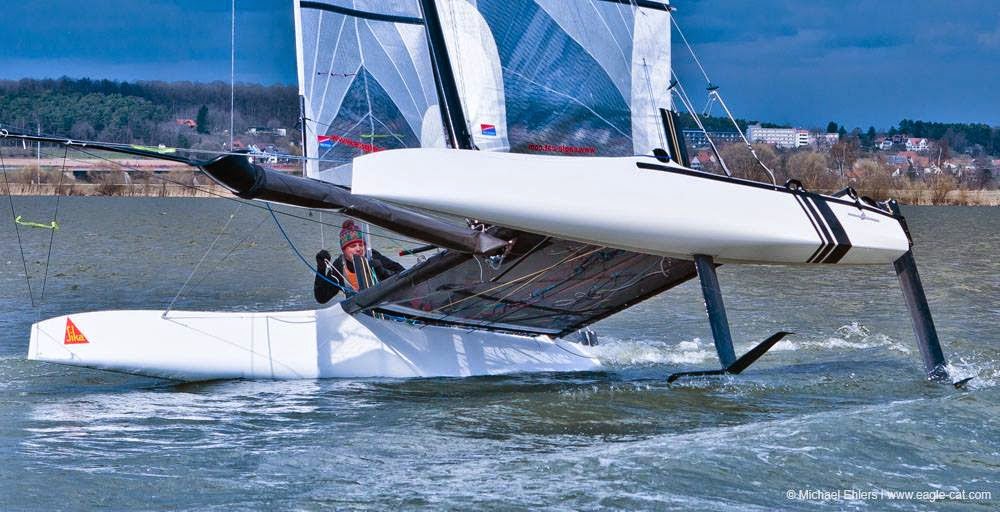
When I told you a new Formula Foiling Class was coming it was no joke or wishful thinking.
Although getting airborne and even final speed does not grant you the meanings to win Course of Long Distance races (Hydroptere, White Dragons, Stunt9 etc) as we’ve been preaching for long time with the new era of beachcat foilers , this is really an impressive nr from the new Eagle 20HF
Above T wing setup being used at the speed session.
The Flying Phantom was the first efficient foiling racing beachcat then followed by the Nacra F20.
Now If this Eagle HF20 system a la Kite/Windsurf foiling kit can be refined to match FP/ Nacra F20 pointing abilities we will see a new paradigm in foil design.
At least it has demonstrated, based on reports, that without a complicated Hydroptere foiling kit it has achieved maybe a speed record for small cats.
What was again the speed achieved by the Moth some time ago?? And this is quite near the GC32s one too.
The Eagle 20HF has reached 36.8knots as reported by the yard through Michael Ehlers.
———-
“Hi Martin
In Germany finally the sailing season started and the conditions improved.
Here an update regarding the 20 HF:
“36.8 knots / 68.15 km/h!….. “Is this a new record for 18-20foot double trapeze multihulls?”
May, 16th. 2015, Altmühlsee, Germany, wind velocity 25 knots, EAGLE 20 HF, half wind, NO Spi, just the regular jib – 5-sqms…
Congratulations to helmsman Timo Späth and EAGLE´s Mastermind Heiner Wolfshoefer…
Michael
Ehlers Media
Kommunikation | Medien | Design
info (at) ehlers-media.com
Chris Draper, Morgan Larson and Yann Guichard from the Bullitt GC32 Racing Tour explain why foiling is entering in a new era of yacht racing.
By rodriquezconsulting.com
Thanks to the Americas Cup and the associated media exposure, it seems that ,at last, the world of leisure boats and yachting is ready to start considering hydrofoil technology as a viable technology. We could not be happier as the Rodriquez family pioneered hydrofoils more than 65 years ago (see History). Indeed, in 1951 when Carlo Rodriquez was building the first commercial hydrofoil for passenger transportation purposes no marine transportation company was farsighted enough to see the future which was being written. Carlo, had to start his own high speed transportation company(SNAV) to prove to his shipyard’s prospective clients that hydrofoils were not a dream but a solid reality. The company was SNAV (Società Navigazione Alta Velocità) and it was effectively raising the bar by an average 20-25 knots in every-day marine passenger transportation.
Read the entire post on rodriquezconsulting.com
From americascup.com
ORACLE TEAM USA became the first America’s Cup team to sail an AC45S boat on the Great Sound in Bermuda.
On Monday, the defending champion of the America’s Cup launched its training boat for the first time and put in over two hours of testing on the future race course of the America’s Cup.
“It’s a real statement to be the first ones out there on the 45-footer and to get a feel for the race course on a boat of this size,” Spithill said. “It can only help to give us an advantage as we come into the race period.”
C-FLY Coastal was launched in 2005 to prove the layout and unique technology of the C-FLY concept. The craft is a 7.6m long catamaran designed to be practical to transport on a road trailer, assemble and sail with three crew. The beam is 5m across the hulls and 8m with the main hydrofoils deployed.
As well as the unique hydrofoil technology, she has pioneered a number of innovative concepts for the hydrofoil lowering and retraction mechanisms, the steering, and the crossbeam layout which includes a central fore and aft beam to stay the rig.
C-FLY Coastal has been used for an extensive programme of sailing trials to further advance and refine the concept as well as hone the practical skills required to sail such a radical craft.
C-FLY Coastal has delivered exhilarating performance and confirmed to the engineering team that the design has achieved the key objectives of stability in open seas, practicality and versatility, combined with breathtaking speed. The confidence gained through this programme takes C-FLY technology to the point of scaling up to the ocean version and application into other areas of high performance sailing.

In 2015, Hannah White will attempt to make history. In a purpose-built, state of the art machine, Hannah aims to not only break the women’s speed record over one nautical mile, but become the first woman to ever set that record above the 40 knot barrier.
To achieve this, Project Speedbird will bring together technological and engineering innovation with Hannah’s determination and physical ability. Every aspect will require intense training and optimisation. Every element pushed to peak performance. The question will be answered: how fast can she go?
The Boat

The design of Project Speedbird will herald a new era in speed sailing, where high tech art meets the science of speed.
A specialist team of the world’s best boat designers, engineers and builders will produce a purpose-built speed machine using the latest technological advances developed by F1, the America’s Cup and Moto GP teams.
The 6 metre boat will be designed to maximise performance over a short, straight distance. The hull will be incredibly light – weighing just 8kg – providing an exceptional power to weight ratio. An advanced, carbon composite foil will lift the aerodynamically (not hydrodynamically) designed hull one metre out of the water. Project Speedbird will literally fly over the water.
