Tag Archives: imoca

Safran suffers leak, situation under control

by safran-sailingteam.com

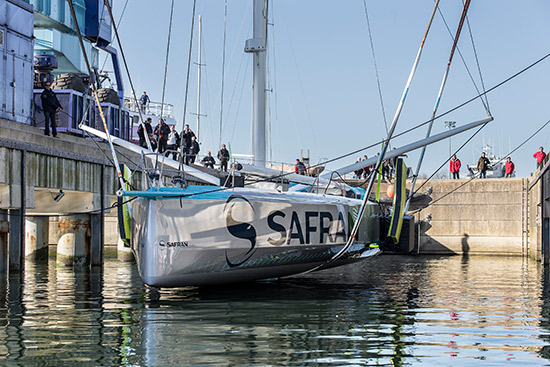
After a good start in the Transat Jacques Vabre, Morgan Lagravière and Nicolas Lunven were forced to turn back home last night. The cause was a crack in the hull at the starboard foil that generated a leak. It is impossible to continue the race in this condition. Contacted this morning, the Safran duo are headed for Brest where they are expected in the middle of the night.

© Jean-Marie Liot / DPPI / Safran

© Jean-Marie Liot / DPPI / Safran

On Monday night at 2020hrs (French time), Morgan Lagravière contacted the race management to inform them of damage to Safran and announce his decision to head back to the port of Brest, in Brittany. Joining by the official race radio this morning, Lagravière detailed the nature of the damage and the circumstances in which it occurred: “The foil area is damaged on the starboard side,” Lagravière said. “The damage has spread around the area and water is seeping into the boat. We quickly tacked to get the damaged section of the hull out of the water. At the time of the incident, the conditions were intense but not extreme. There were 25-knots of wind and 3-4 metres of swell. The sea was not particularly rough and we didn’t hear a particular sound.”

In the wake of Gitana

by Gitana Team

About the Mono60’ Edmond de Rothschild
A 60-foot monohull belonging to the IMOCA class, the Mono60’ Edmond de Rothschild is an on-going project. Announced in January 2014, the monohull will come into being over the course of the summer in 2015 after a year-long build. The designs of this new boat have been entrusted to a duo of naval architects: Guillaume Verdier in association with the VPLP firm. The manufacture will take place on the shores of the Golfe du Morbihan within the Multiplast yard in Vannes, south-west Brittany.

Adhering to the new class measurement in force in the Imoca class since December 2013, the Mono60’ Edmond de Rothschild will be equipped with a one-design keel and mast (identical materials, shapes and suppliers), like all the new boats. These rules were passed at the end of the last Vendée Globe to improve the safety factors and reduce the cost of these incredible machines.

The main races the Gitana Team is targeting with the Mono60’ Edmond de Rothschild are the Transat Jacques Vabre in 2015, The Transat in 2016 and of course the Vendée Globe 2016-2017.

This boat will be the eleventh craft to sport the colours of the Rothschild family and the eponymous financial group since the creation of Baron Benjamin de Rothschild’s offshore racing stable back in 2000.

Why does Safran have foils?

by safran-sailingteam.com

It is the great innovation of the new generation IMOCA 60. And the first monohull equipped with foils to be launched, Morgan Lagravière’s Safran, has led the way; the other five VPLP-Verdier designed boats launched since are also equipped with them. But what is the purpose of these lifting appendages, specially designed with view to the Vendée Globe? Here is the explanation.

© Jean-Marie Liot / DPPI / Safran

© Jean-Marie Liot / DPPI / Safran

“To go fast, a boat must balance lightness with power. These two concepts, often contradictory, can be combined thanks to the foils,” Vincent Lauriot-Prévost, one of the architects, says. “The foils make it possible to create dynamic power and thus lighten the boat. Although lifted, an IMOCA equipped with foils does not literally fly, and is not more powerful, but it sails in a more aerial way, with less wetted surface and therefore less drag. Hence there is a significant gain in speed at certain angles.” Due to the limit of five appendages on the IMOCA (two rudders, a keel, two dagger boards / foils)1, the challenge was to conceive of a geometric solution for achieving a single appendage that could both lift the boat on downwind angles and give control upwind. The research by the architects led to these “Dali moustaches”. The arguments in favour of the now famous lifting appendages that Safran is equipped with, convinced the other teams who had started the construction of new generation IMOCA 60: Banque Populaire, Edmond de Rothschild, Hugo Boss, Vento di Sardegna and St Michel-Virbac. It is also possible that we will see at the beginning of 2016 2 skippers of older generation boats ask the question of replacing their straight dagger boards with foils. “All the competitive teams are interested in them but they are observing, and waiting for the first results before changing everything,” Guillaume Verdier, the other of the boats chief architects, says.

Boats designed for the Vendée Globe

“It’s on downwind angles, and especially when reaching (side-on to the wind), that the theoretical gain is most significant,” Lauriot-Prévost explains. “Strong winds are also favourable: the faster the boat goes, the more the keel and the foils lift and the lighter it gets.” Following a 24-hour sail on board Safran, Verdier agrees: “Downwind, I was also struck that the behaviour of the boat was healthier,” he says. “Thanks to the effect of the lifting appendages, it slams less and the stresses on the structure are reduced.”

On the negative side, the foils do not offer the same surface control of a traditional straight dagger board, meaning there is a handicap upwind, especially in light weather, because they then generate a greater drag. But upwind sailing represents only about 10-15% of the conditions encountered during a Vendée Globe. Thus, the new generation boats are particularly designed for the southern seas where solo sailors normally sail downwind; in strong winds and big seas. “The choice of the foils constitutes risk-taking, but it’s calculated risk taking because we did a lot of studies and routings of the Vendée Globe course.” Quentin Lucet, an architect at VPLP, says reassuringly. On paper, the foils could take two days off the record of 78 days set by François Gabart in 2013. These promising simulations still need to be confirmed on the water.

The Transat Jacques Vabre, a full-scale test

As we see, the performance of the new IMOCA 60 is subject to weather conditions. That is why the architects and the sailors are careful not to draw too hasty conclusions. The races held so far (the Record SNSM, Artemis Challenge and Fastnet Race) were certainly to the advantage of the most optimised older generation boats (PRB, SMA, Quéguiner – Leucémie Espoir). But these events took place on short courses and generally in 10-15 knots of wind, conditions far from representative of a round-the-world race. “We’re in the middle of understanding the foils,” Lucet says. “The IMOCA rules forbid dynamic adjustment of the incidence of foil. We must find the best compromise to increase performance when reaching and reduce the deficit on upwind angles. These are very fine calibrations and adjustment that will, hopefully, increase the effectiveness of the foils, and thus make the boats more versatile. We’ve seen some really promising phases, and we have to continue sailing to refine their use.” Safran will serve as a sort of “floating laboratory” on the Atlantic and at the end of the Transat Jacques Vabre we will know a lot more about the behaviour of foils and their effectiveness.

1 The limitation imposed by IMOCA: http://www.imocaoceanmasters.com/pages/the-boat

2 At the request of the teams that have built new IMOCA, VPLP and Guillaume Verdier signed an exclusive contract and are committed to not work on older generation boats in the development of foils. In January 2016, the architects will be released from this clause and will be able to collaborate with existing IMOCA skippers who choose, or not, to replace their straight daggerboards with foils.

 

Flying 60′ Edmond de Rothschild by VPLP for Team Gitana

by Gitana Team

Launched on 7 August in Vannes, after an eleven-month build at the Multiplast yard, le Mono60 Edmond de Rothschild was able to put in her first tacks just ten days later offshore of the team’s base in Lorient. However, on Monday of this week, thanks to a boisterous low off the north-west tip of Brittany, Sébastien Josse and Charles Caudrelier (his co-skipper for the Transat Jacques Vabre) opted to trial the machine in some blustery conditions. It proved to be a rather bracing sail which photographer Thierry Martinez and cameraman Christophe Castagne captured in full for Gitana Team.

It’s been a very studious summer for Gitana Team! Indeed, the whole of the team fitted out by Baron Benjamin de Rothschild has been working flat out in a bid to complete the build and, on 7 August, ensured the success of the launch of this latest addition to the Gitana saga: the Mono60 Edmond de Rothschild. Delivered from Vannes to nearby Lorient immediately afterwards, the latest generation 60-footer went on to have her keel and mast stepped before undergoing a series of tests to check her compliance with the IMOCA class measurement. On 17 August, Sébastien Josse and his men were finally able to cast off and get a first taste of helming this new steed.

At the start of this week, on Monday 24 August, the weather reports announced that a particularly active and deep low was set to roll across Brittany, dishing up 28 to 35 knots of north-westerly breeze accompanied by a 2.5 to 3-metre swell! Sébastien Josse and Charles Caudrelier saw it as the perfect opportunity to validate the Mono60 Edmond de Rothschild’s performance in blustery conditions: “It was really interesting to get a chance to sail in these boisterous conditions on what was only our 3rd outing! Our current phase is all about discovering and breaking-in the boat. Even though this type of sailing is giving us some positive signs as to how the boat handles, these outings are just sprints for now so they’re much too short to draw any real conclusions from them. We’ll have to wait till the finish of the Transat Jacques Vabre for that. The very demanding 5,400-mile course (nearly quarter of a round the world circuit) offered up by this double-handed transatlantic race serves as a fantastic trial run,” explained the skipper of Edmond de Rothschild.

With a little less than two months till the start of the Transat Jacques Vabre, which sets sail on 25 October from Le Havre, the pace is picking up. Indeed, to stand a chance of being ready to set sail for Brazil, the Edmond de Rothschild duo has a very tight schedule to stick to. In this way, the training sessions will intensify, notably including a 1,000 nautical mile qualifier aboard the new boat, and every opportunity for time on the water will be exploited to the full as Sébastien Josse stresses: “The Transat Jacques Vabre is tomorrow! As a result there’s no time for deliberation. If we get a chance to go sailing, we’re going.”

Premières navigations de nouveau Safran, le premier IMOCA a foils

From VendeeGlobeTV

Morgan Lagravière, skipper du tout nouveau monocoque Safran réalise ses premières navigations d’essai en vue de sa préparation pour le Vendée Globe 2016

Sailing Anarchy comment: “The world’s first outward-facing J/foil made its debut last week, and Morgan Lagraviere seems to have the Open 60Safran going pretty well.”

Safran, le premier IMOCA 60’ foil, mis à l’eau!

Ce jeudi 5 février à 17h30, au chantier CDK de Lorient, Safran, le nouvel IMOCA 60’ de Morgan Lagravière a été mis à l’eau pour la première fois. Après un an de construction à Port-La-Forêt puis Lorient, le plan VPLP-Guillaume Verdier, premier de la toute nouvelle génération de 60 pieds conçus pour le Vendée Globe 2016, a été dévoilé au public.

Safran IMOCA 60

© DPPI / Jean Marie Liot

La mise à l’eau d’un bateau est toujours chargée d’émotions, surtout quand il affiche des évolutions technologiques notables. « J’ai vécu l’année 2014 comme une année de transition où je me suis plongé dans la construction de mon bateau, tout en rêvant du moment où je pourrais entrer dans la phase d’optimisation et de compétition. Désormais je suis impatient de naviguer à bord de ce bateau, et ce moment arrive à grand pas ! », souligne Morgan Lagravière, skipper du nouveau Safran.

SAFRAN IMOCA 60 a foil

© DPPI / Jean Marie Liot

Un projet de longue haleine, désormais concret…
Depuis 2013, le Safran Sailing Team et les architectes Guillaume Verdier et Vincent Lauriot-Prévost, ont planché sur le projet d’un bateau novateur, répondant à la nouvelle jauge Imoca, avec des performances maximales. Safran affiche ainsi une carène puissante dotée de foils (plan porteur permettant de soulager la coque aux allures portantes et donc de gagner en vitesse), d’un mât aile pivotant très reculé, d’un cockpit au centre de gravité abaissé et d’un volume de coque avant prononcé. « La nouvelle jauge, qui impose à tous les bateaux d’avoir les même quilles et les mêmes mâts (aile ou classique mais standardisés, ndlr), n’a finalement pas été une contrainte, mais sans doute un moyen d’innover encore… Pour ma part, j’ai particulièrement travaillé sur le cockpit. Les deux transats à bord du premier Safran m’ont servi d’expérience », explique Morgan.

© DPPI / Jean Marie Liot

© DPPI / Jean Marie Liot

Marc Guillemot, skipper du premier Safran, a eu un rôle majeur dans le développement du nouvel IMOCA 60’, et a pu apporter son savoir-faire riche de plus de trente années de navigations en compétition sur toutes les mers du globe.« Ce fut deux ans de travail intense mais tellement riche. Je pense que la conception du nouveau Safran n’aurait pas été la même si je ne m’étais pas inspiré de mes expériences. Je me souviens y avoir beaucoup réfléchis lors de la dernière Transat Jacques Vabre. Je suis très heureux d’avoir participé à ce projet… », confie Marc lors de ce moment important.

La mise à l’eau de Safran, qui garde le numéro 25, magnifique luge de 18,28 m de long et de 5,85 m de large, fut un moment intense pour toute l’équipe de CDK et du Safran Sailing Team.

Les mots de Morgan Lagravière : « Je ne m’attendais pas à ressentir autant d’émotions lors de cette mise à l’eau. Je viens de prendre la barre de Safran pour la première fois et j’ai déjà eu l’impression de rentrer en communion avec mon bateau. Cela me procure beaucoup de plaisir pour moi mais aussi pour toute l’équipe qui a construit de magnifique bateau. Je viens de vivre un moment très important dans ma vie de marin ».

Le nouveau Safran en bref :
-La coque est plus large avec une étrave plus volumineuse pour dégager l’avant et garder un équilibre de carène même lorsque le bateau gîte.
-Le bouchain est plus haut pour augmenter la puissance.
-Le cockpit est reculé et abaissé pour une meilleure protection.
-Le mât aile est rotatif avec des outriggers pour une meilleure aérodynamique.
-Les plans porteurs : foils de type « moustache de Dali » pour augmenter la puissance.

Caractéristiques techniques :
DATE DE MISE À L’EAU : Le 5 mars 2015
PORT D’ATTACHE : La Trinité-sur-Mer (Morbihan / France)
ARCHITECTES : Cabinet VPLP et Guillaume Verdier
DÉCORATION : Isabelle Keller
CONSTRUCTEUR : Chantier Naval CDK
LONGUEUR : 18,28 m (60 pieds)
LARGEUR : 5,80 m
TIRANT D’EAU : 4,50 m
MÂT : aile pivotant
GRAND VOILE : 160 m2
GENNAKER : 280 m2
SOLENT : 150 m2
TRINQUETTE : 100 m2

An IMOCA fitted with foils

From sailingscuttlebutt.com

Second in the last two editions of the Vendée Globe, Armel Le Cléac’h has given himself the means to win the next race with his new 60-foot IMOCA Banque Populaire VIII, which is now into the final www of her construction. Packed with innovations, the VPLP/Verdier designed boat will be fitted with foils. After her launch planned for March, Armel Le Cléac’h will be tested in the 2015 Transat Jacques Vabre which he will race double-handed with Erwan Tabarly.

Read the entire post on sailingscuttlebutt.com

Leçon de foils par VPLP Design

From VPLP Design

imoca vplp

Dans la classe IMOCA, le passage aux foils s’inscrit dans un courant logique. Une première évolution a été de mettre du “tilt” sur les quilles (axe de rotation de quille angulé par rapport au plan de flottaison du bateau, typiquement des angles compris entre 4 et 9° avec les nouvelles quilles standard IMOCA) , permettant de créer un angle d’attaque sur la quille et donc de soulager le bateau. La conséquence directe de cet angle de “tilt” est de perdre du couple de redressement, car la force s’exerce au vent. La continuité de cette démarche a été de travailler sur les foils pour regagner le moment de redressement perdu par la quille en continuant à alléger dynamiquement les bateaux (plus les bateaux vont vites, plus la quille et les foils portent et plus le bateau s’allège et va vite) …

Continuer à lire environ VPLP Design

Gordon Kay présente ses foils pour monocoques IMOCA

dss-L imoca

DSS-L 2.0

Dynamic Stability Systems se réjouit de la décision d’IMOCA de ne pas ajouter de restrictions à sa classe. Cela permettra aux six nouveaux IMOCA 60 actuellement en construction, ainsi qu’à la flotte existante d’être pourvus des foils latéraux promus par DSS depuis une décennie. Les foils ont déjà été installés sur des voiliers de performance d’Infiniti à Quant, et ont aussi aidé le maxi Wild Oats XI à sa victoire l’an dernier lors de la course Rolex Sydney Hobart.

Read the entire post on seasailsurf.com

Here a video showing DSS 1.0 application on commercial boats

Des foils sur les IMOCA ? Les explications de Jean Kerhoas

From Vendée Globe official website

alex thomson hugo boss imocaL’Assemblée Générale de l’IMOCA s’est tenue hier, mercredi 15 octobre, à Nantes. Deux décisions importantes y ont été prises : les appendices porteurs (foils) ne seront pas interdits et on ne changera plus la règle d’ici la fin du prochain Vendée Globe. Il y aura donc bel et bien des foils sur les prochains bateaux. Interview du Président de la classe, Jean Kerhoas…

read the entire post on vendeeglobe.org