Author Archives: Foiling Week

New Yacht Technology Off to a Rough Start

On New York Times by Chris Museler

Armel Le Cléac’h’s Banque Populaire VIII is one of the new VPLP-Verdier boats, considered the most complex monohull sailboats ever built. Credit Transat Jacques Vabre

Armel Le Cléac’h’s Banque Populaire VIII is one of the new VPLP-Verdier boats, considered the most complex monohull sailboats ever built. Credit Transat Jacques Vabre

The last place the British sailor Alex Thomson expected to be last week was lying on the ceiling of his new racing yacht in the North Atlantic.

With the Vendée Globe, the premier solo round-the-world race, starting in a year, Thomson was testing a new generation of innovative hydrofoils in the 5,400-mile Transat Jacques Vabre from Le Havre, France, to Itajaí, Brazil.

The double-handed race, which started Oct. 25, featured several first-of-their-kind 60-foot yachts, known as Imoca 60s, designed by Guillaume Verdier and VPLP Design.

Four days after the start of the race, Thomson and his Hugo Boss crewmate, Guillermo Altadill, had to be rescued off the tip of Galicia, Spain, with their boat dis…

Continue reading on New York Times

The US Garage Band vs. The World

by Chris Museler

“OK, someone has to take a picture and send it to our hosts as a thank you gift,” shouted Anthony Kotoun, the Dali Lama of the US Moth fleet at dinner a few nights ago. “Then we have to shanghai Zack Maxim’s boat from the shipping company. There’s a $200 prize for anyone willing to wake up at 6 a.m. tomorrow for the 1.18-hour drive…” And the list rolled on that way until our beers and grilled oysters were delivered.

cm01

November US Moth Training Camp, Neuse River, NC

It was a pretty spendy call to take a week from work and family and head to the Neuse River in North Carolina for a training session in the outrageously quick and touchy Moth. The US fleet was offered rooms and a launch at Steve and Heidi Benjamin’s compound on this enormous estuary of brackish water and oyster fishermen.

The major selling point? A $10,000 prize, of course! Amlin International Moth Regatta in December has hand-selected the best sailors in the world to bring their personal, single-handed boats to Bermuda and race for not only a prize purse but bragging rights. You see, all the top America’s Cup teams (with the highest paid sailors on the planet) have fleets of Moths for their sailors to train with. And the Royal Yachting Association has sponsored elite Mothies from the UK for a few years now to top this influential class. They all want to beat the crap out of each other on their own terms, with their own boats. Trimmers wanting to take races off their Cup helmsmen, etc.
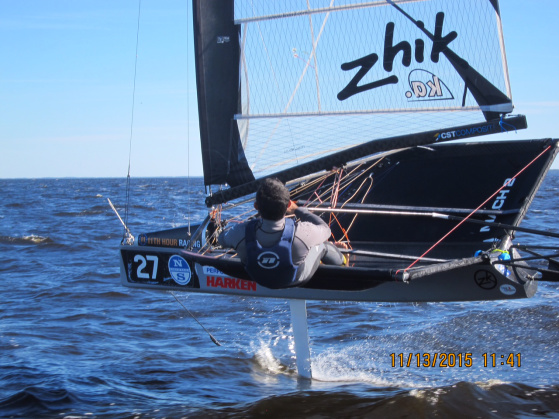
Victor Diaz de Leon, nearing 30 knots downwind, Neuse River, NC
Victor Diaz de Leon, nearing 30 knots downwind, Neuse River, NC

cm03

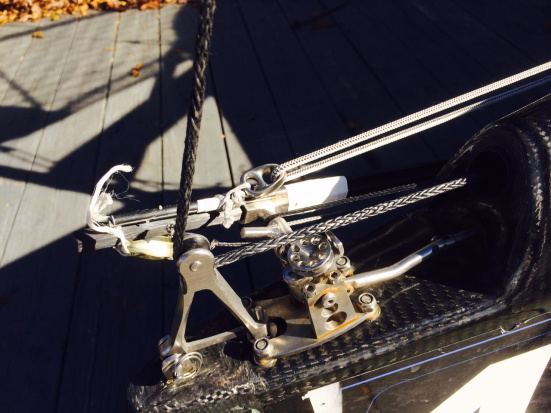
3-D Printed adjustable forestay fitting by Nat Shaver

Then there are the Americans, last week layered in wetsuits during the day getting ripped off their trampolines and hucked into the brown water of the Intercoastal Waterway when the chop would pitch the boats while they were hitting 30 knots. Strangely absent from many of the Cup teams and only supported by the environmentally forward thinking 11th Hour Racing, this group of pro and amateur sailors have been covered in carbon dust and resin every week for the past season adjusting, designing, 3-D printing and training their way toward their goal of out sailing the privileged group in Bermuda.

Last week was my chance to witness how the DIY approach to boat work and training can get someone ready to beat the most well paid, and funded, teams in the world. Very American!

Mach2 Moth box always doubling as work bench

Mach2 Moth box always doubling as work bench

The routine has been the same for this group since the frigid mornings of last April in Newport, the fleet’s summer home. Boat work at night and hours of training during the day to test new systems. North Carolina was a hyper-focused version of this system. Late the other night, Nat Shaver, who designed foils for Team New Zealand in the last Cup and is now working with the French Cup Team was jamming on one of his many carbon fixes since the training camp began.”It’ll be so shitty and ugly,” he said, after using a dremel to grind off the broken bits at the end of his homemade boom, “but it’ll do the job, I think.”
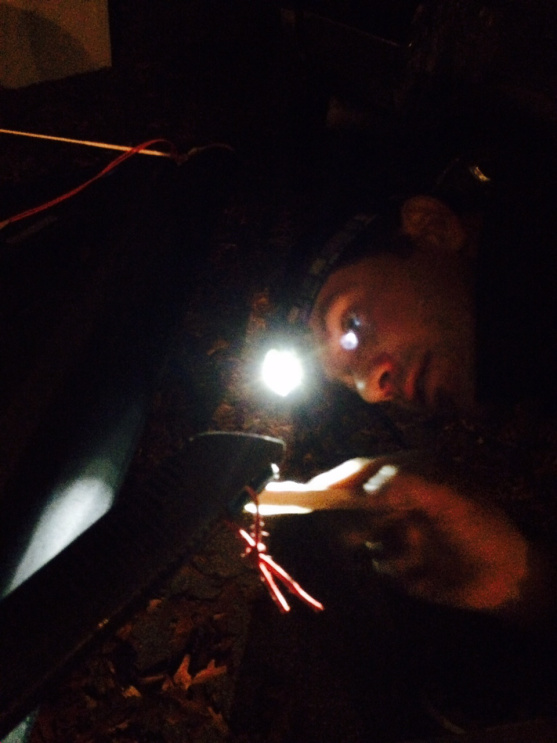
11 p.m. boom repair, 49 degrees

11 p.m. boom repair, 49 degrees

Moth sailors in America easily spend 70 percent of their time on boat work in this development class and barely the remaining 30 on the water. The base structure of the boats is the Mach 2 Moth built by McConaghy in China.

Why do the boats need so much work? Foiling sailboats are still new, at the boundaries of the sport and when you are traveling upwind at 16-17 knots and downwind at 20-30, the most minute adjustment can make many knots-worth of difference. So the short answer is: systems.

Making carbon levers to articulate and assist canting the rig from side to side, gluing little tabs to anchor sail adjustment pulleys (some so tiny they are sourced from remote control boat manufacturers) and repairing the constantly breaking modifications to the carbon wing bars and booms are added to work lists daily, attended to at night, and tested the next day.

The Americans are their own pit crews and coaches. And they want to kick ass next month. Jamestown Distributors president Mike Mills, a foil boarder himself, saw an awesome parallel between what this group is doing and what he was part of in the late 1990s in the International 505 class, easily the most elite double handed class in the world. Mike won the worlds in 1998 with Nick Trotmen after years of this very organic approach. JD sent me down with boxes of their house brand Total Boat epoxies and supplies to support the group.

Asking around, I realized that literally all the top performance sailors in the US, all plugging away in their garages to modify and repair their boats, use JD and the growing line of Total Boat products, especially the epoxies and fibers.

And when you do everything yourself, and pay out of your own pocket to make your boat faster, knowing there is a company that understands and gets you what you need STAT, makes a huge difference.

I’ll report back on how it all went with the work lists, which fixes worked, which didn’t and if this rag-tag group of rouge sailors will be ready to dethrone a few of those fully-sponsored pros in Bermuda next month.

Franck Cammas will sail to round Cape Horn in a foiling catamaran

Franck Cammas, one of the most successful French sailors in the world, will sail to do something never done before: rounding Cape Horn in a foiling catamaran. This is a world first which will begin tomorrow November 8, 2015.

cammas on nacra 20 fcs route

The Julbo Sail Session? It is an “HORNomous” adventure between Ushuaia (Argentina) and Cape Horn (Chile), which the Julbo skipper, Franck Cammas, will share with an amateur sailor, Johannes Wiebel (GER). They will take a flying catamaran round Cape Horn and then moor there.

It will be a remarkable story of an expedition to the end of the world by a pro and an amateur. It is the realisation of a dream for the two sailors, who will send us breathtaking images so that we can make you part of the passage round Cape Horn.

More info on www.julbo.com

FLY SIX en el acertijo, lo nuevo de Billoch – Zerbo

by juanpanews.com

Foiling_logo

El Fly Six es un barco que esta diseñado para aceptar dos juegos de apendices:
Version Standard: (2 orzas y 2 timones) para navegar normalmente, como podria hacerlo un skiff, por sus lineas de casco para planeo.
Version Foiling: (2 orzas en L y 2 timones en T) para elevarse de la superficie del agua y foilear.
Pensado para dos tripulantes, sin restricción de edad ni fisico. Esta planteado para ser un barco simple que le de una dosis de adrenalina a quien se anime.
Algo novedoso y muy interesante es que tiene lastre movil de banda a banda para regular la estabilidad. Se construiria en Argentina.

Eslora: 6 m
Manga: 2.95 m
Material: Full Carbono

More info at www.billoch-zerbo.com

The latest from WASZP designer Andrew McDougall

8fe3e0f34d3083cba6fe73d62a783d7f_XLAn enormous amount of design and testing has gone in since the announcement of the WASZP at Foiling Week.
Things have really progressed fast in the past month. The boat is going a lot better than I ever expected. We’ve now got a top speed of nearly 25 knots and the controllability in waves, which was one of one of our earlier challenges, is now rock solid.

waszpupdate5

One area we have spent a lot of time working on is the control system. We put on an adjustable wand, fitted adjustable gearing and added an adjustable wand angle system trying to solve some of the control issues and there was a fear that this may need to go into the production boat (which would have added a whole lot of complexity for the sailor) but as it turns out a single setting now works for everything and adding the adjustment just helped us pick the optimum solution.
The settings are quite different to what we initially expected because the foils are quite high lift so the angles and gearing ratios vary greatly from the Mach2 which I did not predict – so spending the time to get it right has been well worthwhile.

Wing Tips
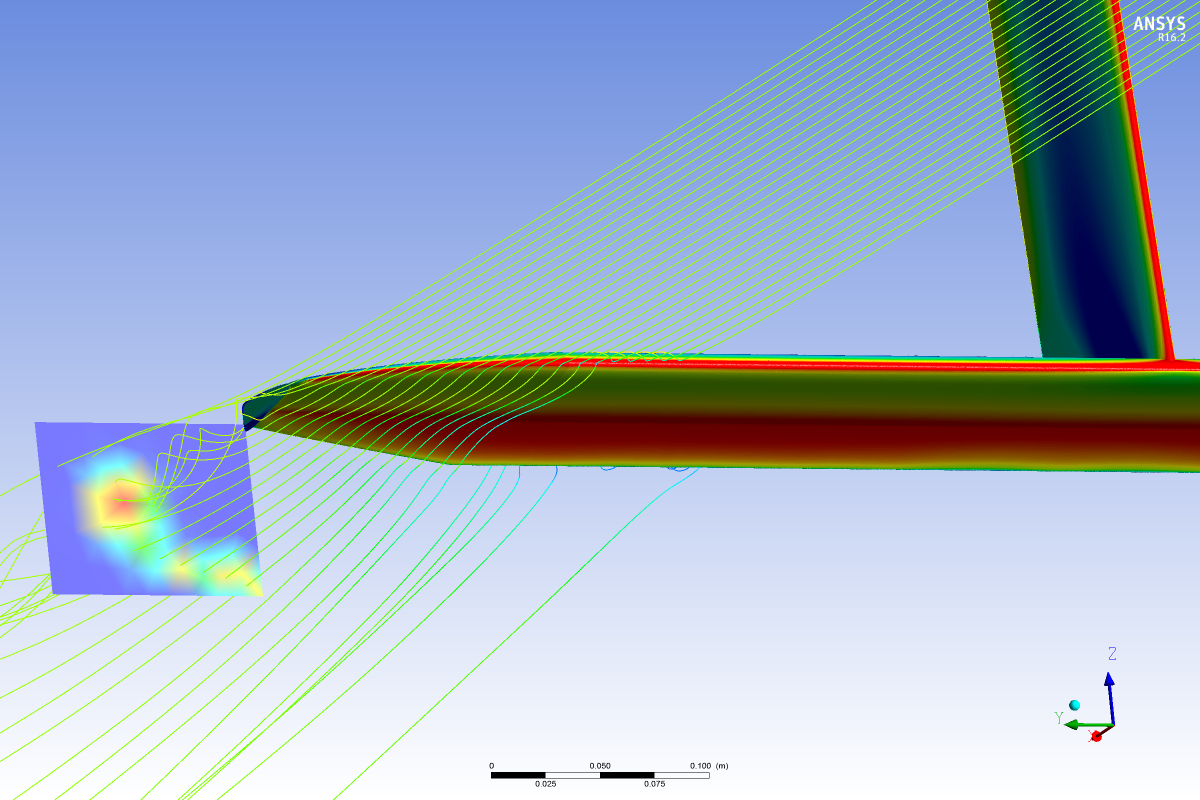
There has been a massive amount of work gone into optimising the foils. We have a new engineer on the team who came on 4 months ago who has done some really, really good work. We’ve done extensive CFD (computational fluid dynamics) analysis and testing on various wing tips and winglets.

CFD

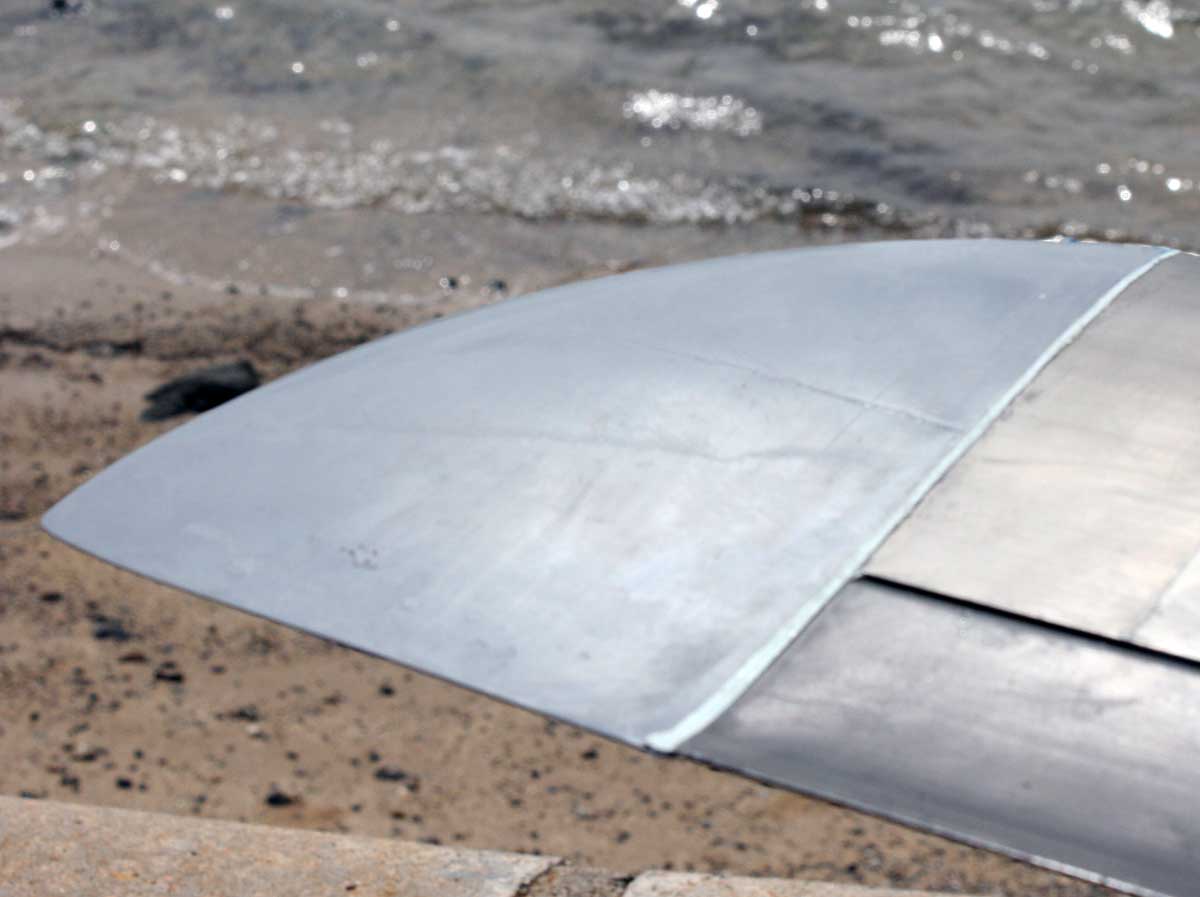
So the wing tips we are going forward with are a lot more conventional and they look a little bit like our high lift Mach 2 foil with tiny winglets and it’s a short taper from the end of the aluminium – about 130mm of wing tip.

waszpupdate2

We worked a lot on trying to get the tips as small as we could and keep the efficiency without having very long wing tips.

With the rear foil it’s very similar except no winglets.

waszpupdate3

For the main front horizontal foil the plan has always been to offer a number of lengths. We have standardised on a specific size as the racing foil, but will offer alternatives for learning.
The vertical foils are also slightly longer than the original prototypes which really helps sailing in waves.

Rig
Our current rig is a camber induced sail and it works brilliantly, infact the first sail we made worked straight out of the bag which was quite surprising.
We started with a 7.7 as these were based on the KA Moth sails and we thought this was a really good size as we were limited by the unstayed mast as you can really only hang so much cloth on it.
However we have found that we can handle a little more area and we are going to run with 8.0 sq. metres as this gives slightly more power for the bigger sailor to get foiling in the same sort of wind range that the Mach 2 does.

waszpupdate4 - Copia

However there is a huge issue that we have not been able to overcome.
The rig is actually quite hard to lift and step into the boat in its current configuration (with a cam sail you lift both the sail and mast together, made harder on the WASZP by having to align to the mast socket) so we’ve had to completely rethink it.
We battled on for a long time, but feedback from sailors trying the WASZP was: “guys, you just can’t do this”.
So we are going to go with a bolt rope mast and sail (still unstayed).

McSailWASZPsail

This however has put us back two months.
I know many people are going to be upset about this delay but we have to solve this and unfortunately there is no way around it.
We knew that we would continue to evolve up to first production and make sure everything was 100% sailor certified, but we thought it would be just small, easy things like foil lengths or control systems. This has hit us hard.

Trolley
Another thing that has been very difficult has been the trolley. You would think: what is so difficult? We’ve been trying to make the WASZP really easy to launch and with the foils in place it is quite logistically difficult to deal with. The original plan was always to slide the boat on and off the trolley with the foils in (up of course) and we have tried very many different scenarios – with the front of the boat encapsulated, with many different ways of hooking the trolley on but the bottom line is it is very difficult in waves or a reasonable amount of wind or with a smaller person it became quite physically demanding.
So we have changed our design so the trolley is put on when the boat is on its side. You can still put the boat in the water with the foils in which is a huge benefit not having to worry about going back to get them. So you just drag it into the water, tip it on its side, pull the trolley off, tip it back up, sail out, push your foils down and off you go. Or you can push the foils down and walk the boat out but you have the choice.
This has again delayed the project because the moulds and jigs were finished so we’ve had to start again.

Fibreglass Shipping Box
We’ve had a number of requests to do a GRP travel box that can be used for shipping the WASZP to international regattas. This has been designed and will be available as an option.

Production Timing
Given where we are now and the impeding Christmas and Chinese New Year shutdowns there is now no possibility that we can deliver complete boats before March, 2016.
We know that this is not ideal and will disappoint many who have jumped on board early. For this we apologise but can only re-enforce that ultimately the changes we have implemented will deliver a better product.
As we have always said anyone who has reserved a build slot can request a refund at any time. We stand ready to provide a full refund with no questions and no delays for anyone who wishes.
When we do start delivering boats will come out very quickly. Those at the tail end of the build slot queue will not see that much delay because we will be building and stocking masts and hulls which are the only composite parts in the boat (which we can only build so many per day). Most of the other parts are done in lots of 1,000 or more and they’ll all be ready for when we do start shipping. So in the first months we anticipate shipping 20 boats per week and so will catch up quickly to those back orders but for those with an early build slot there will be more impact.

The development of the WASZP has been significantly more challenging and time consuming than I imagined. It is so important to get everything right and there have been so many times where we’ve had to make what we call a ‘catastrophic’ change: one thing that did not work and we’ve had to roll back many components – injection moulded parts, aluminium extrusions, moulds – things that we committed that in the end needed to be changed.
On the other hand, the way the WASZP performs now, I’m really happy – the numbers it is hitting, its controllability and ease of foiling are all exceeding my expectations.

Andrew McDougall

Team Invictus launch new C Class Cat at the Advanced Engineering

by yachtsandyachting.com

Team Invictus new C Class

Team Invictus are an all-volunteer team who have determined to win one of sailing’s most high tech events – the C class Catamaran Championships. C class racing began in the early 1960’s as a series of match races. Over the years the class has been at the forefront of technology and design, inspiring the creation of the World Speed Sailing Committee, and influencing America’s Cup design.

The UK dominated the early history, but since then has failed to make a mark, and so Team Invictus have set out to bring the cup home!

C class catamarans are marvels of engineering, and so it is appropriate that the team have chosen the Advanced Engineering Show at the NEC on 4&5th Nov to reveal “Canopus” (GBR039) a C class flying boat, designed from the outset as a foiling catamaran. Both highly radical and innovative in its design, offers a credible challenge against Groupama’s current domination (winners of the C class catamaran championships 2015).

Canopus’s performance is a mix of design and technology, enabling a super-light craft to travel at well over 3 times the speed of the wind. The team are helped in achieving this engineering feat through the sponsorship of suppliers of advanced materials. The hulls, which may see potentially high crash loads if the boat suddenly comes off the foils, will be developed using Chomerat C-Ply shallow-angle NCF materials which come in very light aerial weights.

For the wing sail, the very light weight of the boat means extremely low loads, and so the wing weight is driven almost entirely by how light the structure can be built. To help achieve the lightest wing possible, the team are helped by Sigmatex’s new Spread Tow Fabrics and Evonik’s Rohacell foam cores, bringing the overall weight of the wing to around 40kg. Both Sigmatex and Evoniks products can be seen at their stands at the Advanced Engineering Show at the NEC.

Team Invictus will be displaying their 2013 craft, “Invictus” (GBR039) at the Advanced Engineering Show at the NEC on the 4th-5th November and welcome visitors to come and find out how they plan to bring home the trophy.

Events

Canopus is built with one aim, to win the C class championships, but the team also see her competing at other major events such as Foiling Week, Weymouth Speed Week, and maybe even the Bol D’Or!

The Team Invictus all-volunteer team began in 2002, formed by Airbus engineers Mark Bishop and Norman Wijker, with the rest of the team being drawn mostly from Airbus in Bristol. The team were also lucky enough to be able to call on the dynamic talents of speed sailor Paul Larsen who helmed Invictus at the 2004 and 2010 championships. In the beginning the team were outclassed by the experienced boat designers in the USA, but gradually they have built a foundation of knowledge that has allowed them to compete at the highest level of this design-led class.

This achievement was acknowledged by awarding Team Invictus the honour of hosting the 2013 championships in Cornwall, which attracted an unprecedented 11 boats and saw the first real competition that was decided by foiling.

The winner of the 2013 championships, and the recent event in Geneva was Franck Cammas on his amazing C class catamaran, “Groupama”. This boat is regarded by many as one of the most advanced sailboats on the planet, and has raised the bar for all competitors up to the ceiling; with Cammas’s world class sailing skills and a professional design team, this is what Team Invictus’s weekend warriors are facing.

So if you would like to meet the team or find out more, come and visit the stand at the NEC, and if you are able to help in our quest, we would love to meet you. Email info@teaminvictus.com