

The ground-breaking GUNBOAT G4 is put through the paces by her design and build team during her first week on the water.
Author Archives: Foiling Week
The excitment of TFW according to the New York Times correspondent Chris Museler
Video and ink From Bill Springer
After test-flying the fully-foiling G4 from Gunboat in St. Martin for the last several days, I can’t stop smiling. And I’m sure any of the lucky few that were there for the first flights would agree. Words, and even the remarkable photos of the first days of G4 flight can’t fully capture what it feels like to sail/fly aboard a 40-fo0t catamaran that’s not only capable of hitting 31.9 knots with a crew of non-pro sailors, but is also equipped with comfy bunks, and 360-degree visibility in the large main saloon, and even a kitchen sink and a fridge for cripes sake! And wait till you see how big the cockpit is. So I’m not even going to try.
Just watch this video. And be sure to watch it on a high-rez computer in full-screen mode. And oh yea, turn the volume up. This is what pure speed sounds like. And this is only a taste. Be sure to watch for my full report in a upcoming issue of Boat International and for much more info, including a stunning video from Gunboat that shows much, much more than just the underside of the bridgedeck!
And if you really want to see what the future looks like in person, head on down to Saint Barth’s for Les Voiles next week, or Antigua Sailing Week later this month. The G4 is sure to be one of the main attractions.
From moth-sailing.org
Franks Foiler
By 1970 I had been interested in hydrofoils for some time as a
member of the Amateur Yacht Research Society, and I had made several
successful sailing models. It occurred to me that any high performance
racing dinghy should make a good platform for adding hydrofoils.

I had a moth “Renegade IV” which had been Queensland Champion in 1969. The sail
area at less than 82 sq. ft. was smaller than any sailing hydrofoil that
I know of. (And may still stand as a record if you discount foiled
sailboards?)
In adding foils I did not want to modify or ruin the boat so I
utilised existing attachment points for stays and rudder. I did have to
screw the bow foil gantry to the noseblock however.
The configuration I developed was unique – two main lateral
foils, 6′ by about 14″, surface piercing, for lift, stability and
lateral resistance set at about 45deg. dihedral. For steering and pitch
control there were rudders fore and aft with foils. On the aft rudder
was a low-dihedral submerged foil 6″ chord by about 3′ span. The surface
piercing foil on the bow rudder was of somewhat greater span and set at
about 30deg. dihedral. The two rudders were linked so that the lateral
foils were not loaded or unloaded when turning. The linkage could be
adjusted so that (in theory) more or less pressure could be thrown on
the lee foil.
The foils were shaped by hand in the laundry of my Shepparton
unit out of the toughest Australian hardwood I could find. The section
was flat on the bottom with a slight curve up at the leading edge, and
arc of circle on the upper surface. The leading edge was sharp.
Thickness would have been less than 8%.
The first trials at Albert Park Lake and on Lake Glenmaggie were
hopeless (and incidentally everyone who saw the boat strongly affirmed
that foiling would be impossible). The “stick and string” structure was
a bit like a certain brand of collapsible furniture in that nothing held
up until everything was locked in place.
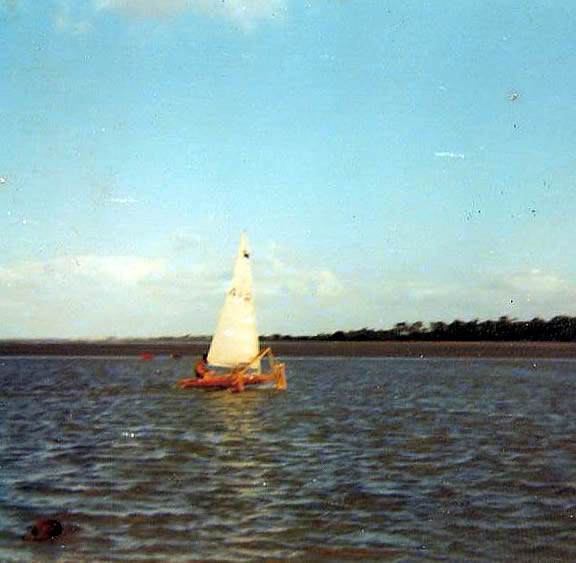
The boat could be launched and sailed off a beach in conventional
mode, then in deep water the foils lowered and the centreboard
retracted.
Finally in March 1972, at Cabbage Tree Creek near Brisbane,
Queensland, I achieved lift-off in about 15 knots of wind.
The best thing about it was how easy it all was – it was
absolutely controllable and stable with no vices. Any dummy could have
sailed it, though I think only my mate Tony Turbot ever did. It was he
who took the photos with my Box Brownie and his colour camera.
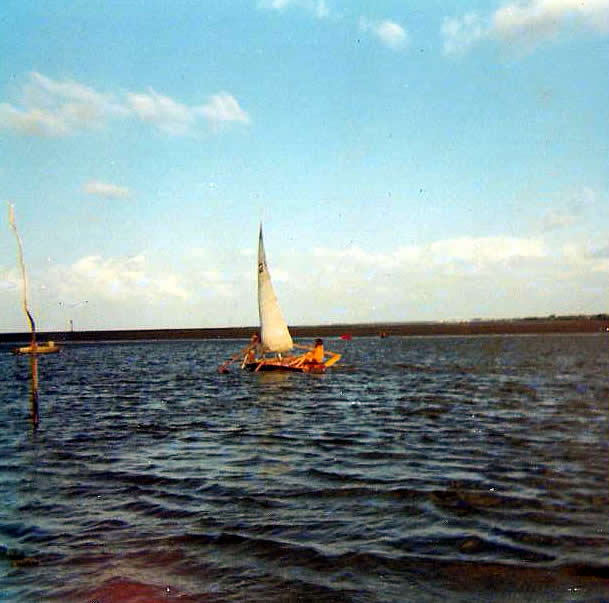
On the foils it was about as fast as the Mark II Moth that was
sailing there at the time. Once, as I remember, I almost managed a gybe
on foils. It came down after the sail came across and just before I
could power up on the new tack. I usually gybed because tacking involved
a stern board.
Off the foils it sailed ok but was slower than a sabot.
Its worst feature was its intolerance of even small waves. They
sucked it down off the foils. I eventually bust the bow foil pushing it
in waves. The hardwood bent like a steel spring before it broke.
Thereafter it would not foil – I could only get it to do half-hearted
“bunny hops”.

ony bought the boat as I was on my way overseas. The boat
eventually cracked up. The foils I never saw again.
All this is true, so help me God.
P. Frank Raisin (11th. Jan. 2008)
Source post http://moth-sailing.org/franks-foiler/
Foiling in the USA is April 9 at 7pm EST
This is the HOTTEST TOPIC in sailing today and since there has been overwhelming interest in this discussion, Thursday’s talk will be broadcast LIVE with the help of LiveStream producers
LIVE STREAMING HERE
A Q&A will be held with the live audience and a TWITTER Feed will be used to handle questions from viewers around the world
The New York Times correspondent CHRIS MUSELER makes sense of the latest developments
GunBoat founder PETER JOHNSTONE on live SkypeVideo chat about the foiling G4 cruiser/racer catamaran in trials THIS WEEK!
The Foiling Week founder Luca Rizzotti will chime in from Lake Garda to explain the vibe when the world’s top foil designers get together to create the future of the sport
AND contributions from other influential visionaries including radical kite foiler Bryan Lake, Waterlust Project filmmaker Patrick Rynne, US Sailing Executive Director Jack Gierhart and more!!!
It Happens at Doyle Sailmakers This Thursday Night, April 9th 7PM
If you want to come in person drive to Doyle Sails LI,1345 New York Ave.
Huntington Station, NY 11746
We’ll Have Pizza, Bring Your Own:
- Bottle
- Folding Chair
- Slippers for the floor
- $15 Donation for Chris’s Efforts
Please RSVP to: Info@DoyleSailsLI.com
from charles walter
A GREAT post By Kimball Livingston on blueplanettimes.com
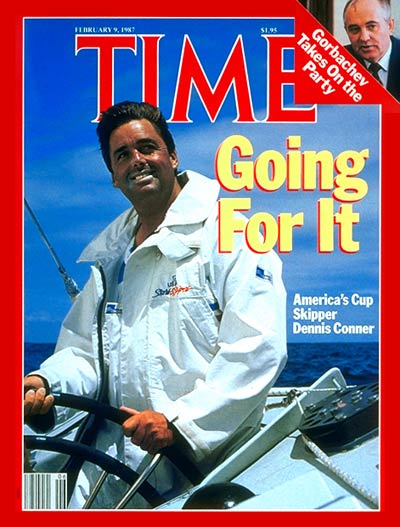
Does Russell get his catamaran circuit or not?
That is the question.
I mean, the catamaran circuit he really wants, in the long run, even if he has to drag the America’s Cup with it.
It’s a question underlying all the chatter and all the undercurrents and all the dissension surrounding the outlook for America’s Cup 35 at this www of the AC potboiler du jour. And, of course, the vote to move to smaller boats closer to the familiar AC45 model, and to run all of the America’s Cup eliminations in Bermuda.
To lower entry costs and bump up the number of competitors, perhaps one or two from Asia, at the risk of peeling off a couple of, should we say, “minor” teams. Patrizio Bertelli’s Luna Rossa, for example, which threatened to withdraw in such case, and today announced — ta da — they have withdrawn.
No arithmetic, please, or we’ll soon be talking about the plight of Team New Zealand.
DC-TimeThe last time the America’s Cup made as big a … Continue reading on blueplanettimes.com
From americascup.com
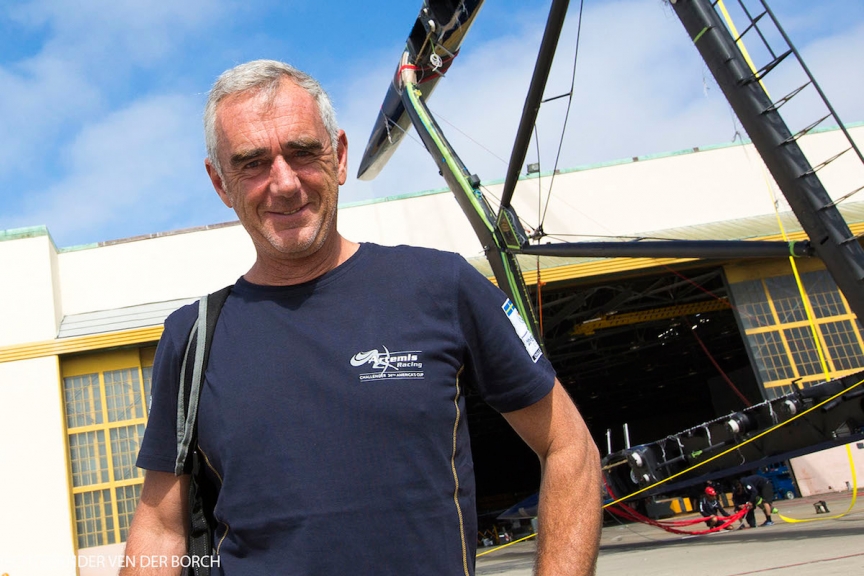
You won’t find an America’s Cup sailor with the depth and breadth of experience of Loïck Peyron. From his fully-crewed assaults on the round the world record, to his various monohull and multihull solo exploits, Peyron is a sailor who has done it all.
Now in his second campaign with Artemis Racing, he is nominally listed as a ‘designer’. But the French legend is much more than this, providing a vital link between the sailing and design worlds.
“I’m involved in many areas because that’s my way,” he explains. “I don’t want to be too specialized. That’s what happens when you’ve been a solo sailor as much as I have. You have to know a little bit – and sometimes quite a lot – about everything.”
Peyron counts many years of experience on multihulls, from round the world behemoths, to the old ORMA circuit, to the catamaran that Alinghi designed and constructed for the 2010 America’s Cup. Alinghi 5 was one of the most incredible boats ever built at the time, but it was eclipsed, if only just slightly, by the American trimaran powered by its towering wing sail, which went on to win the America’s Cup for Oracle Racing.
“When you look back, it’s hard to believe that was just five years ago. We have learned so much since then,” he says, thinking back to those boats, which are almost primitive in comparison to what is being tested by the teams today.
“Each time the America’s Cup becomes interested in something, it forces a huge jump as a lot of clever people focus on that area and start pushing the progress. A century ago we can imagine this was happening maybe with winches and aluminum masts. Today it’s foiling.
“The funny thing with foiling is that speed isn’t related to size. In a classic scenario, speed is related to the waterline length of the boat. But the foiling world is absolutely different. Speed is restricted by drag and by righting moment. That’s why a smaller foiling boat can be quite fast compared to a bigger one. That’s why the boats we have today are so much faster than those monster boats we built in 2010, for example. But it all started from there.
“The main reason behind the new class rule is to push the costs down, so there are some one-design elements in new America’s Cup Class. But one area that is free is the appendages and the controls and there is a lot of room to refine and improve here. The main area of importance on this boat is the drag – aero and hydro. So the appendages are so much more important. The small little details in shape and surface are problems we need to solve. Getting this right can make such a big difference.”
Peyron says Artemis Racing designers are already poring over the new class rule, putting their thinking caps on, sharpening their pencils, and figuring out the best approach. He loves it.
“In the America’s Cup you have so much talent across so may areas that the place is always buzzing. It’s a great ambiance. Everyone is thinking all the time on how to make things work better.
“But it’s a fight every day, by the way,” he says, laughing. “Because hopefully, no one agrees. So you have to defend your opinions and test the options and sometimes learn to accept another point of view. But with this process, the best ideas win out and the boat goes a little bit faster.”
And the incredible flying machines continue to evolve; faster and faster.

A milestone day on the waters of St Maarten. The G4 lifted up on her foils and flew. Top speed was 29.7 knots. A huge thank you to the whole Gunboat G4 development team including the DNA Design Team, including Mischa Heemskerk, Pieter Jan Dwarshuis, and Rudo Enserink, the G4 build team at Holland Composites, including Sven Janssen and Thijs van Riemsdijk, the Hall Spars G4 team including Jacques Swart, Dave Moffat and Ben Hall, and the North Sails G4 team including JB Braun, Kimo Worthington, Jonathan Bartlett and James Allsop. Mostly, we wish to thank owner Eduardo Perez for his belief in this dream, and his unwavering support.
