Category Archives: Web's news /

The three semi-foiling IMOCA 60 concepts

Extract from Yachting World.

20161205_3typeoffoils

They are all slightly different. In essence, there are three concepts at work: one that designers VPLP call the ‘Dali’ foil because of its ostensible similarity to the artist’s moustache; Alex Thompson’s DSS-style foil on Hugo Boss; and another type designed by Nick Holroyd of Team New Zealand used on Jérémie Beyou’s Maître Coq.

The first is a V-shaped foil on which the purpose of the shaft is to hold out an elbow and tip, but the shaft itself is not a key part. On Hugo Boss, the shaft and tip both provide lift, hence Thomson’s board provides, he says, “a two to three times bigger lifting surface.” It is said that Thomson’s foils begin to generate lift at a lower speed and are efficient to a deeper angle downwind than the others.

On Maître Coq the shaft ends in a flat section and has an elbow with a tip that extends vertically.

Every team has been refining these foils. Most have experienced breakages and, after trying out refinements, are on version 2, 3 or even 4. The point is that, for all teams, foils are still very much a learning game.

Alex Thomson came into the Vendée Globe as something of a dark horse, but his boat appears to have the edge over the rest of the foiling pack in downwind conditions. It remains to be seen if a full conclusion can be made since he broke his starboard foil in November, however, as that makes direct comparisons with fellow leader Armel Le Cléac’h’s Banque Populaire difficult.

Read more on yachtingworld.com

Bangin’ The Corners

2016 Bangin’ The Corners Cup presented by MS Amlin.

Congratulations to Iain “Goobs” Jensen on winning the third edition of the event. Thanks to our hosts Royal Bermuda Yacht Club for putting on a great show in such extreme conditions!

Figaro Bénéteau 3

By Press Mare World.

figaro-beneteau-3-the-world-s-first-production-foiling-monohull_22690

Modernity, reliability and performance. By combining its expertise and the competence of naval architects Van Peteghem – Lauriot-Prévost, the Beneteau Group is offering the Figaro class the first one-design production foiling monohull ever devised. The Figaro Beneteau 3 to star in the Solitaire URGO Le Figaro from 2019.

A one-design monohull equipped with foils.
Creation of the Beneteau Racing Division Group to manage the manufacturing of the production boats.

We just have to accept it: even the most reliable boats must, one day, fall back into line. In 2019, as the Solitaire URGO– Le Figaro celebrates its ftieth anniversary, the Figaro Beneteau 3 will take over from its illustrious predecessor, the Figaro Beneteau 2, which has been sailing the length and breadth of the French and Atlantic coasts since 2003.

This Figaro Beneteau 3 is the fruit of a stellar collaboration formed by the Beneteau Group, with the Class Figaro, OC Sport, the organiser of the Solitaire URGO- Le Figaro and Le Figaro group. Penned by naval architects Van Peteghem – Lauriot-Prévost, whose designs won the last two Vendée Globes and are likely to be on the podium for the 8th edition, the latest of the Class Figaro one-designs is in safe hands.

A boat that is part of the current climate, with a design set to last.
«The challenge of the brief we were given, naval architect Vincent Lauriot-Prévost explains, was to create a boat that performs well and is as reliable as the Figaro Beneteau 2.We worked extensively with the specialists from Beneteau Group to design a hi-tech boat in terms of both manufacturing materials and processes.»

Still with a heavy emphasis on top-level performance and competition, the Beneteau Group has gathered together the leading experts within its brands and its trades to design and build this latest iteration. In this way, they’ve brought their know-how into play with the creation of the one-design by VPLP.

figaro-beneteau-3-the-world-s-first-production-foiling-monohull_22689Foils, a mast stepped further aft and a high-performance hull
The first prototype is entering the build phase and will be ready to be launched and tried over the course of the summer 2017. It has been established that the Figaro Beneteau 3 will come under design category A under ISO/World Sailing.

She will wear the insignia of modernity: foils, yes, but also a more high-performance hull below the waterline that is free of ballast tanks, with a narrower and lighter keel, a mast stepped further aft and a more generous sail plan. Finally, the brief for the Figaro Beneteau 3 was naturally to be as reliable as her predecessor. VPLP affirm that if a foil were to break in a collision,it wouldn’t damage the boat’s structure.

The foils
In contrast to the foils on the Imoca60, the latter will have an inward-facing pro le as Vincent Lauriot-Prévost explains. «The versatile foil we’ve created provides more than just the dynamic power and vertical lift that is sought after in Imoca. We’ve designed it in such a way that it creates as little resistance as possible in the light airs and reduces leeway at full speed.»

The hull below the waterline
Made of foam sandwich, glass fibre and polyester resin, it is in line with current designs. The most significant change is the disappearance of the ballast tanks.

The keel
Deeper, with a narrower keel n, it will generate less drag.This will be accompanied by the reduction in leeway created by the foils.

Mast and sail plan
As is the case on the Imoca60, the mast is stepped further aft, which enables the incorporation of more high-performance sails and a bowsprit is attached.The solo sailors will sail with a fathead mainsail, a genoa and of course a jib, as well as a masthead spinnaker (measuring 105m2) and, to seek out speed in the light airs, a small gennaker.

The manufacturing challenge of production boats
Around a hundred Figaro Beneteau 2s have been built since 2003, which augurs well for the 3rd iteration. In order to optimize the manufacture of production boats, whilst adhering to the drastic criteria of the one-design, the Group has just created the Beneteau Racing Division Group. It is a powerful signal of the company’s desire to forge ahead with innovation that is geared towards performance. A dedicated construction site has been put in place in Nantes-Cheviré (Loire-Atlantique).This hub comprises around fifteen experts and will also be tasked with piloting and producing the Group’s future racing and regatta projects.

Game on: the Beneteau Racing Division will have to produce a rst batch of 50 Figaro Beneteau 3s for the end of 2018. At that point, the class will distribute them solely among members by drawing lots so as to retain sports equity.

figaro-beneteau-3-the-world-s-first-production-foiling-monohull_22688

Reaction from: Yoann Richomme, Winner of the Solitaire Bompard Le Figaro 2016. Head of the Class Figaro’s Measurement and Safety Committee.

With this new Figaro Beneteau 3, we’re hoping to offer the fleet to those who are inspired to join us an exhilarating and more modern boat.

Inevitably, after 15 years of offshore racing on the same boat, you get a little tired of it. As such, it was an opportune moment to make the move and, in so doing, get in touch with the status of science. It wasn’t about making the Figaro Beneteau 2 vintage, rather it’s about bringing something innovative and visible to the fore.

Foils are clearly the future, especially in a competition environment. The skippers will be able to get to grips with these tools in the Figaro and this will give them the building blocks to move onto something else further down the track should they so wish.

Technical specifcations
LOA: 10.85 m – Hull length: 9.75 m – Waterline length: 9.00 m – Max beam: 3.40 m – Waterline beam: 2.40 m – Draft: 2.50 m – Light displacement: 2900 kg Ballast: 1100 kg – Mainsail area: 39.5 m2 – Jib area: 30.5 m2 – Large spinnaker area: 105 m2

#RaceToBermuda

The next time the world will see America’s Cup racing is on the beautiful, natural amphitheater of the Great Sound in Bermuda. Three America’s Cup teams are already based in Bermuda, they weigh in on the venue and what we can expect to see in 2017

New designs in Vendée Globe offer more speed, and danger

By CHRIS MUSELER.

LES SABLES D’OLONNE, France — A tear appeared at the corner of Morgan Lagravière’s eye as he was interviewed before the start of his first Vendée Globe, a solo, nonstop around-the-world race.

By the time he was halfway out the mile-long channel to the North Atlantic on his Team Safran Imoca 60 racer, roars from the 350,000 people gathered along the natural amphitheater overwhelmed him. He slid to the deck, crouched with head hung, and broke down in tears.

The start of the Vendée Globe, which takes place every four years, is a phenomenon that rivals the world’s largest sporting events. Bars along the channel were opened at 4 a.m. as visitors filled the streets, singing and chanting in the 40-degree darkness. By dawn, the people were 10 deep along the sea walls for a mile on either side.

More than 1.5 million people, largely French families and school children, poured through the race village here on the west coast of France over three weeks to catch a glimpse of the 29 skippers and the radical 60-foot boats that will take them to the most remote areas on the planet.

When the race began on Nov. 6, the crowds cheered as each boat slowly motored through the channel, the skipper playfully starting an uproar with his arms. Four hours later, the last of the support boats and television helicopters peeled away, and the sailors were left alone to negotiate the solitude and challenges of the open ocean.

They are facing perhaps the most dangerous edition of the race since its inception in 1989.

For the first time, Lagravière and six other skippers are using hydrofoils, which can lift the boats nearly out of the water and reach speeds of more than 30 miles per hour. Designers said these boats would sail an average of three to four knots faster along the 28,000-mile course.

If the new Imoca 60 designs, known as foilers, hold together, François Gabart’s record of 78 days, set in the previous race, is predicted to fall.

The additional stresses the foils are placing on the skippers and the boats have forced some to wear helmets and body armor when below deck to protect against the violent motion of these avant-garde designs.

The new boats are untested in the three-month race. Skippers including the British sailor Alex Thomson, considered one of the fastest in the fleet and the current leader, know the risks well. Though he was third in the last race, he failed to finish the previous two. To reduce this risk, he and other teams have installed sensor alarms that will sound when the boats become overstressed at speed.

On Thursday, Lagravière shed tears of despair as he became the third skipper, and first foiling boat, to retire from the race. His boat hit what he labeled an “unidentified floating object” that tore off more than half of one of the boat’s two rudders.

Entering the weekend, all but one of the new-generation boats were still filling the top five places as the leaders hurtled past the Cape of Good Hope. The top nonfoiling boat, PRB, whose skipper is the former race winner Vincent Riou, became the second retirement of the race on Tuesday.

Proving the dominance of the new boats, Thomson broke the 24-hour world speed record for this class last Saturday, covering 535.34 nautical miles. He rounded the southern tip of Africa on Thursday, beating the race record from the start to the Cape by five days, even though one of his foils broke a week ago while the boat was averaging more than 27 m.p.h.

Since the first race, about half the competitors have finished. There have been deaths and daring midocean rescues.

Illuminating the close bond and respect between the competitors representing 10 nations, the veteran skipper Kito de Pavant held the head of a rival in his hands before the start, kissed his cheek and embraced him, closing his eyes and sharing a final supportive message.

This extreme race is distinctly French.

“There is a huge public love and intrigue and fascination in particularly about single-handed sailing here,” said Mark Turner, chief executive of the Volvo Ocean Race.

Turner said this interest went back to the solo sailing exploits of the Frenchman Éric Tabarly when he won the 1964 Observer Single-Handed Trans-Atlantic Race, a feat for which he received the rank of Chevalier de la Légion d’Honneur.

Today the race is considered the pinnacle of solo ocean racing and is mainly sponsored not by a corporation but by the region of Vendée, contributing to its longevity and prominence in the country.

Gabart said the attraction of the Vendée Globe was the shared experience.

“Everyone looks at the sea, and there is a feeling of freedom,” he said the day before the start. “This is not only about sports. This is something more universal. Something more human about going on a boat and going away.”

Yacht Racing Forum

15134816_721837541326117_2562928940260194290_n

Foiling Week is participating again at Yacht Racing Forum in Malta, November 28th to 29th. We will have the opportunity to discuss our take on safety and sponsorships at 2 of the sessions.

Our 2017/18 plans in terms of events and foiling community support will also be announced. We will be more than happy to meet and talk with anyone about funding, partnering, sponsoring, volunteering, helping, becoming part of the foiling community events! #experienceiseverything

L’hydroptère abandonné, vendu 20.000$

by courseaularge.com

hydropterevendue

Triste fin pour l’hydroptère déclaré abandonné sur un ponton d’Hawaï et vendu 20.000 $ pour pièces. C’est le forum Sailing Anarchy qui a publié hier les photos du bateau et de la pancarte de la marina où il est mentionné que le bateau est déclaré abandonné suite à un arriéré de 20.000 $ n’ayant pas été payé depuis des mois. Le compte Twitter officiel d’Hydroptère confirmait la vente du bateau et un elliptique « Back to soon to San Francisco ».

hydropterevendue1

On sait qu’Alain Thébault est aujourd’hui sur un projet de voiture sur foil sur la Seine et que ses relations avec ses anciens partenaires (DCNS) sur l’hydroptère n’ont pas été des plus faciles. Joint cet après-midi, il n’a pas souhaité nous en dire plus. Un accord de confidentialité a été signé avec l’acheteur. On ne connait pas le montant exact de la vente. Mais les 20.000 $ d’arriérés ont été payés à la Marina.
A suivre.

hydropterevendue0

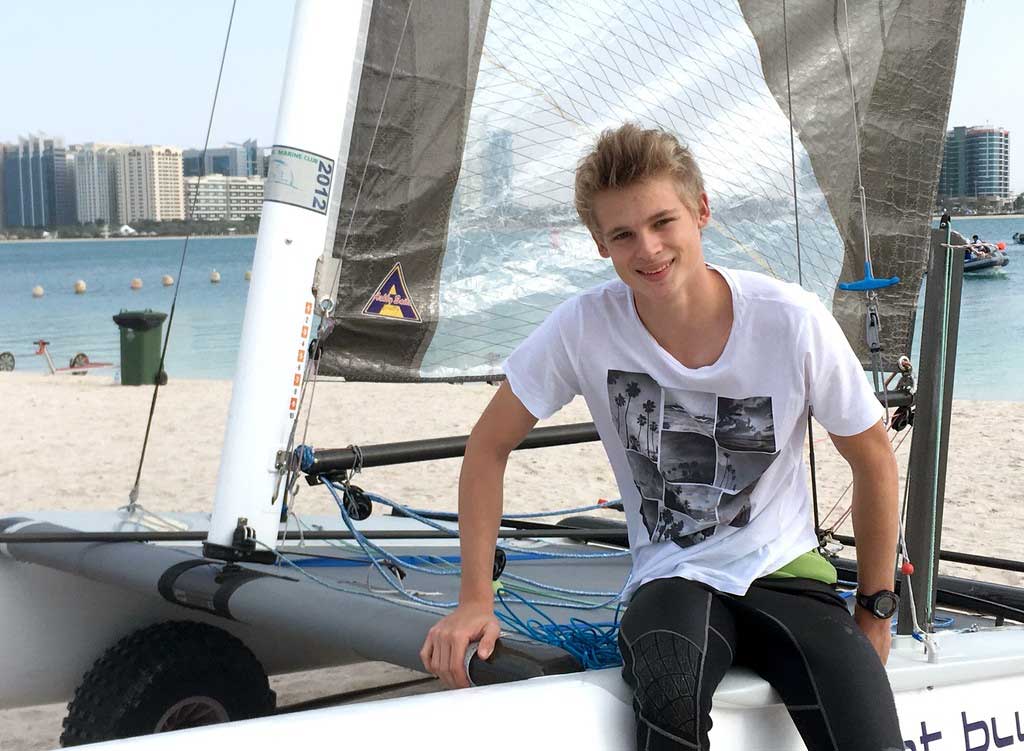
Oscar Lindley-Smith is not like most teenagers

by totaluae.com

uaeboy

He doesn’t spend his weekends hanging out with friends, watching films or walking around a mall.

As the world’s youngest competitive foiling helm – a sailor who steers a catamaran which flies up on top of the water suspended on a pair of hydrofoils – 16-year-old Oscar, who lives in Abu Dhabi, spends most of his spare time at sea.

And now he has another mission to occupy him: to secure US$240,000 of sponsorship to help him forge a career in the sport and compete in Foiling Week – the world’s only dedicated event for foiling boats – on Lake Garda in Italy this summer
.

He hopes to find a company or companies that will sponsor him to help him continue his sailing experience and be recognised at the top of the field.

“Foiling is the new generation,” says Oscar, who used to sail an 8-feet long mono hull but has since moved on to a Flying Phantom, an 18ft carbon fibre catamaran, which his family has shared with another family for just over a year.

“There are less than 100 of these boats around. We bought boat No 11 from the first batch of boats. So I am one of the most experienced young helms anyway for this boat, which is a unique selling point I’m trying to use.”

But because the boats are so new, they are expensive.

If his sponsorship bid is successful, the money will pay for the purchase of another boat, which is worth upwards of €40,000 (Dh167,355) to use in Europe, plus all the running costs, spares and repairs. He will also find a professional crew to take the place of his father, who currently sails with him.

“As a sailor I will be the youngest foiling person in the world competing at the high end. There will be no one else of my age up there competing,” says Oscar.

“Any company that partners with me from the beginning will also benefit from this success. At the moment sailing is in a massive growth www. The viewings have gone up tenfold since even last year. It is a very spectacular sport with these new boats. There are lots of different stunts that can be done that create spectacular imagery.”

Oscar was introduced to sailing at the age of three, but was not immediately taken by the sport as it was initially limited to group exercises with paddles to keep it safe. But his potential was quickly noticed and he was soon sailing twice a week.

“That was when I really started enjoying it because we were racing and sailing independently instead of doing these exercises,” says Oscar, who is from the UK but has lived in the UAE for the past 11 years.

“One of the main things I enjoy is being out and the feeling this gives you. There is a lot of responsibility on you. It is all about the hard work you put in and I really enjoy reaping these rewards when racing.”

To help secure the sponsorship, Oscar, who attends Brighton College, has produced his own proposal document to present his business case. The document outlines his motivations – the freedom, challenge and enjoyment it offers – as well as his achievements, plus short and long-term targets. It shows where a company could display its logo, such as on his rash top, trousers, trailer, the boat itself and even his car.

But most importantly, the document outlines why a company should sponsor him. According to Oscar, the company or companies will receive global TV coverage reaching at least 5.5 million unique viewers and a further 200,000 views via social media. In the UAE, Oscar points out that he trains on the Abu Dhabi Corniche breakwater surrounded by five-star hotels and apartments, which received 1.2m visitors in the first quarter in 2014. He estimates sponsors will receive a further 1,000 views from him sailing in front of Jebel Ali Hotel in Dubai. And more than 2m visitors to Lake Garda will see him train there over the summer.

“Foiling is the high performance top end of sailing that has exploded since the last America’s Cup was raced using giant foiling catamarans,” says the sponsorship proposal, which Oscar put together himself.

“The speed that comes with foiling has drawn many times more spectators than has ever previously been seen in sailing – it has become the Formula One of the sport. Drones continually film and broadcast to spectators on the shore. TV and YouTube coverage is released after every race.”

But persuading companies to get on board here is hard. Oscar has spoken to a few so far, but his conversations have been limited to email so far. Juggling sailing and school is also a challenge.

“I am getting interesting pressure from both sides. I was recently in Oman for the America’s Cup and catching up just two days from that was difficult. I have my AS levels in a month’s time so it is very difficult,” he says.

“I am trying to do both, because if something happens in my sailing, if I get an injury or something, I need a fallback plan. At the moment it is sort of a double focus.”

business@thenational.ae

Le petit hydroptère d’E.T.

by Frédéric Monsonnec – Auteur depuis 2008 du blog Foilers
Texte originele ici

Non non, George Lucas n’avait pas prévu de faire voler E.T. l’extraterrestre à bord d’un hydroptère (enfin je ne le pense pas).

E. T. c’est aussi le grand Eric Tabarly qui, d’une certaine manière, était un extraterrestre ! Les photos du bel hybride que pilota Eric Tabarly en 1976, ont du faire naitre des vocations de pilotes d’engins à foils (au moins une!).

Photo Bernard Deguy 1976

Photo Bernard Deguy 1976

La genèse
L’idée d’utiliser des hydrofoils, Eric Tabarly, l’avait déjà fin 1971. Il souhaitait développer un foiler pour améliorer la stabilité d’un trimaran de course tout en diminuant la trainée (il avait croisé Williwaw le premier foiler océanique en 1969 aux USA). En 1975, il rencontre Alain de Bergh et Claude Picard ingénieurs chez Dassault. Le duo, qui va s’intéresser au projet d’Eric Tabarly, va se transformer en trio avec l’arrivée de l’aérodynamicien Pierre Perrier. Puis en quatuor avec le professeur Tsen du CEAT ENSMA de Poitiers. C’est Alain de Bergh qui, après plusieurs semaines de recherches, propose d’étudier la possibilité de faire voler l’engin. En 1975 des essais en soufflerie sont réalisés, des foils sont testés à l’école nationale supérieur de mécanique aéronautique de Poitiers (ENSMA) et une maquette sur un plan d’eau (tractée par une canne à pêche !)…

En 1976, au retour du Triangle Atlantique qu’il vient de gagner avec Pen Duick VI, Eric Tabarly rencontre Jean Garnault professeur à l’IUT Génie civil de La Rochelle. Jean Garnault lui propose de construire la maquette navigante de son projet. Cette maquette devait permettre de valider les idées d’Eric et des ingénieurs de Dassault. Idées qui, à l’époque, faisaient sourire certains. La maquette devait surtout permettre d’observer le comportement d’un hydroptère à voile en navigation. En Angleterre et en France, d’autres engins de ce type existaient déjà comme ceux de Claude Tisserand (Véliplanes) ou de Roland Tiercelin (Trimama, Triplane …), mais l’engin réalisé par Jean Garnault allait permettre de valider les premières esquisses du projet.

Réalisation
La bête fut construite à partir de la coque centrale d’un Tornado, de son gréement, d’un profil de mat pour le bras de liaison, de flotteurs en contre plaqué stratifié et de foils à priori eux aussi en CP stratifié. Le safran était équipé d’un empennage en V dont l’incidence était réglable en tournant la barre sur elle-même (rotation d’un pas de vis, puis d’une crémaillère fixée en tête de safran).

Pour augmenter la surface du pont, une plaque de contre plaqué avait été rajoutée sur la coque centrale. Sur chaque côté de cette plaque, étaient fixés 2 répétiteurs (girouette, anémomètre …). Cette plate forme rendait le canot légèrement plus «confortable» mais les pieds du barreur se trouvaient tout de même au même niveau que ses fesses. La barre se trouvait dans le dos du pilote, ce qui ne devait pas permettre un pilotage en finesse.

Sur la coque de Tornado, à l’emplacement de la poutre arrière, un petit profilé dépassant de chaque coté avait été boulonné. Il permettait de fixer une pantoire pour l’écoute de GV. De même à l’avant, une mini poutre servait de point de fixation à la poulie d’écoute de foc.

Voiles & voiliers N°448 juin 08

Voiles & voiliers N°448 juin 08

Caractéristiques :
Longueur : 6.09 m
Largeur : 7m
Poids : 160 kg environ, 230 avec le pilote
Surface de voilure : GV 16,87 m² ; Foc 5,20 m²
Longueur des foils : 2 m

Navigations
Assemblé au port des Minimes (arrivé démonté sur une remorque tractée par une DS), l’engin a volé dés sa première sortie, au près serré, par 10/15 nœuds de vent. Il semble que le premier vol n’est pas été réalisé par Eric Tabarly mais par quelqu’un de l’équipe de La rochelle…

Eric Tabarly, qui avait ancré Pen Duick VI à la Rochelle pour l’occasion, fut enchanté par le comportement tout en douceur de l’engin. Décollage et atterrissage en souplesse, passage dans le clapot et le sillage de bateaux à moteur sans soucis. De temps en temps, une jambe de force crochait l’eau mais rien de dramatique. L’envol avait lieu dès 10 nœuds, la vitesse max. atteinte lors de ces essais fut de 15 noeuds.

Hors Série Voile magazine « Tabarly » 1996

Hors Série Voile magazine « Tabarly » 1996

La suite
En 1976, malgré ces navigations encourageantes (durant tout l’été), en l’absence de sponsor, le projet piétine. Autre point négatif, pour réaliser un trimaran de 18 m, l’extrapolation à l’échelle 1 des résultats obtenus à partir de la maquette impliquait un poids maxi de 6,2 tonnes et des foils de 6m de long. Les matériaux de l’époque ne permettaient pas de construire un engin de ce poids et des foils de cette dimension (nous étions aux balbutiements de l’utilisation du carbone). Il a donc fallu se « contenter » de réaliser un foiler en aluminium : Paul Ricard. Mais l’idée de faire voler un hydroptère n’a jamais quitté Eric Tabarly…

Bien des années plus tard, en 1985 Alain Thébault rencontra Alain de Bergh pour lui présenter ses croquis puis Eric Tabarly. Lorsque Alain Thébault, avec l’aide d’Eric Tabarly, a souhaité relancer le projet d’hydroptère, il a voulu réutiliser cette maquette pour refaire des essais. Malheureusement, il semble qu’Eric Tabarly avait oublié de remercier Jean Garnault et l’équipe de l’IUT de La Rochelle pour leur travail (dixit A Thébault, Pilote d’un rêve Flammarion 2005). Alain Thébault essuya donc un refus, et réalisa une nouvelle maquette sur laquelle il navigua de 1987 à 1992. La suite, nous la connaissons…

Sauf erreur, la maquette de 76 après être restée plus de 20 ans remisée, serait maintenant la propriété d’une personne du team d’un tri ORMA. Je rêve d’admirer ce canot de près. Si il existe toujours, il mérite sa place dans un musée ou encore mieux sur l’eau !

Complément d’informations ou rectifications bienvenues !!

Bateaux N°594 nov 07

Bateaux N°594 nov 07