
Category Archives: Web's news /

Heroes and Legends: The moth class today

by Phil Oligario – yachtsandyachting.com

Ben Paton on day 3 of the International Moth UK Nationals at Stokes Bay

Ben Paton on day 3 of the International Moth UK Nationals at Stokes Bay. Photo © Mark Jardine

The moth class is a thing of beauty. It has been around for longer than most of its current membership worldwide and continues to thrive to this day. How is this possible? I believe it’s down to the spirit of the class and the essence of what it represents and as a result the type of people that it attracts.

The old adage ‘like a moth to a flame’ is not lost on those drawn to sail these amazing boats so what exactly is it that compels men and women across the world to take on the challenge of conquering these tiny boats?

If we look at the type of person that sails these boats we can split them into two categories, Heroes and Legends. The heroes are the ones we all know, sailing superstars who have forged their professional careers in all disciplines of sailing from Volvo Ocean Race Yachts to Olympic class dinghies, Melges 24s to Solos.

Dylan Fletcher on day 3 of the International Moth UK Nationals at Stokes Bay. Photos © Mark Jardine

Dylan Fletcher on day 3 of the International Moth UK Nationals at Stokes Bay. Photos © Mark Jardine

These heroes are a recent and welcome addition to the class and with the advent of the America’s cup moving to hydrofoiling, a natural choice for many professional sailors. Our heroes list is pretty much a world roster of top sailors across the globe. Here in the UK, most of our top 10 are made up of professional sailors with such accolades as Volvo Ocean Race winner, Olympic medallists, I14 POW winners and National Champions in a variety of fleets.

These men and women are made of different stuff, driven by a passion and commitment to racing that many of us mere mortals can only dream of. They push the envelope of development and tuning to places unforeseen by others. Committed to winning, they focus their energies on their given craft and their bodies, Racing to them is their life and winning is what drives them.

The fleet on day 3 of the International Moth UK Nationals at Stokes Bay. photo © Mark Jardine

The fleet on day 3 of the International Moth UK Nationals at Stokes Bay. Photo © Mark Jardine

But it wasn’t always like this in the moth class…

Back in 2007, I saw my first youtube video of foiling moths. This was essentially the UK moth fleet consisting of just a handful of boats. Among those names were Alex Adams (who went on to become part of the Vesta’s world record breaking Sail Rocket team), Adam May (now working with America’s Cup team Artemis), Simon Payne (Multiple World, European and National Champion in the moth), Mike Cooke (Builder of the Ninja and the Rocket and also National Champion, filming at the time but nonetheless amongst those present) and James Roche who went on to be part of the design team of the 2014 Winter Olympics Gold winning Skeleton and is now part of the Ben Ainslie America’s Cup design team.

Alex Adams on day three of the International Moth worlds at Horsens, Denmark

Alex Adams on day three of the International Moth worlds at Horsens, Denmark. Photo © Th.Martinez / www.thmartinez.com

Simon Payne on day 6 of the Zhik Nautica Moth Worlds at Campione del Garda. Photo © Th.Martinez / Sea&Co / www.thmartinez.com

Simon Payne on day 6 of the Zhik Nautica Moth Worlds at Campione del Garda. Photo © Th.Martinez / Sea&Co / www.thmartinez.com

These guys formed the nucleus of what we see today in the UK and without their pioneering spirit, many of us would not be in the class today. Skip to the other side of the world and down under a similar movement was taking place. Rohan Veal was the poster boy of Mothing at the time having joined forces with Amac (THE man behind the game changing Mach2), we had people like Bruce McLoud proving that homebuilding a moth was possible. Taking that to the next level was David Lister who was one of the first people to foil tack consistently and is arguably the fastest mothie alive.

Rohan Veal on day one of the International Moth worlds at Horsens, Denmark. Photo © Th.Martinez / www.thmartinez.com

Rohan Veal on day one of the International Moth worlds at Horsens, Denmark. Photo © Th.Martinez / www.thmartinez.com

In the UK, fleet numbers are now up to 70 plus at a National Championship so the question is… who are these people?

The current demographic is hard to pin down because no two mothies are the same. We have a huge mix of self employed, high flying city execs, craftsmen, artists, designers, IT professionals, recruitment consultants and pretty much everything else, so trying to pin it down to career path is a tricky one. The only thing that I have been able to ascertain from my years in the class is that we are all slightly mad. We are unique in that we share the same goal of being on the edge of control in challenging situations whilst happening at the speed of light. Some are more determined than others and that is reflected in their position at regattas. On the other hand, some of us have more time to commit than others and this also helps to move up the ranks however, moving up the ranks is not on everyone’s mind. Some of us love having the opportunity to just race these fantastic machines alongside some of the greatest sailors in the world and on occasion, beat them.

If you ask any moth sailor what it is that keeps them coming back for more, it’s always the same answer. Here is what some of our heroes have to say:

Rob Greenhalgh, current European Champion (Volvo Ocean Race winner among other titles) says, “I’ve been in the moth since 2012 and I keep coming back for more because the moth is the most technically advanced singlehander on the planet and, being a development class, gives me options to evolve elements and work on new stuff.”

Robert Greenhalgh on day 5 of the International Moth World Championships. Photo © Tom Gruitt / YachtsandYachting.com

Robert Greenhalgh on day 5 of the International Moth World Championships. Photo © Tom Gruitt / YachtsandYachting.com

Chris Rashley our multiple European and UK National Champion says, “I started in the moth just over 5 years ago after watching the highlights on youtube of the 2009 European Championships in Lake Silvaplana, Switzerland. I keep coming back because the boats are getting faster easier to handle and the standard of the competition and the racing improves all the time. I won’t be going anywhere until I win the the World Championships.”

Chris Rashley on day 3 of the International Moth UK Nationals at Stokes Bay. Photo © Mark Jardine

Chris Rashley on day 3 of the International Moth UK Nationals at Stokes Bay. Photo © Mark Jardine

And from some of our legends:

Neil Baker, current ‘voice of the UK fleet’ has this to say about what mothing is to him: “I’ve been sailing a foiling moth since November 2010. But I had a gentleman Jim lowrider (similar to magnum 8) from 96 to 1999. I continue to sail it and no other dinghy appeals. There aren’t any other boats that are enough of a buzz that I’d bother to go practice in. Frankly I could never race the moth and just go for a play in it every now and then and be happy, I only sail because I love racing. All my other sailing was based around regattas. And there aren’t many that equal a moth event so you just get bored and sell it.”

Neil Baker, a wise International Moth sailor. Photo © Martina Orsini

Neil Baker, a wise International Moth sailor. Photo © Martina Orsini

James Sainsbury, the only man to build a competitive moth in his front room (no exaggeration!) started sailing foiling moths three years ago and simply says: “It’s fun, it’s fast and you’d be hard pushed to get the feeling you get in a moth anywhere else.”

James Sainsbury on day 3 of the International Moth UK Nationals at Stokes Bay. Photo © Mark Jardine

James Sainsbury on day 3 of the International Moth UK Nationals at Stokes Bay. Photo © Mark Jardine

Ricky Tagg who is known to many, having been sailing since before the 2nd World War says, “I had my first sail in a Moth, a Mistress back in 2006/7, courtesy of my old friend David Ellis. I learned to sail at age of 5 and for nearly 40 years I got to race against and coach great sailors in iconic events and locations across the world. However, whilst I enjoyed the various campaigns and successes in a wide range of boats, I just got bored of racing and sailing.

After that one sail in a Moth, I just had to sail again and I didn’t care if I raced or not. In those days the boats were unrefined at best, however today, with much better boats and control systems, you pay no heed to the fact that you are doing mid to high 20s downwind and it still makes me smile and poke my tongue out! Am I tempted to change class? HELL NO.”

Event winner Ricky Tagg during the Draycote International Moth Grand Prix. Photo © Fabian Katz

Event winner Ricky Tagg during the Draycote International Moth Grand Prix. Photo © Fabian Katz

As for me, Seven years in and the class has become a part of me and visa versa. I cannot think of anything else I’d rather be doing then building them, sailing them, thinking about them or talking about them. I never foresaw this in my life years ago and I would like to think that I’ll be involved with them for many years to come.

The moth today is a strange class in that it draws out the legends and the heroes from all walks of life. One thing is for sure, once you’ve sailed one, you’ll never be the same again. It is such a force of nature that it has changed the face of sailing forever, proving the concept that foiling is possible even with a 72 foot catamaran. Anyone who sails a moth is a legend!

Original post here
Le ridicule ne tue pas ! (Silly never dies)

by adonnante.com

© SANDER VAN DER BORCH / ARTEMIS RACING

© SANDER VAN DER BORCH / ARTEMIS RACING

Alors que l’America’s Cup fait un grand pas en avant en France avec l’arrivée d’un nouveau sponsor pour l’équipe de Franck Cammas et l’accueil des AC World Series à Toulon en septembre prochain, la réalité est toute autre.

Demain s’entretient aujourd’hui !
Signer un nouveau sponsor est toujours un événement important dans l’histoire d’une équipe sportive, surtout quand il s’agit de l’America’s Cup. Bon an mal an la France réussit aléatoirement à participer au plus vieux Trophée sportif du Monde. Avec une aide financière de 1,5 million par an, l’apport de Norauto peut faire sourire quand on sait que cela ne couvrirait même pas la seule ligne salariale d’ORACLE Team USA alors que Russell Coutts est annoncé à plus de 45 000 € par mois et qu’un simple grinder américain gagnait mensuellement 25 000 € lors de la précédente édition… Seul point positif pour les Français est cette vision à long terme – cinq ans de partenariat – qui permet d’être plus réactif pour la 36e édition de la Coupe.

Toulon, Toulon, deux minutes d’arrêt
À 2 millions d’Euros l’étape des AC World Series, peu de ports en France pouvaient se permettre se luxe d’accueillir quatre régates (sic) des éliminatoires de l’America’s Cup. Quatre régates veulent dire quatre manches, soit deux manches uniquement par jour de course. À ce prix-là, la ville de Toulon a répondu présente et a déjà lâché 500 000 € sur la table, mais pour quelle visibilité ? Alors que les AC45F seront en stand-by du côté de la Seyne-sur-Mer, le carré du port de la ville de Toulon restera désespérément vide. Seuls les adeptes de baignade et de bains de soleil sur les plages du Mourillon pourront espérer jouir d’un spectacle de haute voltige caché derrière des gradins difficilement accessibles. Et pas question de voir cela depuis la mer, le périmètre de sécurité est tel que la compréhension des matchs sera bien difficile à comprendre… Mais bon pour deux fois 15 minutes de course quotidienne (33 000 € la minute au frais du contribuable tout de même), personne ne perdra réellement son temps…
Autant dire qu’il va falloir en brûler des cierges à la cathédrale de Toulon pour prier que les conditions météo soient favorables. Un coup de Mistral ou deux jours de pétole et cet événement interplanétaire sera de la poudre aux yeux !

Une visibilité internationale
La Coupe de l’America c’est surtout cela. Une visibilité internationale vendue pour 1 milliard de téléspectateurs. Mais ce que ne disent pas les organisateurs c’est que c’est 1 milliard potentiel tous médias confondus qui ont accepté de payer les droits de retransmission. Droits qui seront accordés aussi au compte-gouttes sur Youtube qui filtrera sans ménagement les adresses IP et donc les pays autorisés à admirer ce show nautique. Et c’est sans compter une application mobile PAYANTE toujours aussi décriée et inopérante. Pas moins de 2 étoiles sur Google Play… sur un score de 5. Beau score s’il en est pour une App à 25$ à l’année ou 7$ le week-end, ce à quoi il faut rajouter 4$ par week-end pour avoir droit à voir le Live… uniquement dans les pays concernés. Français passez votre chemin !

Pour en revenir sur les 1 Milliard de spectateurs, il est bon ton de rappeler que la chaine Youtube officielle de l’America’s Cup n’a que 150 000 abonnés et que la 9e et dernière manche cruciale de la 34e America’s Cup n’est qu’à 1 million de vue depuis 2 ans et demi de mise en ligne ! Et les Replay des différentes manches peinent à passer la barre des 300 000 vues. Autant dire que le milliard de téléspectateurs est loin d’être acquis et n’est qu’un tour de magie proposé par les commerciaux de la Coupe.

Et ce n’est pas nous, pauvres Français, qui allons aider à gonfler ces chiffres. La Coupe est une nouvelle fois prise en otage par le groupe Canal + qui aura l’exclusivité des retransmissions en France. Inutile d’espérer gruger et voir les matchs sur Youtube ou sur votre mobile. Pour accéder à la Coupe il faudra payer votre abonnement Canal +, ou une bière dans un bar et espérer que le public préféra regarder la voile plutôt que le foot. L’application mobile, payante il faut le rappeler, sera une nouvelle fois inopérante alors que les directs y seront bannis faute à la main mise de la chaine cryptée sur les droits de retransmission. Pour tenter d’y voir quelque chose l’application Periscope sera très certainement salvatrice…

Pour revenir à cette visibilité internationale, que penser d’un site Internet et d’un axe de communication entièrement tournés vers l’anglais ? Sur les six équipes présentes, la moitié ne font pas partie de pays anglophones. Ne décliner le site et les communiqués de presse qu’en anglais est un renfermement sur soi-même et non une ouverture sur le monde. Difficile d’attirer le chaland dans ses conditions et de gagner des parts de marché.

La Coupe de l’America est donc clairement rentrée dans une ère de profits au service de ses investisseurs aux dépens de ses acteurs et du consommateur. La mondialisation est partout…

Original post here

World on Water Feb. 21th 2016 by Boats on TV

by boatson.tv

[youtube=https://www.youtube.com/watch?v=FJNHqmoje9o&t=7m22s]

In this week’s Wow a crashing time in Race 1 of the 18 Footers JJ Giltinan Championships, the Pittwater RPAYC MC 38 Championships, all types of boats are in the Foiling Week races in Europe, the 49er FX & Nacra Worlds, Days 1 & 2 of the Rolex Farr 40 Worlds in Sydney,18 Footer JJ Giltinan Championship race 1,Rolex farr 40 Worlds, it’s Tech Tuesday for the Americas Cup and a preview of the Louis Vuitton AC 45’s regatta in Oman next week.
BIG is the word for this week in sailing.

Foiling is adopted by small commercial crafts

by  Jamey Bergman – Yachting & Boating World.

The electric, zero-emission vehicle will float 70cm above the river on "marine wings"

The electric, zero-emission vehicle will float 70cm above the river on “marine wings”

A new electric water taxi is set to be tested on stretches of the Seine River in Paris this summer and its designer wants to use driverless technology to operate the “pods”.

Known as the Sea Bubble, the craft is a quadrofoil and floats above the water on four “marine wings.”

The Sea Bubble is a creation of French sailor Alain Thébault who has set a number of world speed records for sailboats. He is perhaps best known as one of the designers of l’Hydroptère, the double hydrofoil yacht that broke 50 knots in a test in 2009.

The Sea Bubble, on the other hand, will putter along at a mere 18 kilometres per hour, using two electric motors.

Thébault told French website The Local that, in addition to the mayor of Paris and the phone app ride share company Uber, London Mayor Boris Johnson had already called him to inquire about the potentially driverless boats: “Initially, there will be drivers, but quickly, our vehicle can become autonomous.”

Thébault reportedly has the backing of several investors and 100 people have already registered interest in owning one of the boats, expected to cost €30,000.
Read more on Yachting & Boating World

What will foiling do for you? Why foils will change sailing forever

by Matthew Sheahan – Yachting World.

Is foiling here to stay, or is it simply a spectacular means of making pro racers go fast? Matthew Sheahan looks into the rapid development of foils and asks what’s in it for us?

Gunboat-G4-primo-volo-02

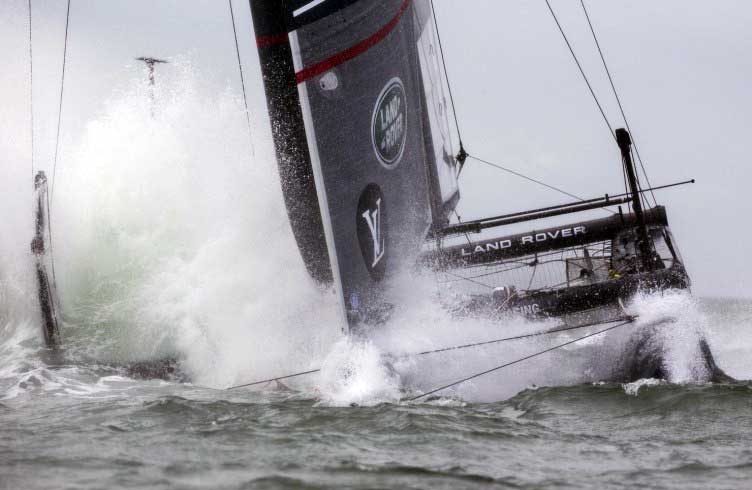
“There’s nothing new in what we’re trying to do with foiling Cup boats,” says Land Rover BAR’s head of engineering, Dirk Kramers. “The Wright brothers would have understood the physics of an AC45f, they just wouldn’t have been able to build it.”

He has a point. The basic principles of lift, drag and flight have been known for over 100 years and if there’s one thing that the experts all agree on, it’s that nothing has changed in the physics. Yet the rapid growth of the new foiling generation has been one of the biggest modern breakthroughs in sailing… Continue reading here


The Remarkable Flying Pyramid

by Jim Dobson / Forbes

Tetrahedron Super Yacht -Jonathan Schwinge – SCHWINGE (CGI Images: EYELEVEL UK)

Tetrahedron Super Yacht -Jonathan Schwinge – SCHWINGE (CGI Images: EYELEVEL UK)

Yes alien spaceships are coming to an ocean near you. With the design of the Tetrahedron Super Yacht, inspired by re-thinking the form, superstructure and propulsion of the modern superyacht into a radically simple enclosure and an elevated mode of travel above the water line. Conceived by London based architect Jonathan Schwinge, this futuristic concept could very soon become a reality.

The form of the yacht is reduced to the absolute geometry of a Tetrahedron. A three-based pyramid consisting of 4 faces and 6 leading edges provides fundamental stability and enclosure. Its form produces a pure, precise, logical and mathematical ‘roof’ from which to connect to the hull assembly. Generally, simple forms are not used in ship and motor yacht construction due to restrictions in ocean-going hull design.

The Tetrahedron will have the appearance at high-speed of levitating over the water: a boat that can fly. This is produced by a HYSWAS (Hydrofoil Small Waterplane Area Ship) hull, that is comprised of a single vertical strut onto a single submerged torpedo hull. The vessel will lift out of the water at speed on side-mounted adjustable hydrofoils. Long distance, smooth travel through rough water at high speeds will eliminate heeling and slamming in rough waters and would banish seasickness forever.

The hull has two working waterlines for its operation. At low speed the Tetrahedron sits gently onto three underbelly hulls. At high-speed the hydrofoils rotate on the lower submerged hull, causing the effect of mysteriously raising the triangle out of the water.

The concept design of this HYSWAS craft is based upon an existing hull design which was developed by several companies, notably the Maritime Applied Physics Corporation in America, and was proven by their technology demonstrator ‘The Quest’ in 1995.

Tetrahedron Super Yacht -Jonathan Schwinge – SCHWINGE (CGI Images: EYELEVEL UK)

Tetrahedron Super Yacht -Jonathan Schwinge – SCHWINGE (CGI Images: EYELEVEL UK)

An auto-pilot ‘fly-by-light’ system taken from the aviation industry would control difficult roll forces and maintain foil born speed. This would also control pitch and heave.

Long distances are achievable with reduced out-of-water drag and stormy ocean conditions would incur virtually no slamming. Improved efficiency is driven by elevated hydrofoil propulsion and would be an inherent performance benefit of this type of design.

Tetrahedron Super Yacht -Jonathan Schwinge – SCHWINGE (CGI Images: EYELEVEL UK)

Tetrahedron Super Yacht -Jonathan Schwinge – SCHWINGE (CGI Images: EYELEVEL UK)

Tetrahedron Super Yacht -Jonathan Schwinge – SCHWINGE (CGI Images: EYELEVEL UK)

Tetrahedron Super Yacht -Jonathan Schwinge – SCHWINGE (CGI Images: EYELEVEL UK)

The future of a superyacht such as this could come faster than you think. Jonathan Schwinge updated me this week on the project, “We are currently working with a large superyacht yard and the design has been developing forward. Much of the development has a new feel – the ‘Trimaran’ 3 hull has now been replaced by a black coated ‘bat-form hull’ with special retractable ocean landing systems.” The Tetra Project is being managed by Marcel Müller at INMAINCO Visionary Marine Management.

Follow me on Twitter and on Instagram

Copyright 2015 by Jim Dobson / Forbes. All rights reserved. Material may not be published, broadcast, rewritten or redistributed without link to original content.

L’utilisation des Foils en Architecture Navale

by Jean SANS – Union Nationale pour la Course au Large

La lecture de la formule de la portance …

La lecture de la formule de la portance …

Depuis des lustres, on a imaginé utiliser des foils porteurs sur les bateaux dans le but de sortir la coque hors de l’eau et de réduire ainsi la résistance à l’avancement de la coque. Les travaux sur les ailes d’avions, donc sur la portance, ont montré que la portance d’une aile est proportionnelle à sa surface alaire et au carré de sa vitesse de déplacement (la forme du profil, l’environnement, l’incidence ont aussi une influence). De là, l’idée d’installer des “ailes sous-marines” (foils) sur un navire a vite effleuré l’esprit des ingénieurs et des architectes navals.

Pour lire les articles entiers cliquez ici

Giovanni Soldini acquista un trimarano con foil

by pressmare.it – Giuliano Luzzato

Giovanni Soldini and John Elkann onboard of Maserati VOR70

Giovanni Soldini and John Elkann onboard of Maserati VOR70

Giovanni Soldini sarebbe in procinto di acquistare il trimarano MOD 70 del Team Gitana di Edmond de Rothschild, attualmente nella sua base di Lorient in Bretagna. I MOD 70 sono trimarani costruiti per un circuito di regate in monotopia di fatto mai decollato. Tuttavia le sue ottime caratteristiche di affidabilità e velocità hanno portato molti team a sceglierla per programmi di vela d’altura e oceanica. L’esemplare che Soldini starebbe acquistando è stato modificato in tempi recenti per sperimentare i foil che permettono alla barca di volare sull’acqua. Infatti lo skipper di Team Gitana, Sebastien Josse, ha in programma la partecipazione al Vendée Globe con un IMOCA 60 (monoscafo) dotato di foil mentre nel 2017 dovrebbe essere varato un nuovo maxi trimarano con foil per dare l’assalto al Trofeo Jules Verne.

[youtube=https://youtu.be/ce060M-XniQ]

Tornando a Soldini, il MOD70 dovrebbe essere ridipinto quanto prima con i colori Maserati per tornare in acqua entro il mese di luglio. Si suppone che ci sarà anche lavoro di sviluppo sui foil, finora Gitana ha sperimentato una forma a C e una a L.
Soldini aveva già fatto 11 anni fa una campagna sul multiscafo ORMA 60 con i colori TIM.


The foiling phenomenon – how sailing boats got up on foils to go ever-faster

by yachtingworld.com

The latest America’s Cup foiling cats are providing a wonderful spectacle as they scorch round the racecourse, but how did foiling start and what are the issues involved? Matthew Sheahan investigates

Photo: Gilles Martin-Raget

Photo: Gilles Martin-Raget

Here’s a challenge. Design a way to support the weight of five saloon cars on a plate the size of your desk on the water. That was the task that faced America’s Cup designers in their bid to make the new breed of Cup boats fly.

If that’s a bit tough, here’s an alternative. Support a 70kg person and their boat in the water on a plank the size of a cricket bat. This one is much easier, the GCSE of hydrodynamics by comparison, with plenty of examples as to how it can be done thanks to the proliferation of foiling Moths around the world.

Getting boats to fly above the water surface is simple in theory, but tricky in practice and has challenged designers for over a century, but in the last decade one class appears to have cracked it.

On the face of it, … Read entire article on yachtingworld.com

Des foils sur un Diam 24

by letelegramme.fr

Nous avons vu un Diam 24 équipé de foils avec François Gabart, Vincent Riou et Guillaume Le Brec à bord. S’agit-il de tests en vue d’une éventuelle modification du bateau ?

Il n’y a pas de secret sur ce sujet-là. François Gabart a acheté un Diam pour s’en servir comme laboratoire pour son maxi-trimaran Macif (ndlr : qui, lui, est équipé de foils). Il s’en sert pour tester plusieurs formes de foils. Il a acheté un Diam 24 classique avec deux flotteurs supplémentaires dans le but d’effectuer des essais.

Donc, il n’y a aucun changement à l’horizon ?

Nous sommes très satisfaits du Diam 24. Je crois que, fin février-début mars, le chantier (1) va livrer sa 60e commande. Ça fonctionne très bien. Pour le reste, disons qu’on regarde François Gabart le faire voler et peut-être que le coup d’après… On ne se met aucune pression, nous n’avons aucun planning, mais on s’est dit : « Dans quelques années, peut-on avoir une version de ce bateau avec des foils ? ». On a vu que c’était une petite bombe avec des foils. Donc, ça interpelle.

Un Diam 24 volant, c’est pour demain ?

Il n’y a aucune date d’arrêtée. Cela se joue à plusieurs années. Il faudrait d’abord que ce soit économiquement viable. Une grande partie du succès du Tour et de ce bateau-là, c’est la donne économique, le fait qu’il coûte 55.000 euros. Une solution volante avec des foils et certains renforts à droite et à gauche, cela veut dire 25.000 ou 30.000 euros de plus. Je me répète, il faudrait que ce soit jouable économiquement parlant, de l’ordre de 15.000 euros de plus. Mais soyons clair, nous ne sommes pas du tout dans des phases d’essais pour le Tour de France. Il y a des marins comme François Gabart, Vincent Riou et d’autres qui s’amusent pour voir ce qu’on peut en faire. Disons qu’ils le font sous notre oeil bienveillant.

Tout le monde vole ou veut voler aujourd’hui. Le Tour de France peut-il échapper à cette tendance ?

C’est le sens de l’histoire donc il n’y a aucune raison que le Tour ne s’inscrive pas, un jour, dans cette tendance. Je ne vois pas pourquoi le Tour n’irait pas et si ça peut se faire avec le Diam 24, ça aurait du sens.

Des foils demain et une aile rigide après-demain ?

L’aile, c’est un autre sujet. C’est à la fois une problématique budgétaire et une problématique logistique. Notre format impose des montages et démontages fréquents, du transport donc cela voudrait dire une aile démontable qui se transporte rapidement. Le Tour de France n’est pas la Coupe de l’America. On leur laisse le soin de faire du développement et de la recherche. Nous, nous suivons la tendance. Mais tout cela est assez excitant.

(1) : ADH Innotec à Port-la-Forêt

© Le Télégrammehttp://www.letelegramme.fr/voile/tiens-un-diam-24-volant-18-01-2016-10924047.php